









Who needs a calculator when AI starts doing original mathematics?
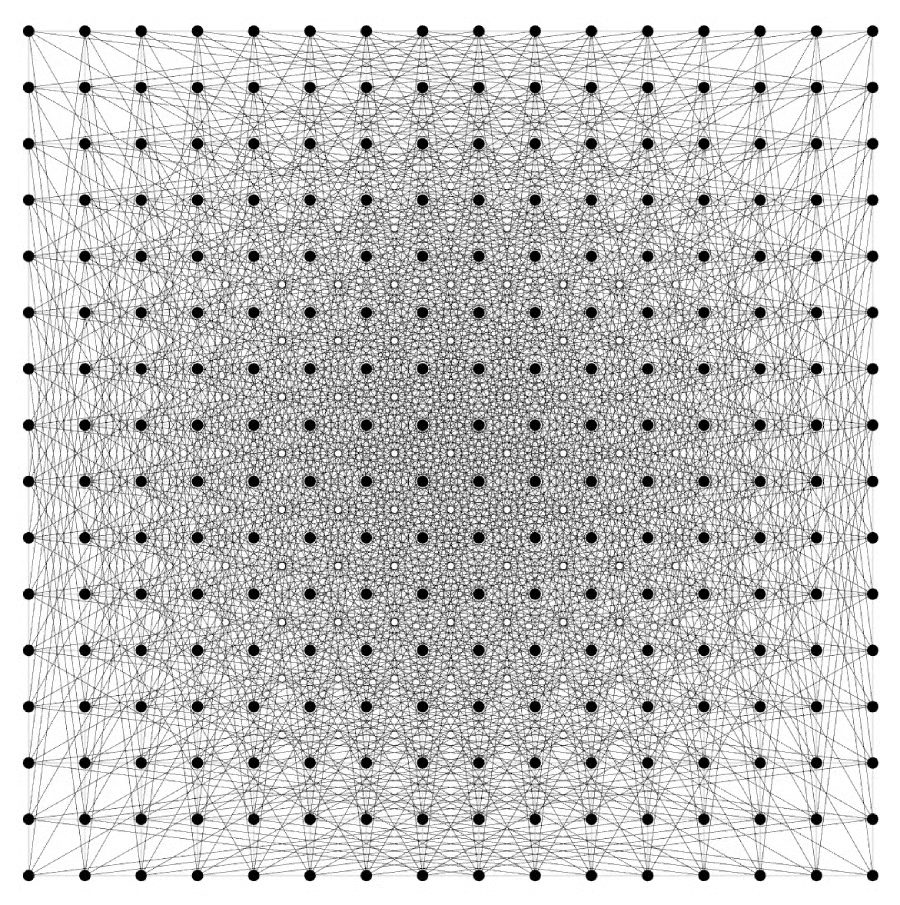
OpenAI says one of its general-purpose reasoning models disproved an 80-year-old geometry conjecture posed by Hungarian mathematician Paul Erdős. The result, which the company said was reviewed by external mathematicians, concerns the number of pairs of points that can be arranged at equal distances from one another.
The AI giant said that the model “has disproved this longstanding conjecture, providing an infinite family of examples that yield a polynomial improvement,’’ and added that the proof has been checked by a group of external mathematicians.
That would be a major claim on its own. It lands with extra weight because OpenAI recently faced criticism for overstating GPT-5’s role in solving other Erdős problems, making this announcement both a potential milestone and a test of the company’s credibility.
General-purpose reasoning model used
Also noteworthy is how the result was found. OpenAI noted that it came from a new general-purpose reasoning model, as opposed to a system trained specifically for mathematics, tailored to search through proof strategies, or targeted at the unit distance problem in particular.
“As part of a broader effort to test whether advanced models can contribute to frontier research, we evaluated it on a collection of Erdős problems,’’ the company said. “In this case, it produced a proof resolving the open problem.”
Why this claim faces scrutiny
This isn’t the first time OpenAI has made a brash claim.
Last October, the company faced backlash after some of its researchers touted math breakthroughs by GPT-5. Former OpenAI VP Kevin Weil posted a now-deleted post on X that “GPT-5 found solutions to 10 (!) previously unsolved Erdős problems and made progress on 11 others.”
The issue was that GPT-5 didn’t actually solve those problems, but rather, found solutions that already existed in literature.
Expert reaction to the proof
However, it appears the company has learned a lesson.
Accompanying the announcement were companion remarks that OpenAI published in support of the mathematicians’ disproof, including those from Thomas Bloom, who oversees the Erdos Problems website and who had characterized Weil’s post as “a dramatic misrepresentation.”
Bloom wrote that when he assesses the importance and influence of an AI-generated proof, he asks himself if it has taught something new about the problem, and whether we understand discrete geometry better now.
“I think the answer is a moderated yes: This shows that there is a lot more that number theoretic constructions have to say about these sorts of questions than we suspected,’’ Bloom said. “Moreover, the number theory required can be very deep. No doubt many algebraic number theorists will be taking a close look at other open problems in discrete geometry in the coming months.”
Another expert who reviewed the results, University of Toronto mathematician Arul Shankar, wrote, “In my opinion, this paper demonstrates that current AI models go beyond just helpers to human mathematicians — they are capable of having original ingenious ideas, and then carrying them out to fruition.”
His colleague, Professor Jacob Tsimerman, said he was also impressed by the results, noting that he had once tried unsuccessfully to disprove the distance problem.
A larger takeaway
This result is significant, OpenAI said, because not only has an AI system autonomously resolved a longstanding open problem, but it also “offers an early glimpse of a new kind of collaboration between AI and human mathematicians.”
The bigger takeaway is that “better mathematical reasoning can make AI a stronger research partner” and “help researchers make progress on problems that would otherwise be too complex or time-intensive to tackle.”
Those capabilities matter beyond mathematics, OpenAI added, and the model has the potential to be useful in biology, physics, materials science, engineering, and medicine on a path toward “more automated research.”
Related: OpenAI is also turning AI’s capacity crunch into an enterprise offering with Guaranteed Capacity, giving customers a way to reserve compute for its AI services.