






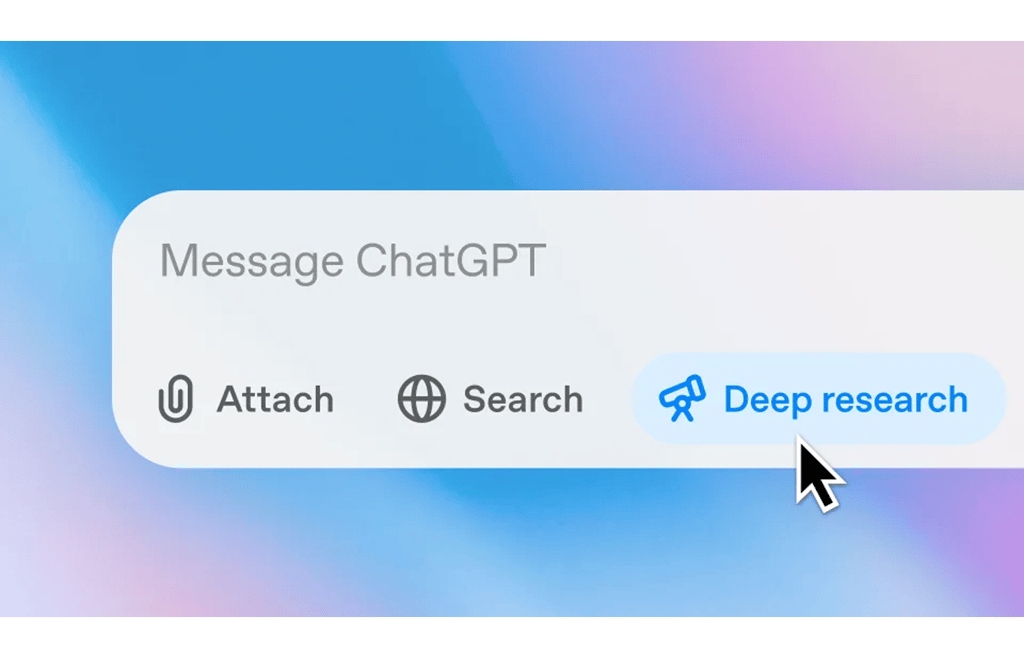


OpenAI has officially expanded its deep research tool to all paying ChatGPT users, making advanced research capabilities more accessible beyond the Pro subscription. The tool, designed to generate detailed reports with citations from multiple online sources, was initially restricted to ChatGPT Pro users — those paying $200 per month. As of this week, it is now available to Plus, Team, Enterprise, and Edu subscribers, OpenAI announced Tuesday on X.
OpenAI’s deep research allows users to generate detailed reports by analyzing and summarizing information from multiple online sources, complete with citations. “Deep research is built for people who do intensive knowledge work in areas like finance, science, policy, and engineering and need thorough, precise, and reliable research,” OpenAI wrote in the deep research release blog.
More users, more research — but with limits
Starting this week, ChatGPT Plus, Team, Enterprise, and Edu subscribers will receive 10 deep research queries per month. Pro users, who previously had a 100-query limit, now have access to 120 queries monthly.
To use the feature, users type a prompt and tap the deep research icon before submitting. Depending on the complexity of the query, it can take ChatGPT anywhere from five to 30 minutes to generate.
Alongside the expanding access, OpenAI has rolled out several improvements to the tool, including:
- Embedding images alongside citations for better readability.
- Enhancing the tool’s ability to process uploaded documents.
- Releasing a System Card outlining how deep research was developed, its capabilities, and the safety measures in place.
According to OpenAI, deep research was trained with input from hundreds of domain experts to ensure accuracy and reliability. The tool has been classified as “medium risk” in OpenAI’s Preparedness Framework.
Will free users get access?
For now, OpenAI says Deep Research is “very compute intensive,” meaning free-tier users won’t have access anytime soon; however, as the tool becomes more efficient, that could change.
OpenAI’s CEO Sam Altman expressed excitement over the rollout, calling deep research “one of my favorite things we have ever shipped.”