






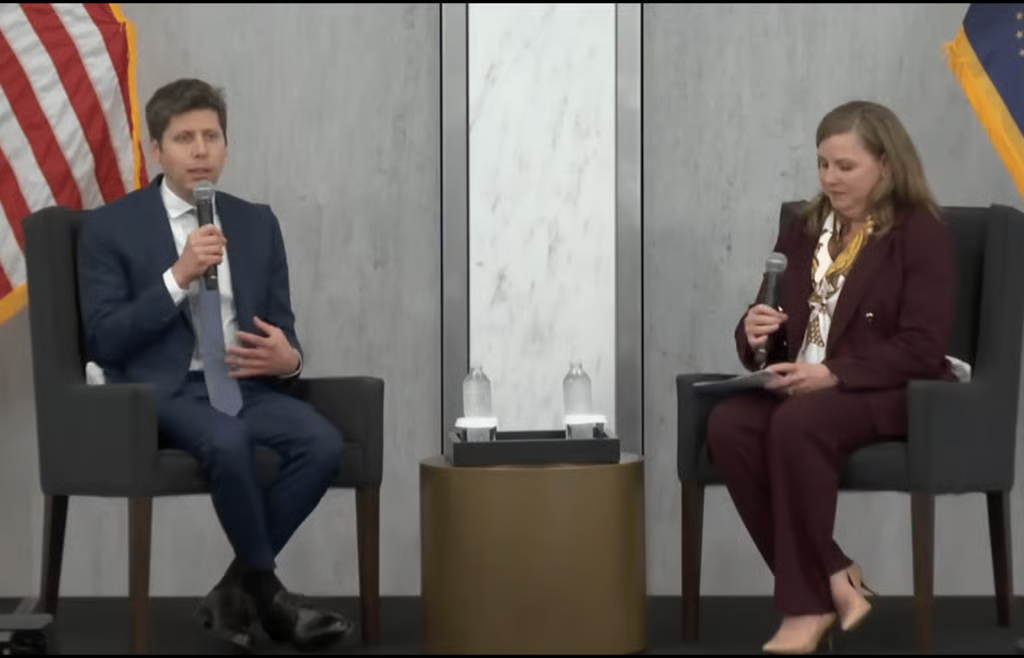


OpenAI CEO Sam Altman is sounding the alarm about the increasing use of artificial intelligence in financial fraud, particularly through advanced voice cloning technologies. In a fireside chat with Federal Reserve Vice Chair for Supervision Michelle Bowman on Tuesday, Altman described the threat as an “impending fraud crisis” and warned that many banks are dangerously behind the curve. He expressed disbelief that some financial institutions still rely on voiceprint technology to verify customer identity.
“A thing that terrifies me is apparently there are still some financial institutions that will accept the voiceprint as authentication,” Altman said. “That is a crazy thing to still be doing. AI has fully defeated that.”
Voice-based authentication, once viewed as a reliable security measure, has become increasingly susceptible to manipulation as AI systems gain the ability to replicate human speech with disturbing accuracy. The method, popular among wealthy clients who access accounts via challenge phrases, now opens the door to highly convincing impersonation scams.
Altman’s warning reflects growing concerns over the realism of AI-generated deepfakes. With software now capable of cloning a person’s voice to near-perfection, criminals could potentially breach security systems by mimicking a user’s voice to transfer funds or obtain sensitive information.
“I am very nervous that we have an impending, significant fraud crisis,” Altman said. “Right now, it’s a voice call, soon it’s going to be a video or FaceTime that’s indistinguishable from reality.” Bowman acknowledged the issue and suggested exploring potential partnerships with the tech industry to find solutions.
Despite OpenAI’s prominence in the AI industry, Altman clarified that the company is not creating tools for impersonation. Still, he stressed that the broader AI community must take responsibility for developing new verification systems, such as “proof of human” solutions.
Altman is supporting tools like The Orb, developed by Tools for Humanity. The device aims to provide “proof of personhood” in a digital world flooded with fakes. His concerns go beyond financial fraud, extending to the potential for AI superintelligence to be misused in areas such as cyberwarfare or biological threats.
Economic impact and job questions
The conversation wasn’t just about risks. Altman also addressed the broader implications of AI on work and the economy. Contrary to some tech leaders who fear mass job loss, Altman took a more philosophical view.
“No one knows what happens next,” he said, adding that the technology is too new and too complex for accurate predictions. He admitted some jobs would vanish, but believes new types of work will surface in their place.
OpenAI expands DC presence
As AI continues to dominate policy discussions, OpenAI is growing its presence in the U.S. The company plans to open its first Washington, D.C., office next year to host policymakers, demonstrate new tools, and run AI literacy programs for educators and officials.
OpenAI’s head of global affairs for the U.S. and Canada Chan Park will lead the office, joined by Joe Larson, formerly of defense tech firm Anduril. The move comes as the White House prepares to unveil its AI Action Plan, and after the Senate struck down a proposed 10-year moratorium on state-level AI regulation.
As AI fraud risks grow, banks and regulators will need to adopt stronger authentication methods. Meanwhile, OpenAI continues to push for balanced AI policies while preparing for a future where distinguishing real from fake becomes increasingly difficult.
Explore our full breakdown of Sam Altman’s appearance at the Hard Fork Live event, where he unpacked the urgent threats AI poses to identity, security, and the future of work.