






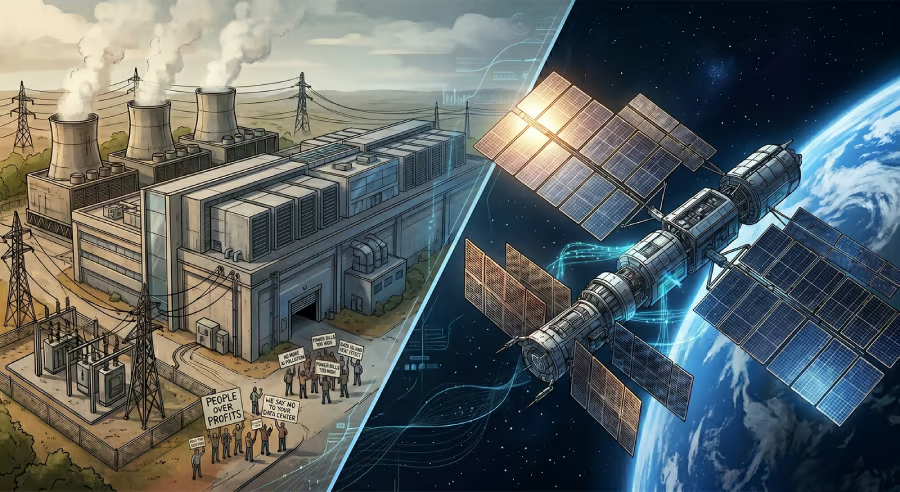


Masayoshi Son recently poured cold water on one of Elon Musk's more futuristic AI ideas: putting data centers in orbit.
At first glance, it sounds like another billionaire disagreement about a science-fiction future. Musk sees solar-powered AI satellites as a way to escape Earth's limits. Son, founder of SoftBank Group, says the AI race will be won with compute built here on the ground, not in space.
I think the more interesting answer is somewhere in the middle.
Orbital data centers are not as absurd as they sound. Sam Altman has called the idea “ridiculous,” and at full hyperscale, that skepticism is understandable. But dismissing the whole category too quickly misses why companies are looking up in the first place.
AI is pushing data center demand through the roof, communities are pushing back against new facilities, power grids are under strain, and water use has become a serious concern in some markets.
Space offers a tempting pitch: abundant solar power, no local zoning fights, no neighborhood noise complaints, no freshwater cooling systems, and a lot more room to expand.
That is the dream. Like most dreams involving unlimited solar power and no zoning meetings, it gets messier once the spreadsheet opens.
The problem is that moving a data center into orbit does not make it stop being a data center. It still needs chips. It still needs power. It still needs cooling. It still needs networking. It still needs maintenance. It still needs replacement cycles. It still has to make economic sense.
And that is where the dream gets complicated fast.
- Son's argument is really about timing
- The pitch makes sense on paper
- The physics are not magic
- The economics are the real bottleneck
- Space is not an empty parking lot
- The first useful orbital data centers will probably not look like cloud regions
- The wrong lesson would be using space as an excuse
- The future is probably hybrid
Son's argument is really about timing
Son's most important point was not that orbital data centers can never work. His point was that orbital data centers probably won't matter soon enough to decide the AI race happening right now.
That distinction matters.
If the next few years are the critical window for AI infrastructure, then orbital data centers are competing against terrestrial projects that are already being financed, permitted, built, and connected to power. Even if SpaceX, Google, Blue Origin, Starcloud, international programs, and others make real progress, orbit is not going to absorb near-term AI demand at hyperscale.
The AI race is moving at data-center speed, not aerospace speed.
That doesn't make orbital compute irrelevant. It just means it's probably not the immediate escape hatch some people want it to be.
The pitch makes sense on paper
The case for orbital data centers starts with a very real problem on Earth.
AI data centers need enormous amounts of electricity; in fact, US data center power consumption is projected to double or even triple by 2028 due to the AI boom. They can require significant cooling infrastructure. They take up land. They can stress local grids. They can raise concerns about water use, noise, emissions, and electricity prices. In some places, public opposition is already slowing or stopping projects.
So the appeal of space is obvious.
By escaping atmospheric interference and bypassing the nightly blackout cycle entirely, an orbital solar array can capture five to eight times the energy of an identical setup on Earth. Instead of draining local watersheds for evaporative cooling, space-based infrastructure sheds its thermal load by radiating heat directly into the vacuum. And many local zoning fights would disappear, even if launch approvals, spectrum rules, debris risks, and orbital governance would create their own headaches.
However, this is where it's crucial to separate the hype from the utility: if you are imagining an orbital data center processing your next chatbot prompt, that is probably not the first use case that makes sense.
Sending terrestrial data up to orbit and back adds latency and bandwidth constraints that matter for interactive AI. The real near-term value is more likely space-native workloads, where processing data closer to where it's collected reduces the need to send massive raw files back to Earth.
That is the distinction that makes this a realistic near-term use case.
Earth observation satellites, defense systems, disaster monitoring tools, and other space-based sensors already generate huge amounts of data. If onboard systems can analyze that information in orbit and beam down only the critical insights, the bandwidth savings become highly valuable.
That is a very different claim than saying we are about to replace ground-based AI data centers with satellites.
The physics are not magic
Much of the optimism around orbital data centers rests on the idea that space is cold.
That is true, but it's also misleading.
On Earth, data centers can move heat away using air, water, pumps, chillers, cooling towers, and liquid-cooling systems. In space, there is no air to move heat away. Heat has to be radiated out into the vacuum, which requires large radiators and careful thermal design.
In other words, space is cold, but cooling in space is hard. The universe may be chilly, but it does not come with a free HVAC plan.
Then there is radiation.
Advanced AI chips are not exactly known for being simple, rugged, long-lived space hardware. Unshielded from Earth's atmosphere, high-energy cosmic rays can strike memory banks and trigger "bit flips" — literally turning a zero into a one. If not caught by software redundancy, advanced error correction, or other radiation-resilience measures, those glitches can cascade into catastrophic miscalculations. Electronics in orbit must withstand radiation, temperature fluctuations, micrometeoroids, and years of exposure to a hostile environment.
Repairs are another problem. On Earth, data center operators can replace servers, swap components, upgrade chips, and maintain equipment as technology improves. In orbit, every repair is either remote, robotic, extremely expensive, or impossible.
That matters because AI hardware moves fast. A data center full of cutting-edge chips today can start looking old in just a few years; on Earth, servers are typically replaced every three to five years as chips improve. If the hardware is orbiting hundreds of kilometers above Earth, refreshing that infrastructure becomes a much bigger problem.
The economics are the real bottleneck
This is where Son's skepticism gets sharper.
If electricity were the overwhelming cost of AI infrastructure, free solar power in space would be a massive advantage. But electricity is only one part of the cost.
Chips, servers, launch, satellite manufacturing, cooling systems, communications, insurance, maintenance, replacement, and operations all still matter. Right now, a hypothetical 1-gigawatt orbital data center would cost roughly three times as much to build as a terrestrial equivalent.
And launch cost is the big swing factor.
Right now, riding a SpaceX Falcon 9 into orbit costs roughly $2,700 per kilogram. To make the financial math work for a data center, next-generation heavy-lift rockets like Starship have to drag that price floor down into the $200–$500 range. That is why so much of the argument depends on SpaceX's Starship or similar heavy-lift, reusable rockets bringing launch costs down by an enormous margin.
That may happen. SpaceX has already changed the economics of launch before. Betting against Musk on rockets has not exactly been a great historical strategy.
But "possible eventually" and "competitive in the next few years" are not the same thing.
Even if launch costs fall, terrestrial data centers are not standing still. Companies are improving cooling efficiency, building closer to power sources, exploring nuclear and renewable energy partnerships, optimizing chips, and pouring significant capital into ground-based infrastructure.
Orbital data centers do not just need to get cheaper. They need to get cheaper faster than the alternatives improve.
That is a much harder race.
Space is not an empty parking lot
There is also a bigger systems question: what happens if everyone starts treating low Earth orbit like the next cloud region?
Space is vast, but useful orbital bands are not unlimited. Low Earth orbit is already incredibly crowded, with nearly 45,000 tracked objects — from active satellites to rocket bodies and debris — currently circling the planet. Adding thousands or even millions of large AI satellites would increase the burden on space traffic management and raise the risk of collisions.
That risk is not theoretical. SpaceX's Starlink satellites alone were forced to dodge other objects roughly 300,000 times in 2025. Adding a million massive data center satellites to that environment would sharply increase the risk and coordination burden across these shared orbits. Astronomers are already dealing with interference from satellite constellations. More large, reflective, power-hungry satellites could make those issues worse.
This is one part of the orbital data center story that does not get enough attention.
On Earth, data center development creates local trade-offs: land, water, electricity, noise, grid capacity, emissions, and community impact.
In orbit, the trade-offs become shared infrastructure problems: debris, collision risk, astronomy disruption, spectrum congestion, launch pollution, and orbital governance. And that's before we even get into cybersecurity, which is a separate article entirely.
Moving infrastructure off Earth does not eliminate externalities. It changes who has to live with them.
The first useful orbital data centers will probably not look like cloud regions
The most realistic future is probably not millions of satellites replacing AWS, Azure, Google Cloud, or the AI campuses being built across the US.
The more realistic path starts smaller. We are already watching companies like Starcloud, which recently nabbed a $1.1 billion valuation after successfully testing an Nvidia H100 GPU in orbit last fall. Meanwhile, Lonestar Data Holdings has carved out a niche in off-planet data storage—banking on the idea that data sovereignty and secure backups offer a much more realistic, low-power market entry point.
Orbital compute makes the most sense where the customer, the data, or the mission is already in space. That could include Earth observation, military and intelligence workloads, weather monitoring, wildfire detection, maritime tracking, satellite autonomy, lunar infrastructure, or sovereign data storage.
In those cases, orbit is not a gimmick. It's the edge.
If a satellite captures a massive image file, processes it in orbit, identifies the important information, and sends only the result back to Earth, that can be valuable. If a defense system needs faster processing close to space-based sensors, orbital compute may have a real role. If a government wants resilient off-planet backup storage, that is a different business case from general-purpose AI training.
This is where I think orbital data centers could become real first: not as a replacement for Earth, but as infrastructure for space-native workloads.
The wrong lesson would be using space as an excuse
The danger is not that orbital data centers are fake. The danger is that people treat them as a reason to avoid hard decisions on Earth.
AI infrastructure is being built now. The grid pressure is happening now. Community backlash is happening now. Water concerns are happening now. Power procurement is happening now.
Even if orbital data centers become viable in the 2030s, they will not solve the data center siting and energy problems of the next few years.
That means we still need to deal with terrestrial AI infrastructure honestly.
Where should data centers be built? Who pays for new power generation and transmission? How much water do these facilities actually use? How do we protect neighborhoods from the constant low-frequency drone of cooling systems, the localized "heat island" effect these campuses create, and the massive visual footprint they impose on communities? How transparent should operators be with communities? How do we keep electricity costs from shifting onto residents? How do we ensure AI infrastructure is optimized not just for speed and scale but also for public trust?
Those questions do not go away because someone can imagine a better version in orbit. A satellite constellation is not a permission slip to ignore the power bill down here.
The future is probably hybrid
My guess is that orbital data centers will happen, but not in the way the hype suggests.
They will start as specialized infrastructure. They will support space-based sensors, edge processing, national security use cases, resilient storage, and eventually some AI inference workloads where latency and economics make sense. Over time, if launch costs collapse and in-orbit maintenance improves, the use cases could expand.
But the next phase of AI infrastructure will still be built mostly on Earth.
That is where Son's critique lands. The near-term AI race is about who can secure chips, power, land, capital, and execution fastest. Orbital data centers may become important later, but they are not arriving quickly enough to meaningfully curb the terrestrial buildout already underway.
So the smarter framing is not "Musk is wrong" or "Son is right."
It's this: orbital data centers may be part of the future of computing, but they are not a substitute for solving the infrastructure problems we are creating right now.
The companies that win will not be the ones that just build the most futuristic pitch deck. There are only so many times you can write "space-based AI infrastructure" before someone asks where the revenue is. The winners will be those who match workloads to the right environment, whether on land, at the edge, underwater, near power sources, or eventually in orbit.
Space may become another layer of the computing stack.
But Earth is still where the next round gets decided.
Editor’s note: This article originally appeared on LinkedIn Pulse.