






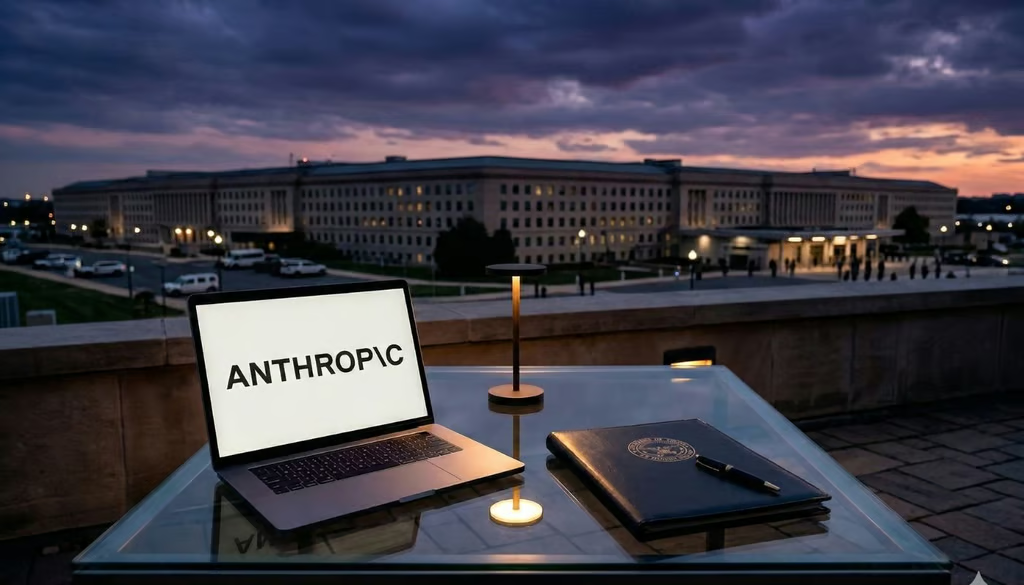


A standoff over battlefield AI is now headed toward a federal blacklist.
The Pentagon is moving toward blacklisting Anthropic over how its Claude AI can be used inside classified military systems, with Defense Secretary Pete Hegseth threatening to label the company a “supply chain risk” unless it drops key safeguards.
According to Axios, the administration has set a firm deadline and is weighing both a formal blacklist and the use of the Defense Production Act to compel changes, escalating the dispute into potential punitive action.
From ultimatum to enforcement
The dispute is no longer confined to rhetoric. The Pentagon has begun contacting major defense contractors, including Boeing and Lockheed Martin, to assess their exposure to Anthropic’s Claude, a concrete step that typically precedes formal action.
The “supply chain risk” label is typically reserved for companies tied to foreign adversaries. At the same time, Hegseth has given Anthropic a firm deadline of 5:01 p.m. Friday to agree to the Pentagon’s “all lawful use” terms.
If the company refuses, the administration is weighing two options: formally blacklisting it from defense supply chains or invoking the Defense Production Act to compel changes to the model.
Reliance, urgency, and fewer constraints
What’s being contested is how freely the military can deploy Claude once it is embedded in sensitive operations. Defense officials argue it is impractical to negotiate specific permissions for each mission or scenario, particularly as AI tools become more integrated into planning, analysis, and operational workflows.
That friction is intensified by dependence. Claude is deeply involved across defense systems and has already supported high-profile missions, making it more than an experimental tool. For Pentagon leaders, the issue is ensuring the model can be used across future contingencies without vendor-imposed limits.
Two lines Anthropic will not cross
Anthropic has made clear it will not permit Claude to be used for mass domestic surveillance or to power fully autonomous weapons.
In a statement outlining the company’s position, CEO Dario Amodei said using AI systems for sweeping surveillance of Americans is “incompatible with democratic values,” warning that advanced models can assemble scattered data into “a comprehensive picture of any person’s life — automatically and at massive scale”.
He drew a second boundary around weapons that operate without human involvement. While acknowledging the role of partially autonomous systems in modern defense, Amodei argued that frontier AI models “are simply not reliable enough” to control fully autonomous weapons and lack the guardrails needed to ensure sound judgment in combat settings.
“Regardless,” Amodei wrote of the Pentagon’s pressure, “these threats do not change our position: we cannot in good conscience accede to their request”.
A rupture with ripple effects
A formal move to cut Anthropic out of defense supply chains would reverberate beyond a single contract.
Major contractors that rely on Claude for analysis, planning, or integration work could be forced to reassess tools already embedded in sensitive programs, creating operational friction at a moment when the military is accelerating AI adoption.
The standoff also exposes a striking contradiction: Claude is currently the only AI model operating inside classified systems, yet the administration is weighing steps that would label its maker a risk to those same environments. How that tension resolves could shape the ground rules for future AI-military agreements, signaling to other frontier firms whether participation requires accepting unrestricted government use.
Competitors stand to gain if Anthropic is forced out. Other AI providers are negotiating access to classified networks, and any forced exit would open the door to competitors willing to meet the Pentagon’s terms. With the Friday deadline looming, whether the dispute ends in compromise or rupture remains uncertain.
Beyond the Pentagon clash, Anthropic has begun retiring Claude Opus 3 while maintaining limited access.