





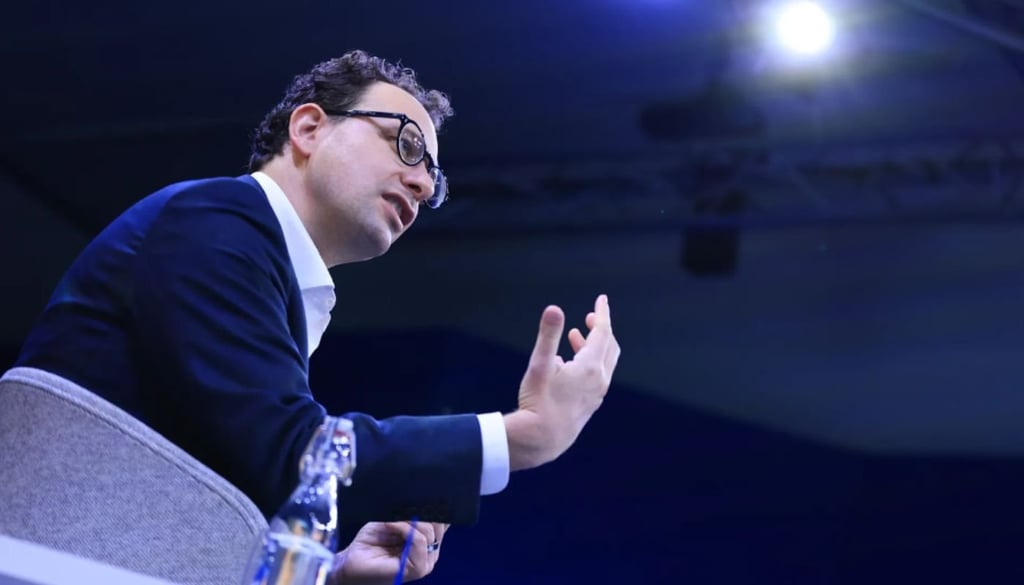


War Secretary Pete Hegseth has summoned Dario Amodei, the CEO of artificial intelligence company Anthropic, to the Pentagon Tuesday morning for what officials describe as a high-stakes confrontation over how the military can use the company’s flagship AI model, Claude.
The meeting comes as negotiations between the Department of Defense (DOD) and the San Francisco-based AI startup have hit a breaking point. While most introductory meetings in Washington involve polite handshakes, officials are making it clear this sit-down will be anything but cordial.
“Anthropic knows this is not a get-to-know-you meeting,” a senior Defense official told Axios. “This is not a friendly meeting. This is a sh*t-or-get-off-the-pot meeting.”
The blunt assessment captures the growing frustration inside the Pentagon toward an AI lab that has positioned itself as the safety-conscious alternative to rivals like OpenAI and Google, but now finds itself alone in refusing to give the military everything it wants.
The Claude problem
Claude is currently the only advanced AI model operating inside the Pentagon’s classified networks. It’s deeply embedded in sensitive defense and intelligence work, and military officials say replacing it would be a massive undertaking with no obvious alternative that matches its capabilities.
But Anthropic has drawn a red line… two of them, actually.
The company is willing to loosen most of its usage restrictions for military applications, but it wants guarantees that Claude won’t be used for two specific purposes: mass surveillance of Americans, and the development of autonomous weapons that can fire without human involvement.
The Pentagon sees things differently. Defense officials say negotiations have shown no progress and are teetering on the edge of collapse. The department wants all AI labs to make their models available for “all lawful uses” without having to clear individual applications with the companies.
In a January speech at SpaceX, Hegseth expressed his frustration with restrictive AI, stating he was moving away from models “that won’t allow you to fight wars.” He added that his vision for the department includes systems that operate “without ideological constraints that limit lawful military applications,” before concluding that the Pentagon’s “AI will not be woke.”
That same month, Hegseth announced that Musk’s xAI would bring its Grok chatbot to the Pentagon network, a move that came days after Grok drew global scrutiny for generating sexualized deepfake images without consent. In early February, OpenAI announced it would also join the military’s secure AI platform, enabling service members to use a customized version of ChatGPT for unclassified tasks.
The ultimatum
The tension escalated following the January raid that captured Venezuelan President Nicolás Maduro, where Claude was reportedly utilized. The incident highlighted the divide between the military’s operational needs and the company’s ethical boundaries.
If Tuesday’s meeting doesn’t result in a breakthrough, the consequences could be massive. The Pentagon has threatened to label Anthropic a “supply chain risk.” Such a move would not only void Anthropic’s $200 million contract but could also prevent other defense contractors from using Claude in their own work for the government.
A history of tension
This isn’t the first time Anthropic has found itself at odds with the Trump administration.
The company publicly criticized the administration’s proposals to loosen export controls on AI chips to China, needling Nvidia in the process. At the time, Trump’s top AI adviser, David Sacks, accused Anthropic of “running a sophisticated regulatory capture strategy based on fear-mongering” in response to comments from co-founder Jack Clark about balancing optimism with “appropriate fear” about AI advancement.
The meeting could determine whether Claude remains inside the Pentagon’s most sensitive systems, or whether the military follows through on its threats and begins the painful process of pushing Anthropic out.
Despite the looming ultimatum, Anthropic is publicly maintaining a diplomatic tone. A company spokesperson told Axios: “We are having productive conversations, in good faith,” adding that the firm “is committed to using frontier AI in support of US national security.”
Also read: OpenAI’s ChatGPT rollout on GenAI.mil is aimed at expanding secure, unclassified AI access across roughly 3 million military and civilian personnel.