






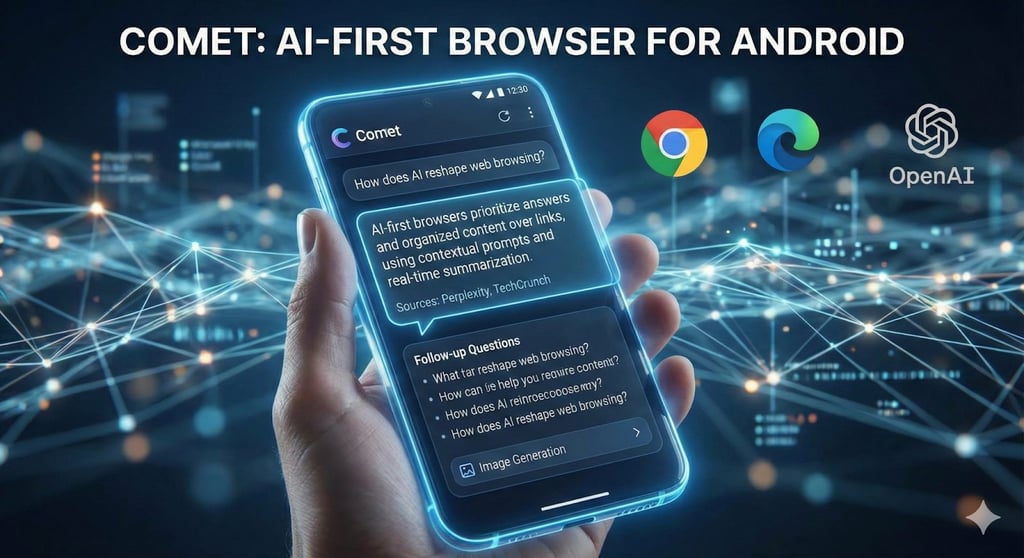


Browsers show you links. Comet shows you answers. And now Perplexity is bringing its AI-first browser to Android, right where most search journeys begin.
The Comet Android app translates the web browser’s most compelling desktop features, functioning as a hybrid browser and assistant to surface answers, citations, and suggest questions in a single mobile interface.
“Building an AI-first browser has required deliberate work for each OS and every form factor,” Perplexity said in the announcement. “We didn’t want to just force a desktop experience onto mobile. Instead, Perplexity has redesigned the mobile web browser for the new age of the internet.”
The app’s ecosystem is designed to remove friction from search by placing sourced answers at the top of the screen and using contextual prompts to help users refine their queries. It includes follow-up suggestions, real-time information retrieval, image generation, and a browsing mode that processes the content of any page directly inside the app.
Setting the pace
As AI-assisted search becomes an expected part of web browsing for desktop and mobile users, Comet’s Android expansion positions it as a leader in the move away from traditional link-based search toward experiences that interpret and organize content before a user clicks anything.
Google, for example, is pushing its Gemini features into Chrome and Search, while Microsoft continues to fold Copilot into Edge. Other companies, including Arc, are experimenting with AI-enhanced browsing models that prioritize summarization and guided navigation.
OpenAI has begun piloting its own browser approach built around GPT-driven page analysis, adding another native AI model to the competitive field.
With the browser landscape shifting and redefining itself in real time, Comet for Android’s native AI design challenges legacy browsers’ integration approach by offering an experience built on answers rather than retrofitting features.
That distinction matters most on Android, where Chrome has shaped user habits for years and where mobile search traffic dominates globally. Bringing Comet to this platform places Perplexity in front of the broadest possible audience, effectively turning mobile into the proving ground for whether an answer-first browser can compete with long-established search engines.
Shaping AI browsing
Comet’s initial rollout in July landed quietly on desktop, but its move to Android exposes it to the search results where most people search by default. The platform’s scale makes it an ideal test of whether those users will embrace a browser that interprets and organizes content at the start of a query rather than at the end. Perplexity is betting that it will.
The company noted: “Having the best question will always matter more than the best answer. We think the point of good answers is to give you more questions. Curious people change the world.”
Recent coverage of AI-driven job cuts pushing 2025 layoffs past 1 million tracks how automation and agentic tools are reshaping corporate headcount decisions.