






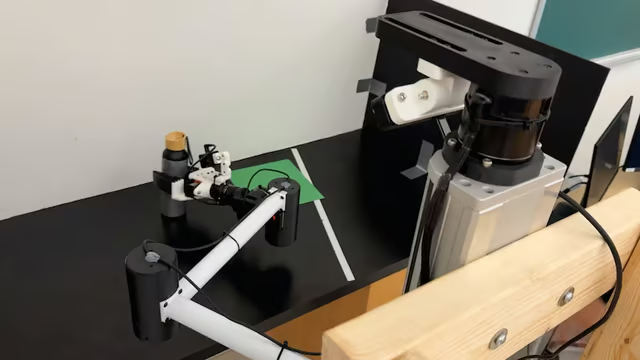


A selfie became proof that a robotic arm can restore everyday independence.
An Ottawa startup is developing an assistive robotic arm designed to help people with physical disabilities complete everyday tasks independently, with new funding expected to accelerate testing and development.
Sielo Robotics, a company founded at the University of Ottawa, raised CA$1 million, or about $710,000, in seed funding in May as it works to bring its robotic arm, called Arlo, into homes for beta testing later this year, according to CBC.
Unlike many assistive technologies developed primarily in research labs, Sielo says people with lived experience have helped shape Arlo's design from the beginning. One of those users is Hollis Pierce, the company's head of accessibility and partnerships, who uses a powered wheelchair. Pierce tests the robotic arm by controlling it with a space mouse, a six-direction input device used to manipulate objects in 3D space.
One milestone stood out.
“I’m 38 years old and I’ve never taken my own selfie,” Pierce said. He explained that taking his first selfie with Arlo took about an hour, but the experience has improved as the technology evolved.
“I sort of put it in my head that I wanted to pick up my phone and take a selfie and that was going to be my goal for the day," Pierce said. "It took me about an hour to do at first.” Pierce also said the fourth-generation version now feels "almost like playing a video game," CBC reported.
Funding to accelerate development
The new investment marks a turning point for the company after years of relying on student entrepreneurship competitions and research grants.
“We didn’t have any [venture capital] or organizations funding what we were doing. It was all people... hearing what we’re doing,” said Laila Burns, Sielo's chief revenue officer. Burns said the funding will help accelerate development, with the company aiming to place robotic arms in users' homes for beta testing by the end of the year.
Sielo currently operates from a laboratory at the University of Ottawa and has partnered with The 8-80 Collaborative, a collaboration between the CHEO Research Institute and Bruyère Health.
AI and adaptable controls
The company is also developing AI-powered features intended to make the robotic arm easier to use.
Masoud Karimi, Sielo's robotics control engineer, said the goal is to allow the system to learn and repeat routine activities.
“Our goal is to use this technology to do more complex tasks that [are] really hard for people with disability to do [on] their own using a space mouse,” Karimi said, according to CBC. Another challenge is ensuring the arm works with the wide range of accessibility controls people already rely on.
“Everyone controls their wheelchair in a slightly different way. People use eye gaze, sip and puff, joysticks … switches in their headrests, their legs,” said Rafaël Hébert, the company's chief technology officer. “We can translate that to being able to use our product as well.”
What this could mean for assistive technology
Sielo's approach highlights a growing effort to make advanced robotics more practical and affordable instead of limiting them to research labs or high-cost medical settings.
If the company succeeds in securing insurance coverage for Arlo and pricing it below competing systems, it could expand access to assistive robotics for more people who currently cannot afford the technology.
That said, the product is still under development and requires additional real-world testing before broader deployment. Its long-term success will likely depend on how reliably it performs in everyday home environments and whether healthcare providers and insurers ultimately support widespread adoption.
Also read: Georgia Tech researchers developed a faster AI training method that helped a humanoid robot navigate sand, gravel, wet grass, and steep slopes using a single controller.