






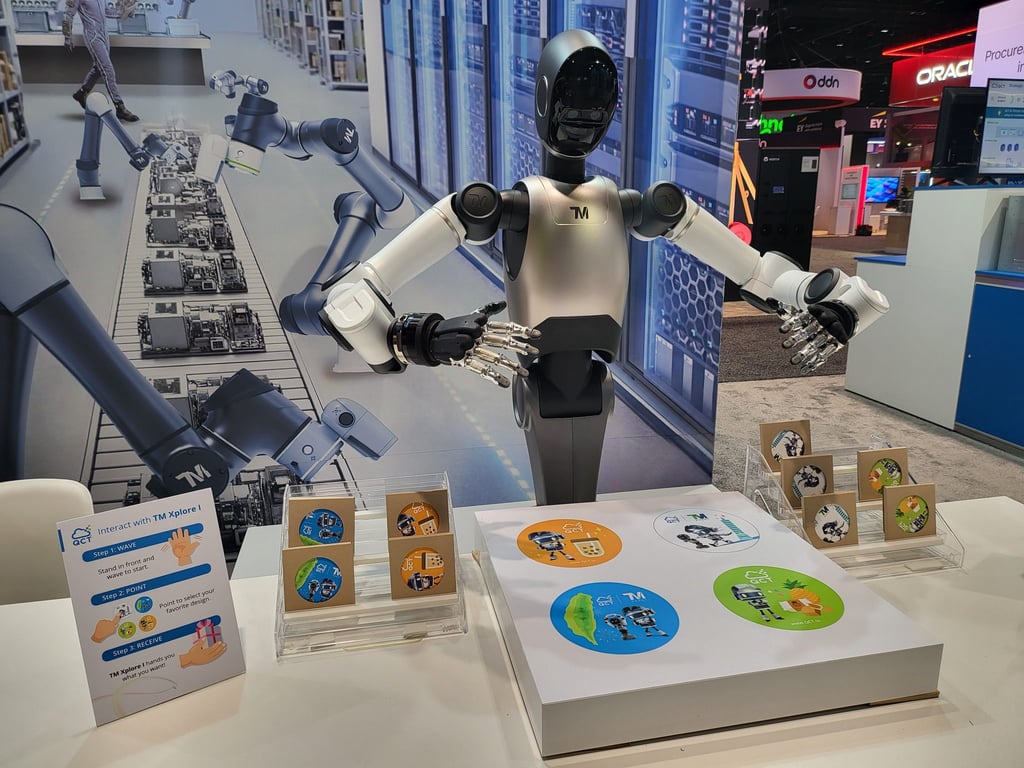


A robot that can see, think, and act like a human helper took center stage at Nvidia’s GTC 2026, as Techman Robot unveiled its latest push into the world of Physical AI.
Techman Robot used the global AI conference to introduce the TM Xplore I, a next-generation humanoid robot designed for industrial work. Unlike traditional humanoid designs, the robot combines a human-like upper body with a wheeled base, a choice the company says improves both stability and flexibility in factory environments.
At the event, the robot interacted directly with visitors, even delivering items to specific locations, offering a glimpse into how such systems could operate alongside humans in real-world settings.
The platform is built around NVIDIA’s Jetson Thor computing module, giving it the ability to handle high-performance AI tasks at the edge. This allows the robot to adapt to new assignments without the need for constant reprogramming, a key limitation of older industrial machines.
Powered by ‘see, think, act’ AI strategy
Alongside the hardware, Techman Robot introduced its 2026 brand direction, framed as “See · Think · Act — Powered by AI Robotics.” The idea centers on combining perception, reasoning, and action into a single system.
The TM Xplore I uses a Vision-Language-Action (VLA) model, enabling it to process images, understand instructions, and make decisions in real time. This allows the robot to carry out complex tasks such as semiconductor manufacturing, electronics assembly, and automotive production with greater autonomy.
To improve reliability, the company is also leaning heavily on simulation tools such as NVIDIA Isaac Sim and FoundationStereo, which help train robots in digital environments before deployment in the real world.
Through its collaboration with QCT, Techman is integrating full-stack infrastructure, from AI models to GPU-powered servers, to accelerate development cycles and real-world deployment.
Beyond the hype: Real business
While the demo is impressive, Techman’s business fundamentals suggest there’s substance behind the show.
The company reported an after-tax profit of NT$136 million ($4.3 million) last year, up 46% year-on-year, according to Taiwan News. Growth is being driven by robot hardware and software integration solutions as smart manufacturing expands.
Techman plans to commercialize its wheeled humanoid robots and apply for patents this year. The company also noted that its robotic arms are being integrated into Taiwan’s China Shipbuilding for welding work on large bulk carriers and container ships.
As Techman pushes into humanoid robotics, it joins a growing field of companies racing to bring general-purpose robots into real-world environments. Firms like Tesla, Figure AI, and Agility Robotics have all showcased humanoid systems designed to handle repetitive or physically demanding tasks, particularly in logistics and manufacturing.
While many of these platforms are still in pilot phases, the industry is rapidly shifting from experimental prototypes to deployable machines, signaling a broader transformation in how businesses approach automation.
What sets this new generation apart is the integration of advanced AI models that allow robots to adapt rather than simply execute pre-programmed actions. By combining vision, language understanding, and physical movement, systems like TM Xplore I reflect a move toward more flexible, multi-purpose machines that can work alongside humans with minimal oversight.
As labor shortages persist and production demands increase, humanoid and semi-humanoid robots are increasingly positioned as collaborative tools reshaping the future of industrial work.
Meanwhile, humanoid robots are already being tested in far harsher conditions, with new deployments on Ukraine’s battlefield exploring their role in reconnaissance and future combat.