






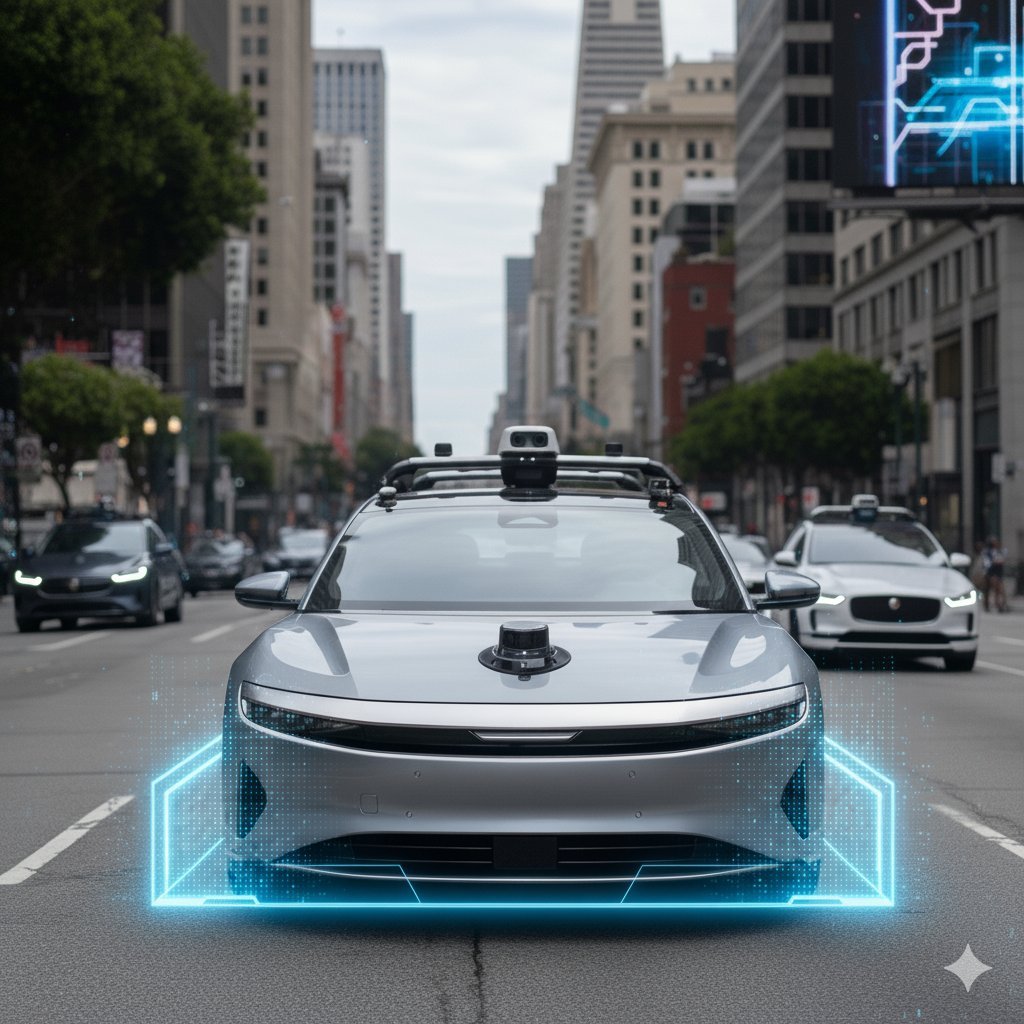


The streets of San Francisco are about to get crowded… with robots.
Uber plans to take the fight to its robotaxi partner, Waymo, in its hometown of San Francisco next year. The company is clear about its plans and will offer driverless rides using Lucid Motors vehicles equipped with Nuro self-driving technology.
The ride-hailing app has already partnered with several autonomous vehicle operators, including May Mobility in Arlington, Texas, Pony.ai in the Middle East, and Momenta in the United States and China. These partnerships typically connect Uber’s large ride-hailing platform and capital resources with the self-driving technology developed by others.
I love Lucid
On the streets of San Francisco, Uber will work with Lucid Motors to outfit 20,000 vehicles with Nuro technology and Nvidia chips for deployment in 2026.
The company plans to expand that to 100,000 vehicles equipped with Nvidia hardware by 2027. Lucid and Nuro are already road-testing the vehicles in San Francisco with human operators, with hundreds more expected to be deployed before the end of the year.
Nuro has been developing self-driving vehicles for close to a decade but recently pivoted to focusing on software for other hardware manufacturers and service operators. The company initially worked on small delivery vehicles designed for public roads, but has since expanded its self-driving technology to support vehicles of all sizes.
While Uber has been an active partner of Waymo in Phoenix, Austin, and Atlanta, it isn’t tied to a single operator and has shown a clear strategy of working with as many partners as possible. The ride-hailing giant also holds a significant stake in Aurora Innovation, to which it sold its in-house autonomous division in 2020. It has a strategic partnership with Volkswagen that could provide the manufacturing scale needed to compete with companies like Tesla and Google.
Waymo is uber-nonchalant
Waymo, for its part, doesn’t appear concerned about Uber’s growing investments. The self-driving subsidiary has partnered with Uber rival Lyft in Nashville, Tennessee, and continues to expand its own operations across multiple cities.
That confidence may stem from Waymo’s clear lead in the self-driving market. Safety reports indicate that Waymo cars are 85 percent less likely to cause serious injuries than human-driven vehicles and 92 percent less likely to be involved in pedestrian crashes. Its recent expansion across the US and into London suggests the company is confident in its technology, and parent company Alphabet increasingly views Waymo less as a moonshot and more as a standalone business.
It has taken a while for Waymo and others to reach this point. In 2015, Google, Tesla, and Ford all called 2020 the year fully autonomous driving would hit the road. That didn’t happen, with several setbacks by Waymo, Cruise, and other operators slowing down the deployment of self-driving vehicles.
But self-driving seems to be riding the AI wave, and fewer regulatory boundaries under the new Trump administration, to make 2026 the year we see large scale deployment by several operators.
By the way, Waymo also plans to launch Waymo rides in London in 2026 through its own app.