






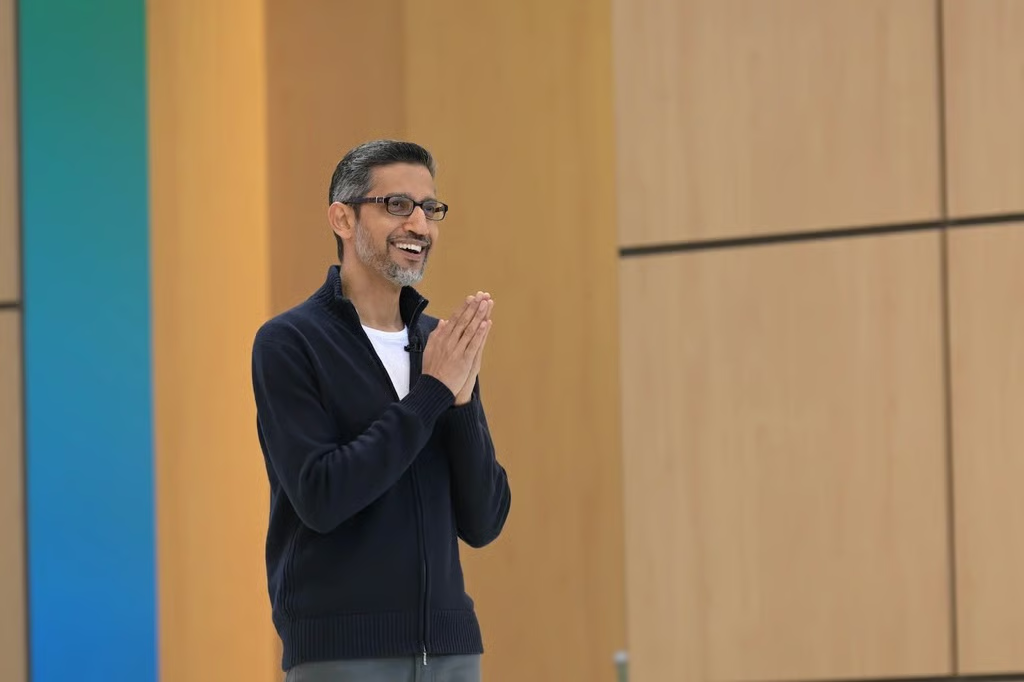


As the fears of AI taking over human jobs continue to rattle the tech industry, Alphabet CEO Sundar Pichai says AI isn’t here to take jobs — at least, not at Google. The tech giant plans to keep hiring engineers well into next year, even as it doubles down on artificial intelligence.
Speaking at the Bloomberg Tech conference in San Francisco, Pichai directly addressed concerns that AI could lead to mass job cuts, as seen in other tech giants like Microsoft. He emphasized that AI is not a replacement for human workers, but an “accelerator” that enhances their productivity.
“I expect we will grow from our current engineering base even into next year, because it allows us to do more,” Pichai told Bloomberg’s Emily Chang.
While acknowledging that AI is changing the way work gets done, Pichai described the technology as something that makes engineers more productive, not obsolete.
“I just view this as making engineers dramatically more productive, getting a lot of the mundane aspects out of what they do,” he said.
Pichai added that rather than cutting jobs, AI is speeding up product development, creating demand for more skilled workers.
A glimpse into AI’s limitations
Despite his optimism, Pichai acknowledged that AI still has its limitations. He noted that while AI excels at tasks like coding, it is far from perfect and continues to make basic mistakes.
On the bigger picture of where AI is headed, Pichai offered a grounded view. When asked whether AI is moving us toward artificial general intelligence (AGI) — a level where AI matches human thinking — he said: “So are we currently on an absolute path to AGI? I don’t think anyone can say for sure.
“There’s a lot of forward progress ahead with the paths we are on, not only the set of ideas we are working on today, [but] some of the newer ideas we are experimenting with,” he added.
Recent layoffs were due to a shift in focus
Alphabet has let thousands of employees go in recent years, including 12,000 jobs in 2023 and another 1,000 or more in 2024; but 2025’s layoffs have been more limited and strategic. Earlier this year, fewer than 100 employees were laid off in Google Cloud, and a few hundred more in its platforms and devices unit.
Despite this, Pichai reiterated that the focus now is on building, not cutting. He pointed to Alphabet’s ongoing projects, such as Waymo self-driving cars, quantum computing, and YouTube’s thriving creator economy, particularly in India, where 15,000 channels have over a million subscribers.
Fears about AI’s impact on the workforce
Some tech leaders have sounded alarms about the long-term threat AI poses to the workforce. Anthropic CEO Dario Amodei recently warned that up to half of entry-level white-collar jobs could disappear within five years.
Pichai didn’t dismiss the concern. “I respect that … I think it’s important to voice those concerns and debate them,” he said.
A PYMNTS Intelligence report recently found that 54% of US workers believe generative AI could lead to widespread job losses. The sentiment is even stronger among tech workers, particularly those who already regularly use AI tools.
Google’s AI search answers won’t kill websites (yet)
Pichai, who has led Google since 2015, is no stranger to AI’s promises and problems. As Google Search evolves to include more AI-generated answers, some publishers worry about losing web traffic, but Pichai said the company is taking care not to cut them out.
“Compared to most companies in the world, we take care to design an experience which is going to showcase links,” he said. “We took a long time testing AI Overviews and prioritized approaches which resulted in high quality traffic out. I’m confident that many years from now that’s how Google will work.”
Read eWeek’s coverage about how to AI-proof yourself at work.