






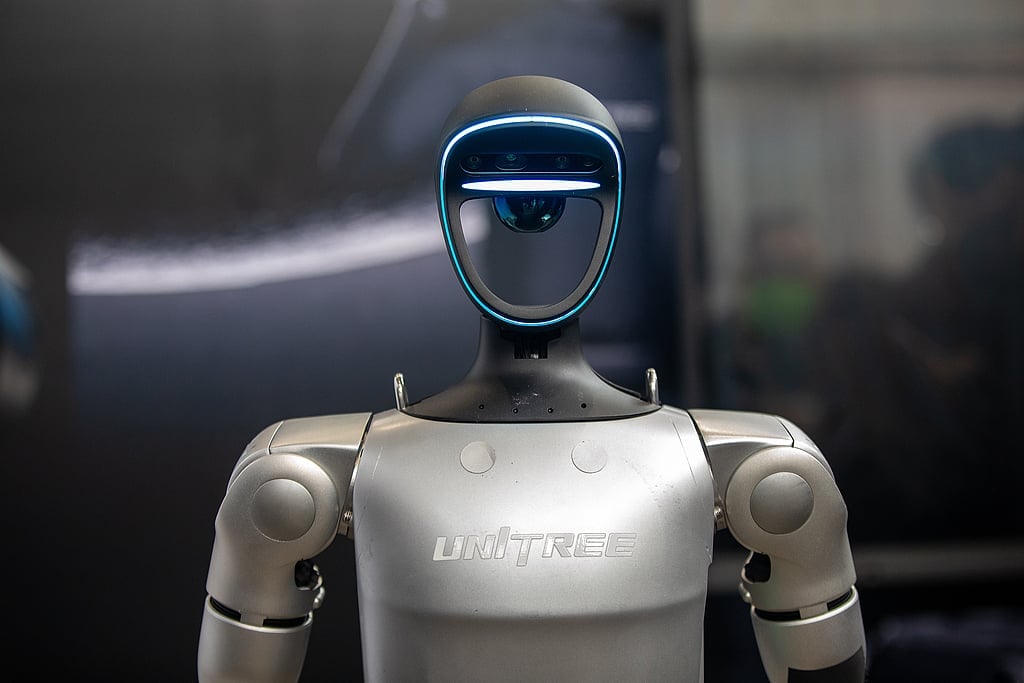


The US government may soon be barred from using robots made by Chinese companies if a new bipartisan bill gains traction in Congress.
The proposed legislation, called the American Security Robotics Act, indicates rising anxiety about the security risks posed by foreign-made technology amid the tech rivalry between the US and China. Republican Senator Tom Cotton and Democratic Senate Majority Leader Chuck Schumer are leading the effort.
As reported by Reuters, the proposed bill would prohibit federal agencies from purchasing or operating humanoid robots and other unmanned ground vehicles produced by companies based in China or other countries considered strategic adversaries. It would also block federal funding related to such technologies.
The bill’s motivation is largely preventive, with lawmakers seemingly trying to get ahead of a potential security problem before it progresses.
National security and data concerns
Modern robots aren’t just machines that move boxes or assemble products. Many are equipped with hardware and AI systems that continuously collect information about their surroundings. Lawmakers fear that this data could potentially be accessed remotely or transmitted back to China, either intentionally or through vulnerabilities.
The bill’s supporters argue that Chinese-made robots could pose serious security vulnerabilities if deployed within federal agencies, positioning the legislation as part of an effort to protect American technological leadership while limiting exposure to foreign competitors.
The proposal includes some flexibility, allowing military and law enforcement agencies to continue acquiring Chinese robots for research and evaluation, provided safeguards are in place to prevent data from being transmitted outside regulated environments.
Part of a decoupling trend
Robotics development has grown in recent years, with both American and Chinese companies racing to build humanoid robots capable of performing real-world tasks. These machines are increasingly being designed for jobs ranging from industrial operations to even household assistance.
The proposed robotics ban fits into a larger pattern of US efforts to reduce dependence on Chinese technology in certain sectors. Over the past several years, Washington has increasingly taken steps to reduce reliance on Chinese technology in sensitive areas, especially in areas involving data collection or critical infrastructure.
The legislation aligns with bigger US–China tech tensions. Robotics may represent the next area of focus, particularly because lawmakers have expressed concern that robots could transmit and, in theory, expose operational data.
These factors raise the question of whether the threat is immediate or largely preventive, and the legislation appears to be more about defining boundaries early than about solving an immediate crisis. It also remains unclear how extensively Chinese robots are currently being used by the federal government, with limited public evidence suggesting that they are widely used by federal agencies today.
The next chapter
The American Security Robotics Act could influence how federal agencies approach automation and procurement, demonstrating that robotics is becoming a strategic technology area in which security considerations increasingly affect purchasing decisions.
Whether the American Security Robotics Act ultimately becomes law remains to be seen. But as humanoid robots move closer to mainstream adoption, policymakers appear determined to ensure that innovation does not overtake safeguards.
Also worth a read: a humanoid robot recently struck a child during a dance performance, raising fresh concerns about real-world robot safety and oversight.