




BERLIN—At the CloudNative/Kubecon EU event in Berlin on March 29, the big news was that Docker contributed its containerd runtime, while CoreOS contributed its rkt (pronounced rocket) runtime to the Cloud Native Computing Foundation (CNCF). The containerd and rkt projects are rival container runtimes that aim to implement specifications that are being formally defined by the Open Container Initiative (OCI) project.
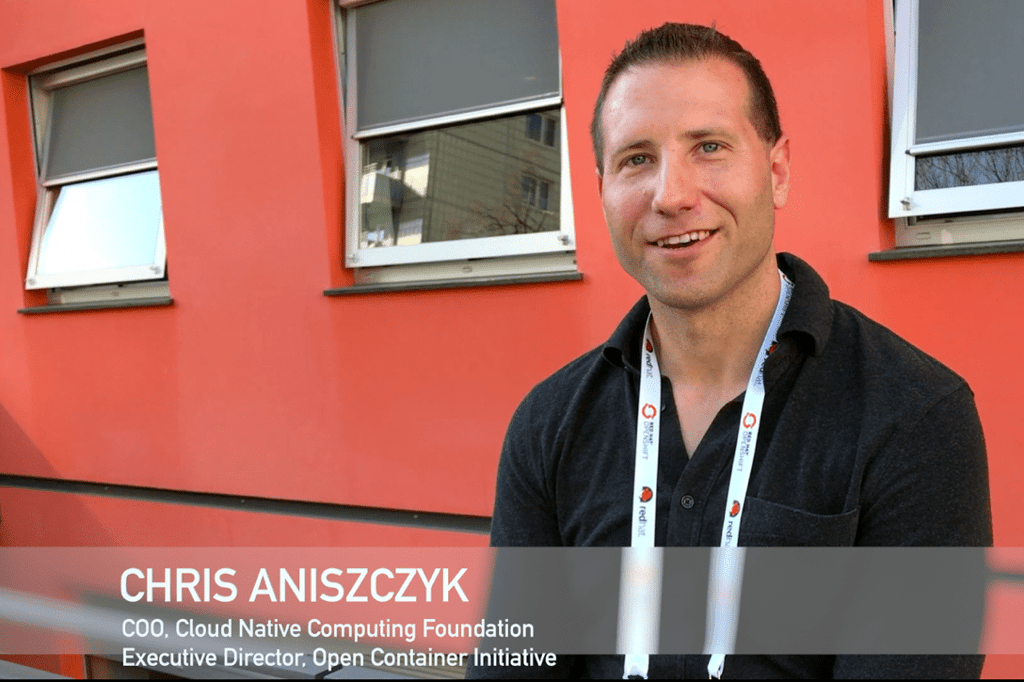
In a video interview, Chris Aniszczyk who serves as both the Executive Director of OCI as well as the Chief Operating Officer (COO) of the CNCF, detailed why the contributions of containerd and rkt matter and what it means for the future of container standards and interoperability.
Aniszczyk also provides insight into how the CNCF has evolved over the past year since eWEEK last conducted a video interview with him in May 2016, when he was the foundation’s interim Executive Director. He noted that there are now more than 80 members of the CNCF and all of those companies are now also members of the Linux Foundation as well. The CNCF itself is a Linux Foundation Collaborative Project and was launched in July 2015, with Kubernetes as the first project. The CNCF is now home to nine projects, including the newly included containerd and rkt container runtimes.
Overall, Aniszczyk is very optimistic that the containerd and rkt projects will help to bring benefits to the CNCF and the container landscape as a whole.
“It’s a win-win for the whole industry to get the two major container engines under one neutral home,” Aniszczyk said.
At a high-level, both containerd and rkt are implementations of the OCI’s container runtime specification, which is nearing the 1.0 mark. While containerd and rkt are rival approaches, Aniszczyk said that as long as both support the underlying OCI specifications, having two different runtime projects is a good thing for innovation.
As an analogy he noted that when it comes to web standards, HTTP is the standard web protocol specification and it is implemented and extended in different ways by HTTP web servers including Apache and nginx.
“They compete in some ways, but it kind of strengthens the technology overall by having a specification with multiple competing implementations that move things forward,” Aniszczyk said.”As cool ideas surface in the implementations, they will eventually get pushed into the specification over time as things stabilize.”
Watch the video interview with Chris Aniszczyk above.