




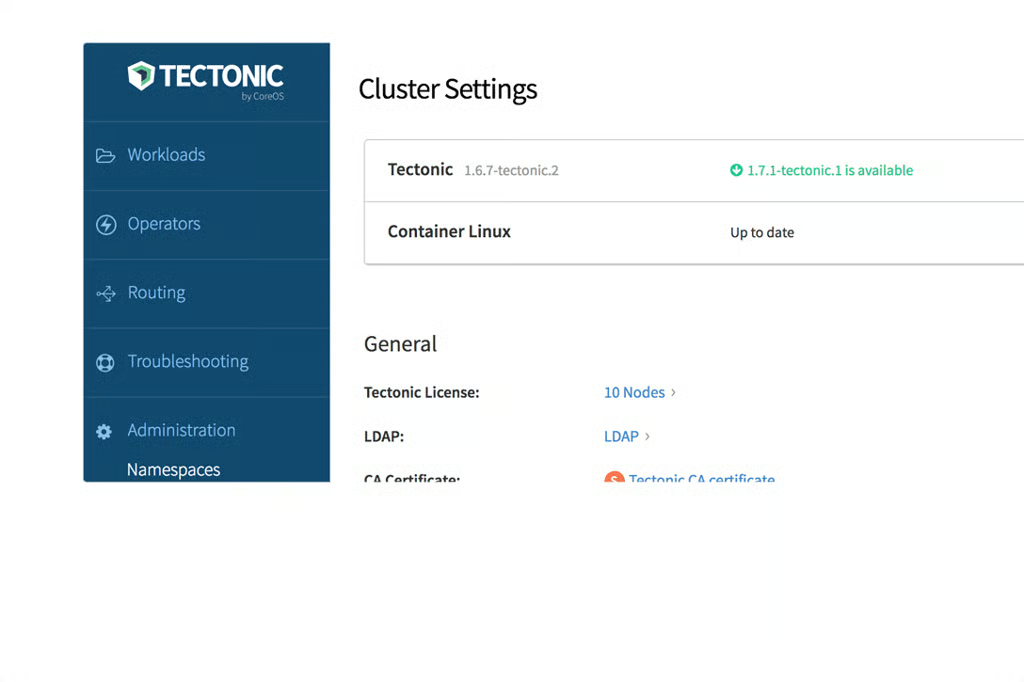
Container management vendor CoreOS today released the latest update of its Tectonic platform, bringing the open-source Kubernetes based system to Microsoft’s Azure cloud. The Tectonic 1.7 release is based on the upstream Kubernetes 1.7 project update that debuted at the end of June.
Kubernetes started off as a Google open-source effort and became the cornerstone project of the Linux Foundation’s Cloud Native Computing Foundation (CNCF) in July 2015. Kubernetes like other container technologies initially started off as a Linux-only platform but is now finding its way to Microsoft Azure thanks to the efforts of organizations like CoreOS. Microsoft’s own Azure Container Service (ACS) added support for Kubernetes in February.
“The Microsoft developer experience folks stepped in to help us make sure Tectonic, and therefore Kubernetes, runs smoothly on Azure,” Rob Szumski, Tectonic product manager, at CoreOS, told eWEEK. “The real benefit for our customers lies in the availability of a hybrid cloud, which allows them to avoid vendor lock-in and save costs.”
Though CoreOS is now providing a stable, production-ready version of Tectonic for Microsoft Azure, organizations can not run a mix of different operating system containers with Tectonic 1.7 on Azure. Docker containers can run with a Windows operating system or Linux base and Microsoft has worked on providing support for Windows-based containers as well.
“Our focus is Linux containers, so Windows containers running on Azure are not supported in this release,” Szumski said.
One of the emerging use-cases for Kubernetes is to potentially enable a multi-cloud deployment of containers. In such a scenario, Kubernetes acts as the master orchestration system managing application containers deployed on different underlying cloud infrastructure providers, for example both Amazon Web Services and Azure. Szumski explained that networking performance impacts the multi-cloud use-case and because of that it is not really compelling for CoreOS customers at this time.
“Customer applications are typically sensitive to latency, especially as they are split into microservices that expect to be located close to each other,” Szumski said.
He added that moving workloads between clouds is best done by addressing each cluster separately using the common API and consistent configuration provided by Tectonic. However, Szumski said that CoreOS is continuing to work together with the industry on the technical challenges and in the future expects that cloud federation will be available to Tectonic customers.
Beyond the new support for Azure, Tectonic 1.7 now also integrates with the open-source Prometheus monitoring project providing a new alerting capability. Prometheus like Kubernetes, is a project hosted by the CNCF. Szumski said that in prior releases, Tectonic shipped Prometheus in a collect and display mode and the 1.7 release adds active alerting capability.
“This has been one of the most requested features from customers, and is new and stable in this release after significant testing,” Szumski said.
Tectonic 1.7 also serves as a preview for a new network policy feature that is intended to provide improved control and security for container traffic. The Network Policy API landed as a stable feature in the upstream Kubernetes 1.7 release, helping to enforce rules about which container pods can connect to each other.
“The Kubernetes community promoted the network policy API to stable with 1.7 and our ability to quickly ship new versions of Tectonic means we are actively testing it with customers,” Szumski said. “Tectonic 1.7 offers this improved network security and will continue to enhance it over successive releases of Tectonic.”
Sean Michael Kerner is a senior editor at eWEEK and InternetNews.com. Follow him on Twitter @TechJournalist.