




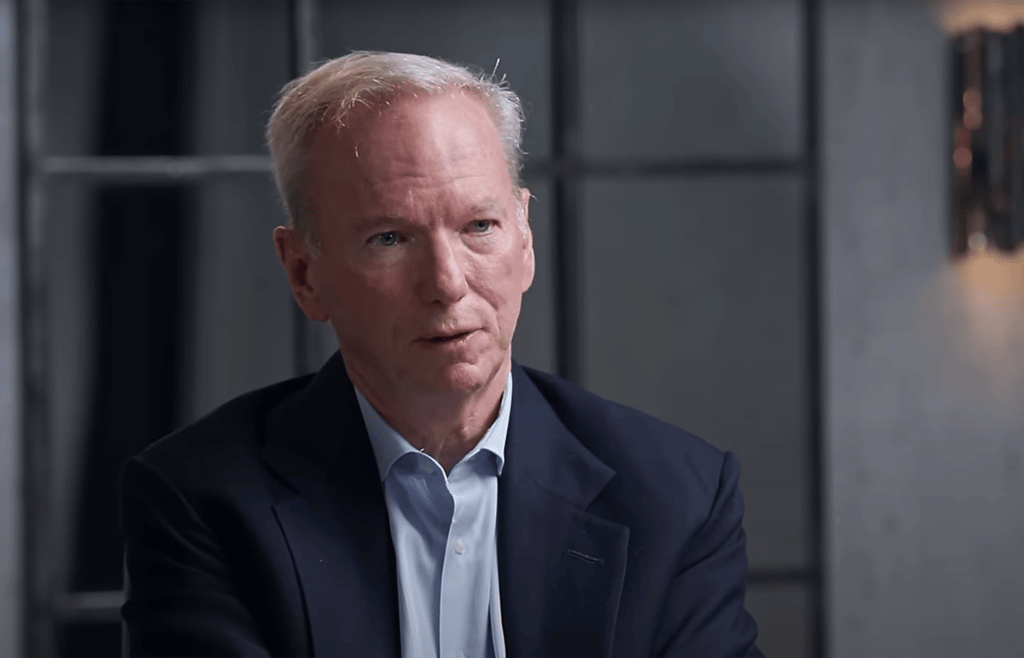
Google CEO Eric Schmidt pushed aside concerns over a possible artificial intelligence (AI) slowdown to say there’s “no evidence” AI scaling is decelerating—instead, he predicts huge improvements in AI models over the next five years could pose serious dangers if they aren’t managed well.
“In five years, you’ll have two or three more turns of the crank of these large models,” he said in an episode of the Diary of a CEO With Steven Bartlett podcast released on November 14. “These large models are scaling with an ability that is unprecedented. There’s no evidence that the scaling has … begun to stop. They will eventually stop. But we’re not there yet.” In other words, predictions that prompt engineering jobs or AI detection tools are passing fads are unlikely to prove true anytime soon.
Schmidt theorized during the interview that coming advancements will cause an exponential increase in AI’s capabilities.
“Each one of these cranks looks like it’s a factor of two, factor of three, factor of four of capability,” he said. “So let’s just say turning the crank, all of these systems get 50 times or 100 times more powerful in and of itself. That’s a very big deal.”
He also hypothesized about threats highly advanced AIs could pose. The most obvious, he said, is cyberattacks—specifically, zero-day attacks that exploit previously unknown vulnerabilities without existing solutions.
“They just keep trying, because they’re computers and they have nothing else to do,” Schmidt said. “They don’t sleep, they don’t eat. [Bad actors] just turn them on and they just keep going.” Other potential dangers include the creation and dissemination of inaccurate information, the development of novel viruses, and new warfare techniques involving drones.
However, Schmidt said, his biggest fear about AI is something most people wouldn’t even imagine.
“My actual fear is we’re not going to adopt it fast enough to solve the problems that affect everybody,” he said—for example, using AI to improve childhood education and healthcare systems as a virtual teaching assistant or doctor’s assistant.
“The algorithms will advance,” he said. “That’s not a question. The question is, are we advancing with it, and do we have control over it?” Listen to the full episode from Diary of a CEO With Steven Bartlett to hear more of Schmidt’s concerns about AI.
Looking to stay ahead of rapid AI developments? Check out our picks for the best machine learning courses and top AI certifications.