






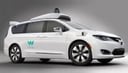

As expected, the first vehicles powered by Google’s self-driving technology will hit the roads later this month.
The vehicles—a fleet of about 100 Chrysler Pacifica minivans developed in collaboration with Fiat Chrysler—will make their initial appearance in Phoenix, Ariz. and Google’s hometown of Mountain View, Calif.
John Krafcik, CEO of Waymo, the autonomous car startup that was spun out from Google last month, announced the rollout at a press event at the North American International Auto Show in Detroit on Sunday.
The Chrysler Pacifica minivans will be the first vehicles to be equipped with Waymo’s all new fully integrated autonomous vehicle hardware suite. The minivans are designed to operate completely independently without a person at the steering wheel at any time.
All of the self-driving sensor technology that has been integrated into the Chrysler minivans are Waymo’s own and were built from scratch by the company, according to Krafcik. “It’s all been designed and built from the ground up by Waymo with every part manufactured with just one goal in mind—to safely handle the complex task of full autonomy,” Krafcik said. “It’s the world’s first self-driving minivan capable of getting you door-to-door without a person at the wheel.”
The vehicles will feature three different types of remote sensing technology, Krafcik said in an interview with CNBC at the Detroit auto show.
One is a Light Detection and Ranging (LIDAR) unit on top of the vehicles that will provide 360-degree coverage of objects around and near the vehicle. The other two technologies are a 360-degree radar system and a separate sensor unit that will provide additional remote sensing capabilities.
By manufacturing all of the autonomous sensor technology on its own, Waymo will have more control over product safety and have the ability to drive costs down as well Krafick told CNBC. Currently, for example, Waymo’s LIDAR array cost around $7,500, which is roughly halfway where it needs to be for mass volume production, he said.
The autonomous Chrysler Pacifica minivans are the result of a partnership that Google entered into with Fiat Chrysler in 2016 before it spun out Waymo as a separate business. The collaboration is the firm’s first with an automaker on a mass production vehicle. Waymo has said that it will seek similar collaborations with other major automakers as well.
News that Waymo’s autonomous vehicles will hit the road later this month should put to rest some of the speculation surrounding Google parent Alphabet’s plans for the autonomous car unit.
Google has been developing and testing autonomous car technology for more than eight years. The company was one of the earliest in the field and has clocked more than 2.5 million miles testing its autonomous vehicle technology.
Recently though, it has been overtaken by others in the race to actually putting self-driving vehicles on the road. Ridesharing service Uber, for instance, already has a fleet of self-driving cars on the road though it got into the game much later than Google.
Another venture that has managed to beat Google to market is a Massachusetts Institute of Technology spinoff, nuTonomy, which like Uber has begun a limited rollout of self-driving vehicles.