






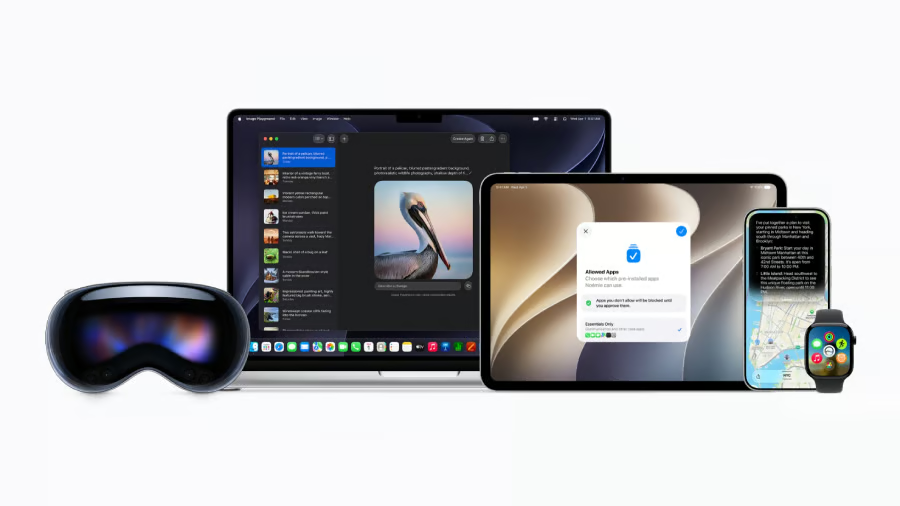


Apple may finally be ready to switch on Apple Intelligence in China, but getting there required help from two of the country’s biggest technology companies.
Chinese regulators have reportedly approved Apple’s AI platform after the company enlisted Alibaba and Baidu to support content filtering and search features, according to Bloomberg. The authorization could end a two-year delay that left Chinese iPhone users without many of the generative AI tools available in other markets.
The launch would help Apple close a major product gap in one of its most important markets. It could also place the company deeper inside the widening technology dispute between Beijing and Washington.
Chinese iPhone users still a generation behind
While this is a major step for Apple devices, the platform remains a generation behind what the company announced at WWDC this year. The revamped Siri, which is powered by Google Gemini outside China, will not be available to Chinese users, and Apple has not said when it expects to launch it.
This may not be too damaging to the brand, however, as the other major mobile operating system, Android, is not operated by Google in China. This means the deep integrations Google provides on Android are also unavailable to Chinese users, leaving them with a mishmash of AI providers competing to win them over.
Apple is investing significant time and resources into outfitting the iPhone with the latest AI features as it attempts to catch up with rivals, announcing several new features alongside Siri. It has also been working on using AI to make the iPhone more efficient and intelligent.
While most US companies have either been blocked from China for years or have reduced their revenue expectations for the country over the past few months, Apple still sees it as a key market. According to Counterpoint Research, the iPhone maker was the market leader in the fourth quarter of 2025, capturing 22% of smartphone sales.
China-US AI battle escalates: Apple stuck in the middle
Working with Alibaba and Baidu was likely the only way for Apple to make it through the verification process with Chinese censors, but the partnerships may not sit well with the US government, which is trying to reduce cooperation between US and Chinese companies, particularly in AI.
The Pentagon recently blacklisted a slew of Chinese companies, including Alibaba and Baidu, over allegations that they support China’s military-civil fusion strategy. While it remains legal for Apple to work with these companies, the partnerships may create tension with a US government that is taking an increasingly hardline approach toward China.
As the US government tries to slow the growth of China’s AI operations, the Chinese government is also looking to restrict cross-border activity. It is reportedly considering limiting access to its homegrown AI models for foreign businesses and individuals. While this is unlikely to affect Apple, it could harm other companies that use Chinese AI models to reduce costs.
For consumers, access to AI models looks to be increasingly dependent on your location and your country's alignment with one of the two superpowers.
Related reading: For more on Apple's US strategy, read our coverage of the White House's reported push for an Apple-Intel chip deal.