







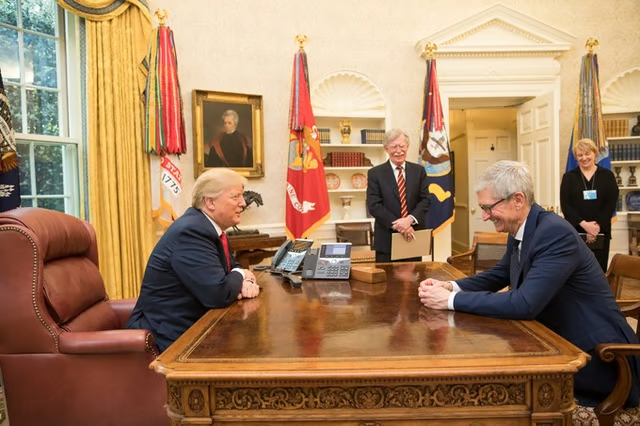
Apple's reported agreement to have Intel manufacture some of its chips came after pressure from the Trump administration during negotiations over proposed semiconductor tariffs, according to a report from The Wall Street Journal.
The report says Apple CEO Tim Cook traveled to Washington in August 2025 to persuade the administration not to impose a proposed 100% tariff on imported semiconductors, a move that could have significantly increased Apple's production costs.
According to the Wall Street Journal, Apple ultimately secured an exemption after committing to invest hundreds of billions of dollars in the United States. During those discussions, President Donald Trump and Commerce Secretary Howard Lutnick reportedly encouraged Cook to use Intel's US manufacturing facilities to produce some Apple-designed chips.
A resource person cited by The Journal said that Apple now plans to have Intel manufacture chips for both Mac computers and iPhones. Neither company has publicly disclosed which chips are involved, production volumes, or when manufacturing could begin.
Intel becomes central to Washington's semiconductor strategy
The reported Apple arrangement comes as Intel has become a major focus of the US government's effort to strengthen domestic semiconductor manufacturing.
Last year, the US government converted $9 billion in federal grants into a 10% ownership stake in Intel, making it the company's largest shareholder, according to The Journal. Since then, the administration reportedly encouraged several technology companies, including Nvidia and SpaceX, to work with Intel as the chipmaker rebuilds its contract manufacturing business.
Intel continues rebuilding its foundry business
Intel's foundry business remains under financial pressure. The company reported $10.4 billion in operating losses over the last four fiscal quarters. Outside customers have largely lost confidence in its ability to produce reliable, high-volume silicon. Turning that ship around takes time.
Under CEO Lip-Bu Tan, the company reorganized its engineering teams, recruited executives from competitors, including Samsung and SK Hynix, and shifted investment toward advanced manufacturing equipment rather than building additional fabrication plants.
The report also stated that Commerce Department officials maintained regular contact with Intel executives while closely monitoring progress on the company's manufacturing technologies and advanced packaging capabilities, which both Intel and the administration reportedly see as critical to competing with Taiwan Semiconductor Manufacturing Co. (TSMC).
What this could mean for Apple
Although Apple reportedly plans to diversify part of its manufacturing, the company is still expected to rely on TSMC for the majority of its custom silicon, according to experts cited by The Journal. The reports also note that there is no official timeline for Intel-manufactured Apple chips, and Apple has not publicly commented on the reported arrangement.
Looking beyond the announcement
In the era of AI, semiconductor manufacturing has become intertwined with trade policy, national security, and industrial strategy.
For Apple, adding another manufacturing partner could reduce supply chain risk as demand for advanced chips continues to rise. For Intel, securing Apple as a foundry customer would provide a major credibility boost at a time when it is trying to convince more companies to trust its manufacturing capabilities.
The larger uncertainty is execution. Intel must still prove it can consistently deliver advanced chips at the quality and scale expected by companies like Apple. Until production begins, questions remain about which Apple chips Intel will manufacture and whether the partnership will materially change Apple's long-standing reliance on TSMC.
Also read: Apple has sued OpenAI over alleged trade secret theft, escalating tensions around AI hardware, former employees, and proprietary technology.