






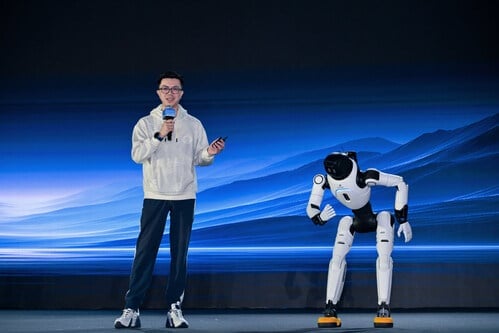


At its 2026 Partner Conference, Chinese robotics leader AGIBOT declared that this year marks the beginning of “Deployment Year One.”
Moving beyond simple demonstrations, the company introduced a massive lineup of five robotic platforms and eight AI models designed to handle real-world tasks in factories, stores, and homes. The goal? To move robots from being a “laboratory curiosity” to an essential part of the human workforce.
“Embodied intelligence is no longer a concept, it is becoming a new form of productive infrastructure,” Peng Zhihui, co-founder, president, and CTO of AGIBOT, said in the company’s announcement.
Five robotic platforms for different environments
AGIBOT introduced a mix of robots designed for different environments, from customer-facing roles to industrial operations.
The AGIBOT A3 is the company’s new humanoid headliner, 173 cm tall, 55 kg, and built with magnesium and titanium to keep things light without sacrificing strength. It boasts a 10-hour battery life with a 10-second swap time, and can coordinate with up to 100 other units simultaneously using UWB centimeter-level positioning.
For tighter, more collaborative environments, the G2 Air is a compact single-arm mobile manipulator designed to work directly alongside humans. It squeezes into spaces under 800mm wide and turns on a dime, making it practical for retail aisles, hospital corridors, and assembly lines. Notably, it collects real-time training data while it works, meaning every shift it completes makes the next one smarter.
On four legs, the D2 Max quadruped is billed as the world’s first all-terrain Level 3 autonomous robot. Unlike earlier quadrupeds that needed a human joystick operator, the D2 Max navigates independently, making it a candidate for security patrols, industrial inspections, and emergency response in environments too dangerous or unpredictable for standard wheeled robots.
For hands-on precision work, the OmniHand 3 Ultra-T brings 22+3 degrees of freedom, full 3D tactile sensing, and a sub-0.3 second response time to the question of robot dexterity. It’s joined by the industrial OmniPicker 3 gripper rated for 140N of force and one million cycles, and the rugged OmniHand 3 Lite for high-impact environments.
Rounding out the hardware slate is MEgo, a data collection system that doesn’t require a robot body at all. Operators wear it and go about their tasks normally, capturing synchronized vision, motion, and tactile data that feeds directly into AI training pipelines. It’s AGIBOT’s answer to the persistent bottleneck of obtaining sufficient high-quality real-world data to train manipulation models.
The ‘one body, three intelligences’ brain
The hardware is powered by what AGIBOT calls its “One Robotic Body, Three Intelligences” architecture. This system unifies eight different AI models to help robots move, work, and talk more naturally.
For instance, the WITA Omni model allows robots to understand a person’s feelings and respond with synchronized speech and gestures. Meanwhile, the Behavioral Foundation Model (BFM) enables a robot to learn to perform a new task simply by watching a short video of a human performing it.
To speed up training, AGIBOT also launched Genie Sim 3.0, a platform that creates “digital twins” of real-world environments, allowing robots to practice skills in a virtual world before trying them in real-world environments.
Proving it in the factory
AGIBOT confirmed it rolled out its 10,000th robot in March. Many of these units are already working on live production lines. At a Longcheer Technology plant in Nanchang, China, G2 humanoids are currently testing and sorting tablets. They reportedly handle up to 310 units per hour with a success rate over 99.9%.
Also read: As AI-native factories take shape, physical AI is becoming part of how manufacturers connect robots, digital twins, and real-time decision-making on the floor.