








Samsung wants to make checking your phone optional, at least for some everyday tasks.
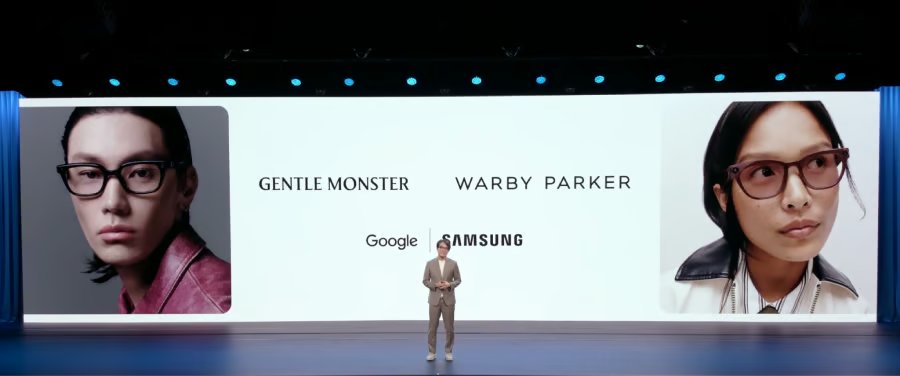
At Galaxy Unpacked in London, Samsung shared new details about its Android XR smart glasses, developed with Google and designed alongside Gentle Monster and Warby Parker.
The display-free eyewear uses cameras, microphones, speakers, and Gemini to summarize messages, translate conversations, capture notes, and respond to what the wearer sees.
Android XR brings Gemini into everyday eyewear
Samsung said the glasses can summarize long messages, read key information aloud, support live translation, and provide navigation assistance without requiring users to pull out a phone.
The built-in camera can capture video or interpret what the wearer sees. During a meeting, for example, users could ask the glasses to collect information from a whiteboard and organize the main points in Samsung Notes.
“As agentic AI reshapes mobile experiences, the next step is to make those experiences more intuitive and responsive to each user’s context,” Won-Joon Choi, chief operating officer of Samsung’s Mobile eXperience business, said in the press release.
The glasses run on Google’s Android XR platform and use Qualcomm’s Snapdragon AR1 Gen1 processor. They must connect to a smartphone, making them a companion product rather than a standalone replacement for a phone.
Samsung also showed a shutter button and privacy-mode toggle built into the frame, according to 9to5Google. Photos captured with the glasses will appear in a dedicated app, while copied text and other visual information can be transferred to Samsung Notes.
Samsung enters a market led by Meta
Samsung plans to launch the glasses this fall through Gentle Monster and Warby Parker sales channels. More designs and colors are expected when the product reaches the market.
The company has not announced a price, although Samsung executive James Choi described the device as a premium product that would not compete at the lowest end of the category.
“We want to make it reasonable, but as I mentioned ... the quality of the product itself, we want to position as premium. It doesn’t mean that it’s crazy expensive,” Choi said, according to CNBC.
Meta controlled 69.2% of the smart-glasses market during the first quarter of 2026, according to IDC figures cited by CNBC. Its portfolio includes a $299 entry-level model and the $799 Meta Ray-Ban Display glasses.
Samsung’s model does not have a built-in display, so users will rely on audio, cameras, voice controls, and connected Galaxy devices rather than seeing information projected onto the lenses. The display-free approach could help Samsung maintain a slimmer frame, although the company did not directly compare its design with display-equipped alternatives.
Samsung rated the glasses for up to nine hours on one charge, while the portable case can recharge them more than seven times. By comparison, Meta rates its display-equipped glasses for up to six hours, 9to5Google reported. Both figures are manufacturer estimates, so actual battery life will depend on feature use.
Workplace features raise privacy questions
Samsung highlighted that the glasses could capture information from meetings, provide live translation and navigation, record the wearer’s point of view, and share what the wearer sees during video calls.
The features could help employees access instructions, document fieldwork, or communicate across languages while keeping their hands free. Cameras and live-sharing tools could also create privacy, security, and compliance concerns in offices, hospitals, classrooms, and other restricted spaces.
Samsung said availability may vary by market, language, app, network, and local consent requirements. Organizations considering smart glasses will need policies covering recording, visual sharing, AI processing, and the storage of captured information.
Final pricing and regional availability remain unknown. Samsung’s fall launch will show whether Galaxy integration, Gemini, and fashion-focused designs can persuade consumers and businesses to add another connected device to their daily routines.
See how Samsung’s new Android XR glasses compare with Meta, Google, Apple, and the rest of the smart eyewear market in our Smart Glasses Cheat Sheet.