






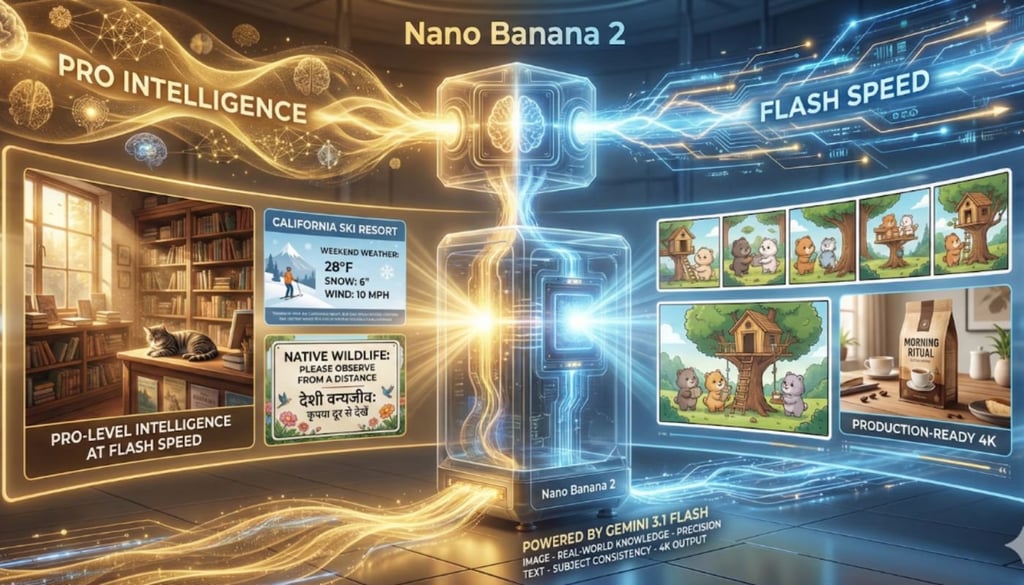


Last summer, Nano Banana went viral. In November, the Pro version raised the bar for quality. Now Google is trying to merge both worlds.
Nano Banana 2, officially Gemini 3.1 Flash Image, promises Pro-level intelligence at Flash-level speed. It adds real-world knowledge, cleaner text rendering, stronger character consistency, and production-ready 4K output. Instead of listing specs, we tested it the practical way: with prompts designed to push its speed, reasoning, layout control, and multilingual capabilities.
If you want to see what Nano Banana 2 can really do, start here.
Pro-level intelligence at flash speed
Nano Banana 2 blends the reasoning power previously reserved for the Pro model with the speed of Google’s Flash architecture. In simple terms, you don’t have to choose between fast and smart anymore.
The model is built on Gemini 3.1 Flash Image, which means it can process complex prompts more thoughtfully while still generating images in seconds. That matters if you’re iterating quickly, testing ideas, tweaking lighting, changing backgrounds, or refining details. Instead of waiting for slower, deliberate outputs, you can now experiment freely and still get high-quality results.
Try this prompt:
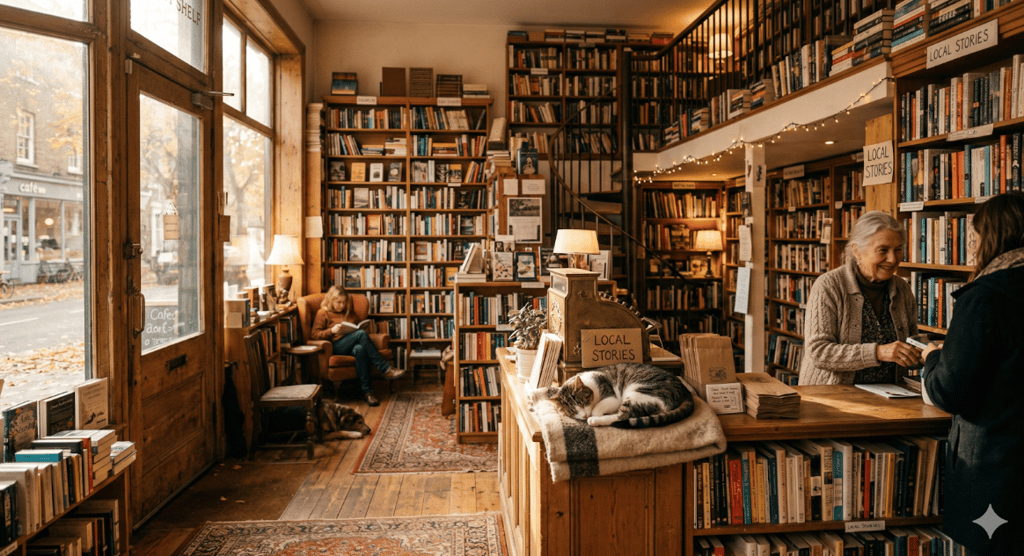
A cozy independent bookshop interior, golden afternoon light streaming through dust-flecked windows, overstuffed wooden shelves, a striped cat napping on the counter — cinematic, warm, photorealistic
AI- generated by Aminu Abdullahi/eWeek Image: Nano Banana 2
Advanced world knowledge (backed by real-time search)
Most image generators are essentially very sophisticated pattern-matching algorithms. They’ve seen millions of pictures of castles, so they can make you a castle. But ask them to generate something specific, like the actual layout of the Louvre’s courtyard, and they’ll give you castle-ish mush.
Nano Banana 2 connects to real-world knowledge. It can draw on web search and Google’s understanding of real-world places, objects, and concepts. This matters more than you’d think. For marketers, educators, and anyone making visual content that needs to be correct, this is the difference between “good enough for social” and “I can actually use this.”
Try this prompt:
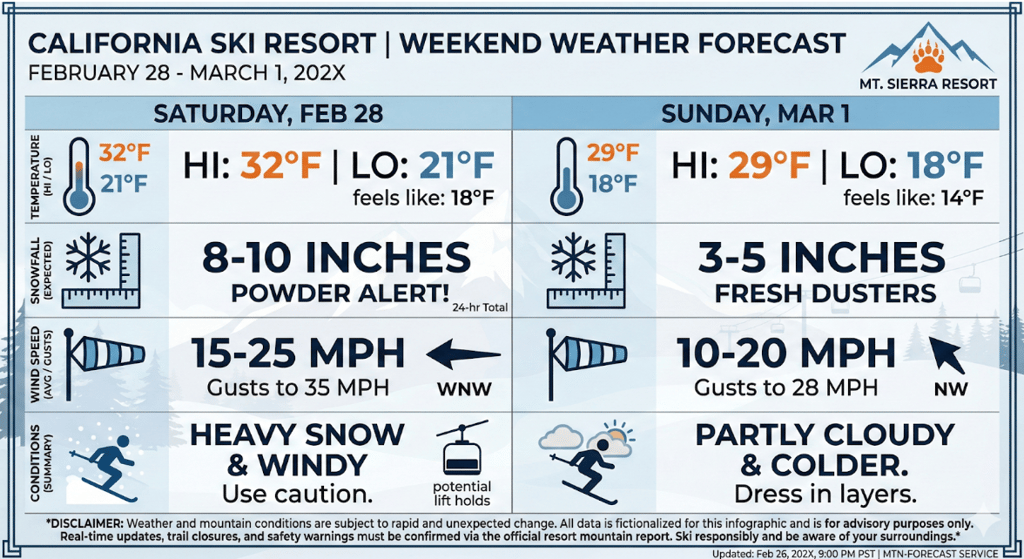
Design a weekend weather infographic for a ski resort in California, including temperature, snowfall, wind speed, and a small disclaimer at the bottom. Clean layout, readable typography.
AI- generated by Aminu Abdullahi/eWeek Image: Nano Banana 2
Precision text rendering
If you’ve ever watched an AI model confidently spell “HAPPPY BIRTHDAY” on a greeting card, you know the pain.
Text in AI-generated images has historically been a mess, with wobbly fonts, garbled letters, and nonsense words arranged to look plausible. Nano Banana 2 takes serious aim at this problem, offering precise, legible text rendering that makes it genuinely useful for marketing mockups, event posters, greeting cards, and UI concepts.
But Google went further than just making text readable. Nano Banana 2 can also translate and localize text within an image, meaning you can create a sign, ad, or infographic in English, then ask the model to swap the text into Hindi, French, Arabic, or any of eight newly supported languages. That kind of multilingual in-image text is a huge deal for global teams and content creators reaching international audiences.
Try this prompt:
Part 1- Generate prompt
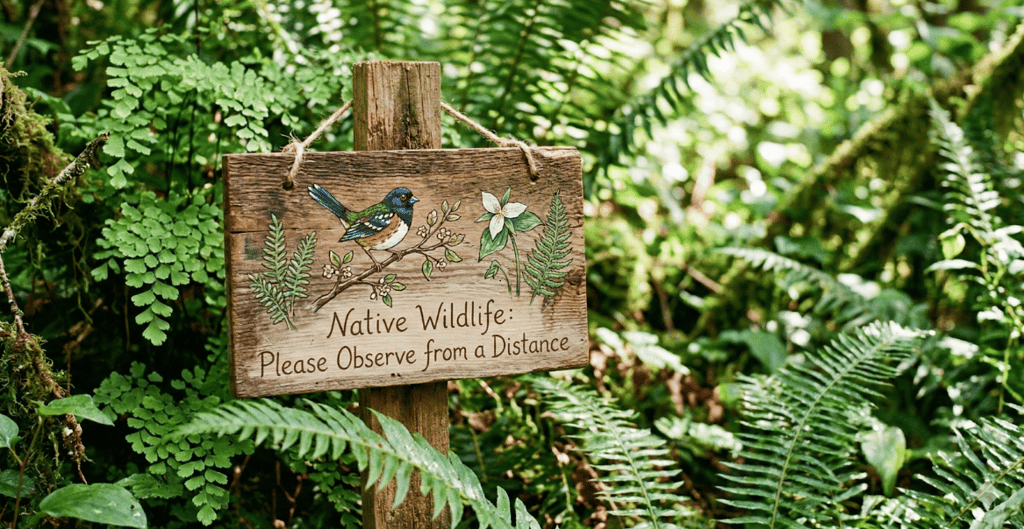
An intimate, naturalistic cinematic close-up of a small illustrated sign made from recycled materials, showing drawings of local birds and flowers. Delicate script below reads: “Native Wildlife: Please Observe from a Distance.” Soft diffused light filtering through fern leaves, vibrant green foliage background.
AI- generated by Aminu Abdullahi/eWeek Image: Nano Banana 2
Part 2- Localize prompt
Take this concept and localize it to an Indian setting, including translating all text in the image to Hindi.
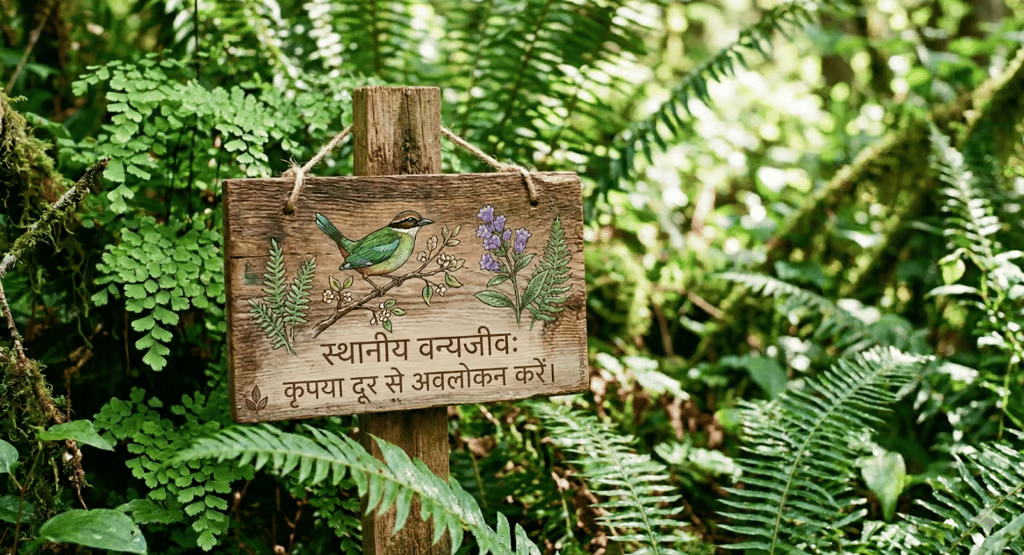
AI-generated by Aminu Abdullahi/eWeek Image: Nano Banana 2
Subject consistency across up to 5 characters
Character consistency has been one of Nano Banana’s signature strengths, and version 2 takes it further.
Google says the model can maintain resemblance for up to five characters and preserve fidelity for up to 14 objects in a single workflow. This makes storyboarding, comic creation, product line visuals, and narrative sequences much easier. Instead of regenerating slightly different faces each time, you can maintain continuity across scenes.
Try this prompt:
Create a funny 6-panel story with 3 fluffy animal friends building a treehouse together. The story is thrilling, with emotional highs and lows, ending on a happy moment. Keep each character’s identity and clothing consistent across all 6 scenes, but vary their expressions and camera angles.
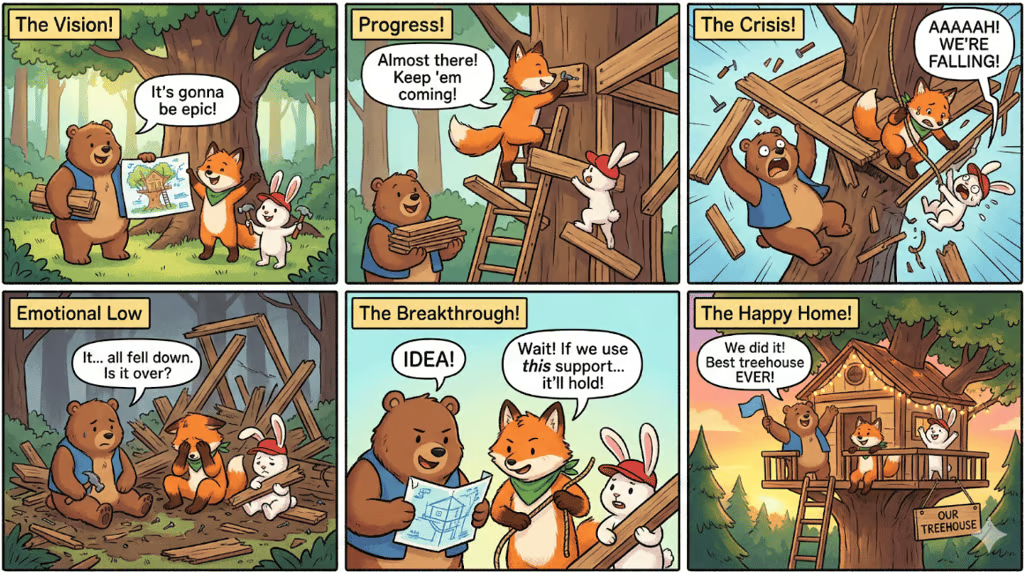
AI- generated by Aminu Abdullahi/eWeek Image: Nano Banana 2
Precise instruction following
If you’ve ever felt like you were arguing with an AI to get a specific layout, you’ll appreciate this. Nano Banana 2 is much better at “listening” to complex, multi-layered prompts. If you ask for a red ball on a blue table behind a green chair, it actually understands the spatial relationships instead of just tossing all three items into a pile.
This precision allows for much more sophisticated compositions. You can describe the lighting, the camera angle, and the specific placement of objects with confidence that the model will actually adhere to your blueprint.
Try this prompt:Example 1: A cluttered detective’s desk in the 1940s: a steaming cup of coffee on the left, a magnifying glass resting on a newspaper in the center, and a silhouette of a man visible through the frosted glass door in the background.

AI- generated by Aminu Abdullahi/eWeek Image: Nano Banana 2
Example 2: Cinematic still in a bold, graphic style with saturated colors. A young dark-skinned individual with tightly coiled hair wearing a tailored blazer with swirling electric blue and hot-pink patterns, wide-leg trousers, yellow heart-shaped sunglasses, and large pink circular earrings. Solid cerulean blue background. Hands on hips, camera low looking up, commanding presence. Pop-art energy.
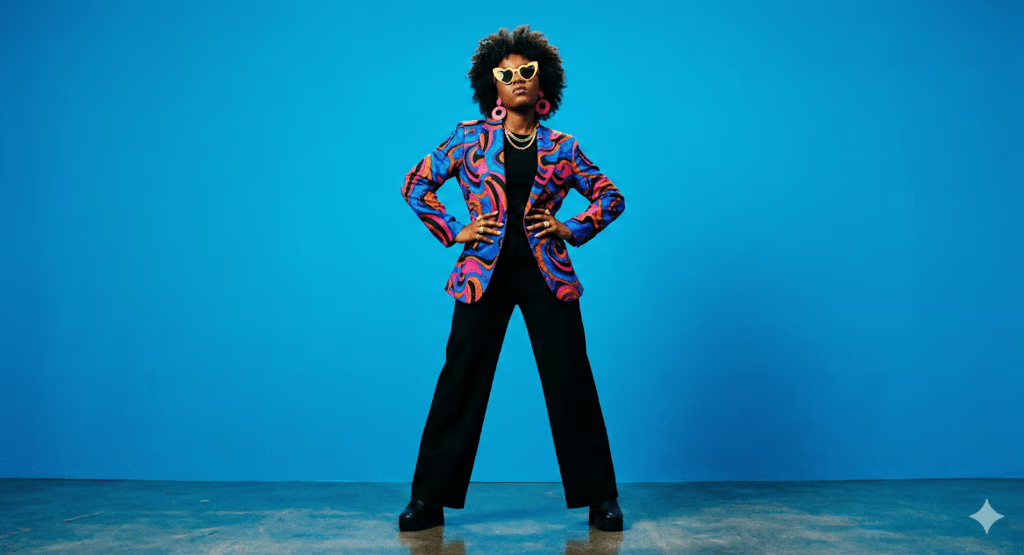
AI- generated by Aminu Abdullahi/eWeek Image: Nano Banana 2
Production-ready specs: 512px to 4K
This isn’t just for low-res social media posts anymore. Nano Banana 2 supports resolutions from 512px all the way up to 4K. It also gives you full control over aspect ratios, whether you need a vertical 9:16 for a TikTok background or a wide 21:9 for a cinematic backdrop.
The Flash speed applies here, too. Even when generating at higher resolutions, the model maintains its efficiency. The final files are sharp, detailed, and ready to be dropped into professional design software or printed without looking like a blurry mess.
Try this prompt:
A premium coffee packaging mockup labeled “Morning Ritual,” lifestyle product photography. Generate in 4K production-ready format. Aspect ratio 16:9.
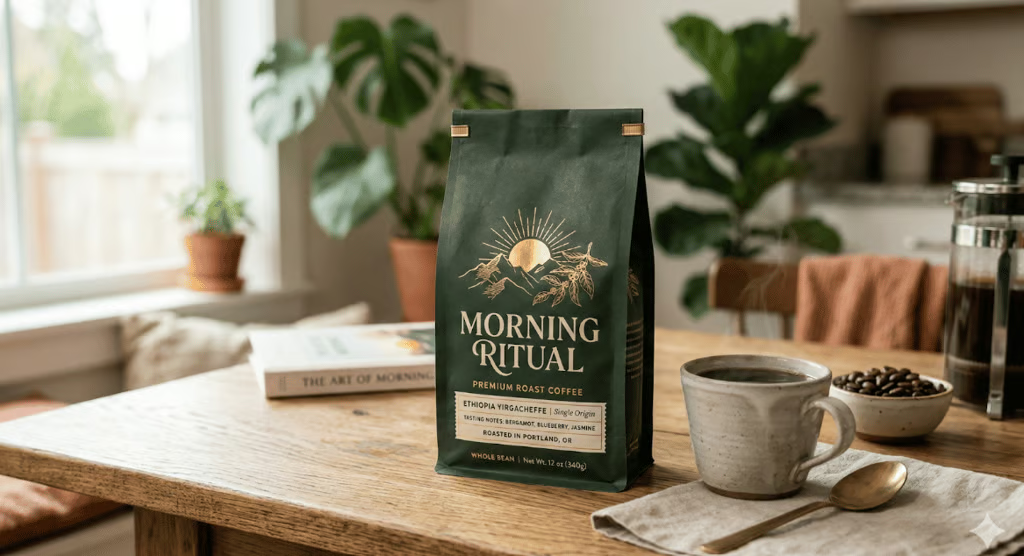
AI- generated by Aminu Abdullahi/eWeek Image: Nano Banana 2
What else can Gemini Flash Image do?
Integrated image-search grounding
One of the coolest under-the-hood features is how Nano Banana 2 uses Google Search to stay grounded. If you ask for something that exists in the real world, like a specific car model or a current tech gadget, it can perform a quick search to ensure the visual details are factually accurate.
This reduces hallucinations (where the AI just makes stuff up). It’s particularly useful for journalists and researchers who need visuals that are representative of real-world facts rather than just a “reamed-up version of reality.
More powerful photo editing
Nano Banana started as an image editor at heart, and that DNA remains. You can upload a photo and ask for targeted modifications, changing environments, outfits, or scene context while preserving core identity details. In testing, it’s capable of mimicking small elements from the original image, like jewelry or clothing patterns, and keeping them consistent.
SynthID watermarking and C2PA provenance
As AI images become harder to distinguish from reality, transparency is key. Nano Banana 2 comes with SynthID watermarking and C2PA Content Credentials baked in. This adds an invisible digital signature to every image, letting people know it was generated by AI.
It’s a behind-the-scenes feature that matters for the health of the internet. It allows platforms to verify the origin of content, helping to fight misinformation while still letting creators have fun with the tool. It’s about building trust in the tech we use every day.
Where can you use it?
Nano Banana 2 is now the default image model inside the Gemini app. It’s also rolling out across Google Search (AI Mode and Lens), AI Studio, the Gemini API, Google Cloud’s Vertex AI, Flow, and Google Ads. In other words, this isn’t a niche tool; it’s deeply embedded across Google’s ecosystem.
Related reading: For more practical ways to level up your results, check out our guide to the 6 best Gemini AI photo editing prompts.