






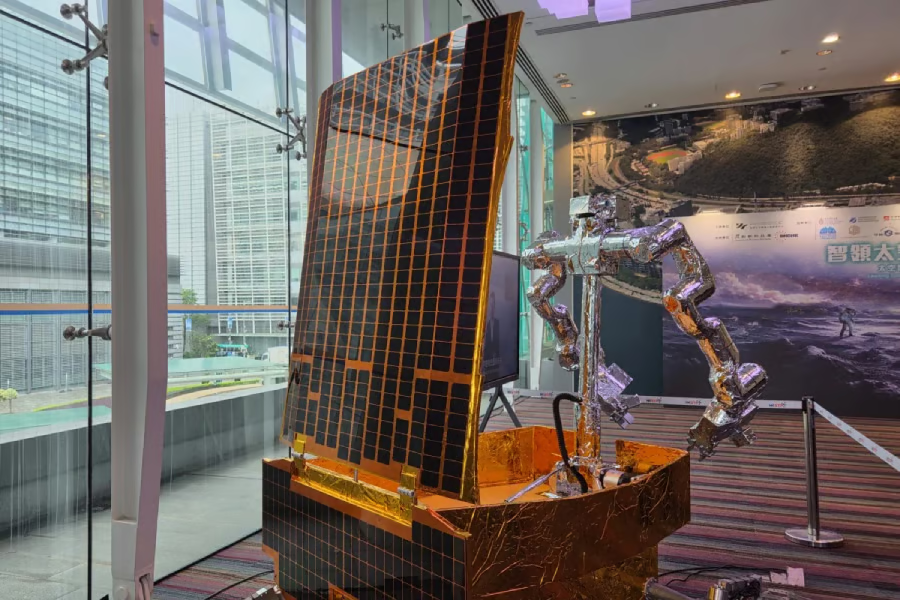


China has revealed a new AI-powered lunar robot designed to help carry equipment, install scientific instruments, and support future moon infrastructure during the country’s Chang’e-8 mission in 2029.
The robot, developed by a team led by the Hong Kong University of Science and Technology, combines a humanoid upper body with two robotic arms mounted on a four-wheeled rover platform. According to the South China Morning Post (SCMP), the machine weighs about 100 kilograms (220 pounds) and is intended to operate near the moon’s south pole.
Researchers say the robot will function as a robotic porter once the Chang’e-8 lander reaches the lunar surface. Its tasks include transporting scientific payloads, placing sensors, installing equipment, and collecting lunar samples.
HKUST professor Gao Yang said the project represents a major step for China’s lunar robotics efforts.
“We have heard that Chang’e-7 is probably going to see the first humanoid robot landing on the [moon’s] south pole. But our robot will go to a different part of the South Pole – it is a very large area, and we are curious about all of it,” Gao told the SCMP.
“This will be a novel demonstration of humanoid robotics on the moon and by China. We are very proud of this design,” she added.
AI will guide the robot across dangerous terrain
The robot is expected to operate semi-autonomously using onboard artificial intelligence. According to Gao Yang, the AI system can “identify and trace objects, allowing it to formulate a strategy before executing a task.”
Researchers say that the capability will help the robot work with instruments developed by different international partners participating in the Chang’e-8 mission. Since the equipment was not all designed together, engineers expect the robot to encounter “non-cooperative” objects that may not interact perfectly with its systems.
The AI will also assist with navigation across the Moon’s rough south polar terrain, which includes permanently shadowed craters and rugged ridges.
Designed to survive brutal lunar nights
The solar-powered robot is being built to survive at least two years on the Moon.
That includes enduring more than 24 lunar nights, each lasting over 330 hours in freezing conditions. According to HKUST, the robot includes a thermal management system that circulates fluid and uses advanced materials to protect internal components from temperatures ranging between 120 degrees Celsius and minus 180 degrees Celsius.
Gao Yang said the machine is currently undergoing integration testing with the lunar lander that will carry it into space.
“Developing spacecraft has been a challenge for scientists due to the severely limited mass and energy resources in the harsh operating environment,” she said, according to the SCMP. “It is a delicate balancing act to maintain performance while miniaturising and maximising energy efficiency [all while ensuring safety is not compromised].”
Chang’e-8 mission tied to future Moon base plans
China’s Chang’e-8 mission is expected to explore Mons Mouton near the lunar south pole and will work alongside the earlier Chang’e-7 mission, which is scheduled to launch in August.
Scientists are particularly interested in the Moon’s south pole because some craters there are believed to contain water ice. Researchers say those deposits could eventually provide drinking water, breathable oxygen, and even fuel for future Moon missions.
China is separately aiming to land astronauts on the Moon by 2030, while the US continues work on NASA’s Artemis program and SpaceX’s Starship-based lunar landing system.
Also read: Our humanoid robot rankings compare Tesla Optimus, Unitree, Agility Robotics, UBTech, and other machines moving closer to practical use.