






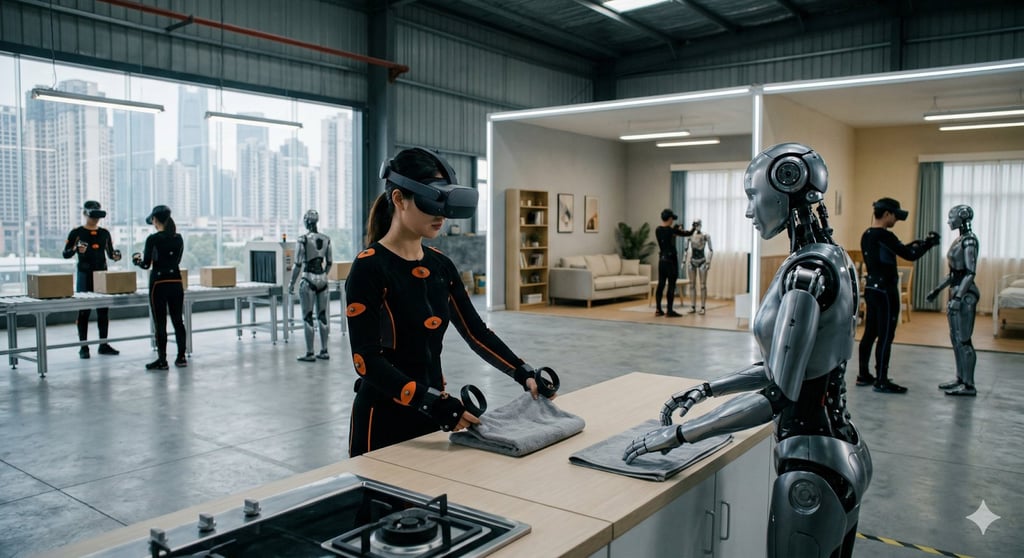


In massive warehouses across China, from the “Optics Valley” of Wuhan to the industrial hubs of Shandong, a new kind of school is in session.
There are no textbooks or pop quizzes here. Instead, hundreds of humanoid robots are mimicking their human teachers to master the subtle, often frustrating art of existing in a human world.
These facilities represent a massive shift in how we build AI. While ChatGPT learned to speak by reading the internet, these robots are learning to move by watching us, one repetition at a time.
Inside a 10,000-square-meter facility in Shijiazhuang, the scene looks like a silent, synchronized dance. Human trainers wear VR headsets and motion-capture suits, their every move mirrored by a 1.66-meter-tall robot standing nearby. When the human reaches for a medicine bottle, the robot does the same.
This isn’t just for show. Because humanoid robots interact with physical objects, they can’t simply “read” how to be useful; they need data on force, pressure, and joint rotation.
“We wear VR (virtual reality) glasses and have controllers in hand. Our left and right hands are like the robot’s left and right arms. It will learn our postures by moving them. The data will be uploaded to the cloud. Once the data is approved (forming a dataset), it will be uploaded to the robot, and it will learn from it,” Qu Qiongbin, an AI robot trainer, told Euronews.
“It’s actually a very interesting process. I feel a great sense of accomplishment when I get it to complete the task, just like teaching my own child and feeling like it has grown up,” she added.
Why simple tasks are so hard
While a robot can calculate complex physics in a millisecond, folding a wrinkled towel is a nightmare for a computer.
Towels change shape, bunch up, and have no fixed geometry. To solve this, Chinese researchers are using brute-force repetition. At one center in Hubei, 100 robots repeat the same actions (ironing, wiping tables, or sorting boxes) thousands of times to perfect their grip.
Yang Xinyi, a project leader at Data Fusion Technology, told Euronews: “We train and teach robots by creating realistic, one-to-one scenarios. Trainers may repeat a single action hundreds, thousands, or even tens of thousands of times to teach it, and then use the data to support this training.”
This “practice makes perfect” approach is working. Some centers report a 95% success rate for tasks that were considered nearly impossible for humanoids just a few years ago.
A growing national campus
China isn’t just dabbling in this; they are building an infrastructure. By the end of last year, the country had established over 40 state-backed robot data centers, with 24 already in full swing. These schools are designed to look like the real world, featuring mock-up living rooms, automobile assembly lines, and elderly care wards.
The goal is to move beyond the “cool tech demo” phase and into actual commerce. According to Chosun Biz, three centers in Jiangxi, Guangxi, and Sichuan have already helped generate 566 million yuan (about $80 million USD) in sales for the robotics firm UBTECH.
The race for the real world
A global labor shortage fuels the urgency behind these schools. From car factories in Canada to warehouses in Korea, there simply aren’t enough humans to do repetitive, “dull” jobs. China is betting that by schooling its robots in real-world settings now, it will be the one to provide the workforce of the future.
As these mechanical students graduate from their warehouses, they are already heading to work. Visitors in Wuhan can already visit the 7S Humanoid Robot Store to watch these “graduates” take commands and perform tasks in person.
Also read: Microsoft plans to build its own advanced AI models by 2027.