






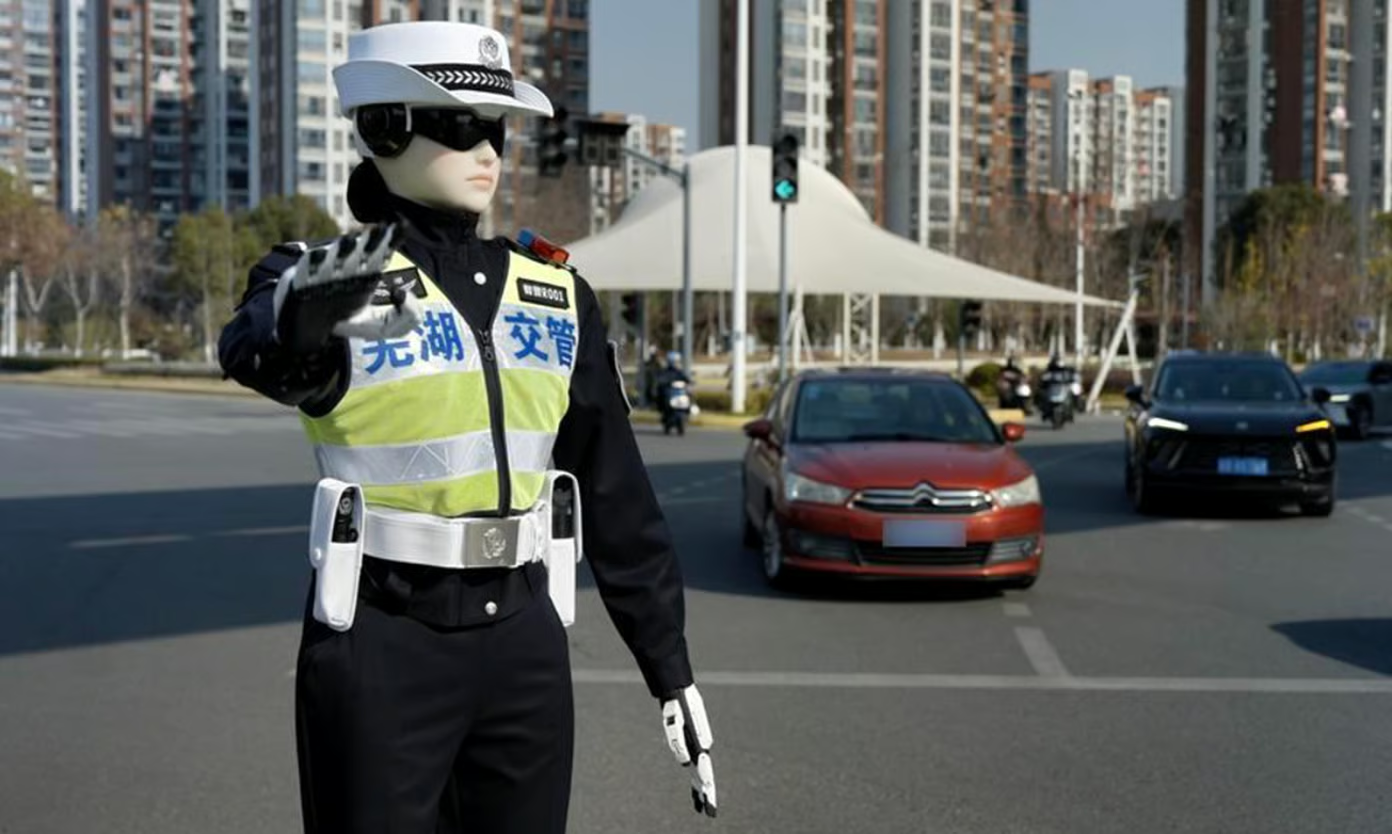


Holiday traffic in one of China’s busiest tourist cities came with an unusual sight this year: robot police directing crowds, issuing warnings, and even giving directions.
During the May Day holiday, Hangzhou deployed what state media describes as the country’s first formally organized robot traffic police squad. According to Global Times and Xinhua, the unit consists of 15 intelligent robots stationed at key intersections, including the popular West Lake scenic area.
The role of these machines is to help manage traffic, guide pedestrians and cyclists, and support human officers in keeping order during one of the busiest travel periods of the year.
The move marks a shift from earlier trials to a more coordinated, real-world deployment. Previously used at large events like marathons, the robots are now operating in everyday urban conditions, handling dense holiday traffic.
What the robots actually do
The machines are designed to take on repetitive, time-consuming tasks typically handled by human officers.
Equipped with visual recognition systems, they monitor intersections for violations such as crossing stop lines, riding without helmets, or walking into vehicle lanes. When they spot an issue, they issue voice warnings. If ignored after repeated alerts, the system records the violation and sends it to a central command unit, according to Global Times.
They also double as digital assistants. Tourists can interact with the robots through a touchscreen and voice interface to ask for directions. Using real-time traffic data, the robots suggest optimal routes for walking or public transport.
In addition, the robots are synchronized with traffic light systems and programmed with standard hand signals used by traffic police, allowing them to direct vehicles and pedestrians with clear, coordinated gestures.
Real impact on the ground
Early numbers suggest the robots are already active enforcers. The machines issued 11,897 warnings in just three days, averaging roughly one warning every minute and 43 seconds, according to The Straits Times, citing Hangzhou Daily.
The machines’ presence may also be changing how people respond to enforcement. As reported by The Straits Times, police officer Chen Sanchuan said, “The robots’ verbal reminders are objective and direct, so people are more willing to accept them.”
Authorities say the robots can operate continuously for eight to nine hours a day, reducing the physical strain on human officers who would otherwise handle tasks like directing traffic manually or issuing repeated warnings.
Beyond Hangzhou: A national push
Hangzhou is not alone. Similar robot deployments were reported in other cities during the holiday period.
In Kashgar, a robot in a high-visibility uniform directed traffic at a busy intersection, while in Ordos, two robot officers carried out traffic control and safety education duties, according to Xinhua. Meanwhile, in Shenzhen, humanoid robots even joined patrol teams, drawing attention online.
Experts say this reflects a broader national strategy to integrate artificial intelligence into public services. Jiang Lei, a robotics scientist quoted by Xinhua, said, “This trend suggests that robot traffic police are just the beginning, with more industries in China poised to accelerate their intelligent transformation.”
Also read: Linkerbot’s robotic hands are part of China’s broader race to build dexterous robots for manufacturing, health care, and other real-world uses.