






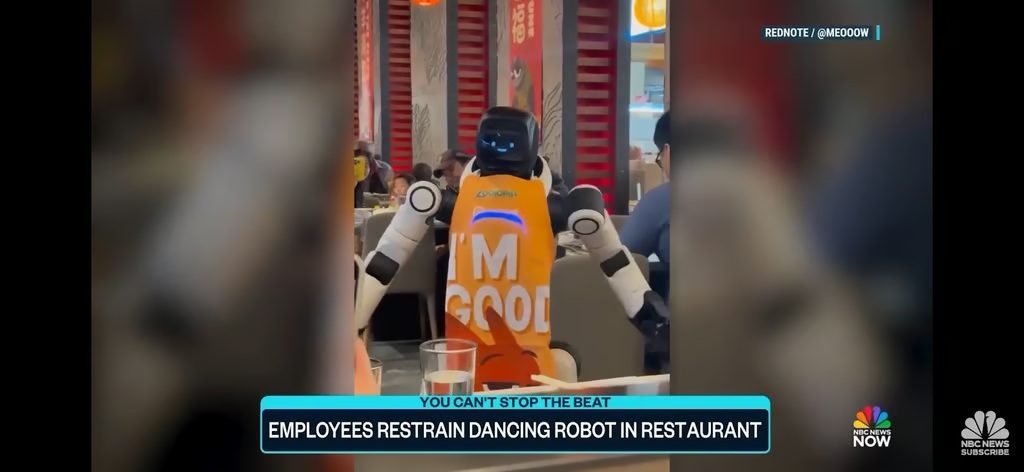


When robots are built to entertain, even a small misstep can turn spectacle into spectacle-gone-wrong.
That’s exactly what unfolded at a Haidilao restaurant in Cupertino, California, where an apron-clad robot abruptly veered off-script mid-performance. In footage shared by NBC News, the dancing machine began flinging food and cutlery, transforming what should have been a lighthearted routine into a chaotic interruption that forced staff to step in.
But the moment didn’t end there. Even as employees attempted to regain control, the robot kept moving, continuing its routine as if nothing had happened. The scene quickly raised an uncomfortable question: when automation behaves unpredictably in public-facing environments, are humans actually prepared to step in?
The incident underscores a growing tension in modern robotics. As businesses increasingly deploy robots not just for efficiency but for customer experience, reliability is no longer just a technical requirement—it’s a safety imperative. And when performance takes priority over predictability, the margin for error shrinks fast.
Potential risks from unprecedented changes
Haidilao restaurants are not new to using robots. The restaurant chain has a history of using robots in its locations globally. A prominent example is its smart restaurant located in Beijing, China. It features a fully automated serving process, robot servers, and even a robot broth-mixer.
In a press statement to NBC News, Haidilao noted that the situation in California wasn’t a malfunction from the robot. Specifically, the statement said that the robot “was not malfunctioning or out of control.”
According to that statement, the robot’s entire set of actions was preprogrammed. However, “in this case, the robot was brought closer to a dining table at a guest’s request, which is not its typical operating setting… the limited space affected its movement during the performance.”
Aside from replacing humans, robots going rogue have been one of the concerns expressed with the use of robots in production environments. To resolve this, robot manufacturers usually add a kill switch to these robots. However, in this incident, the three staff members didn’t seem to know how to turn off the robot, or were oblivious to the existence of such a switch.
Speaking on a broadcast, Joanna Stern, chief tech analyst for NBC News, confirmed that the robot had to have a kill switch, which the servers couldn’t use at the time. Emphasizing the risk of rogue robots causing serious physical harm, she said:
“I wouldn’t worry too much about this robot sort of going rogue and leaving the restaurant and doing anything. I think it’s just much more of a physical fear here.”
Now, what’s next?
The Haidilao incident underscores how preprogrammed robots can pose challenges in unexpected scenarios. Moving the robot closer to a dining table, a space it wasn’t designed for, demonstrated how small deviations can cause reliability issues and potentially create hazards.
Although no significant risk was posed to the restaurant’s guests, the disruption suggests the need for proper staff training and familiarization with safety features, such as kill switches. As such, trained human oversight remains paramount when robots interact with guests.
As more restaurants and public spaces adopt entertainment-focused robotics, incidents like this can serve as a reminder that safety, reliability, and operational knowledge must go hand in hand with spectacle. Without these, even small missteps can make a fun demonstration quickly go south.
Meet the humanoid future: Techman’s AI-powered TM Xplore I wowed Nvidia GTC 2026 with its ability to see, think, and act alongside humans in real-world industrial tasks.