






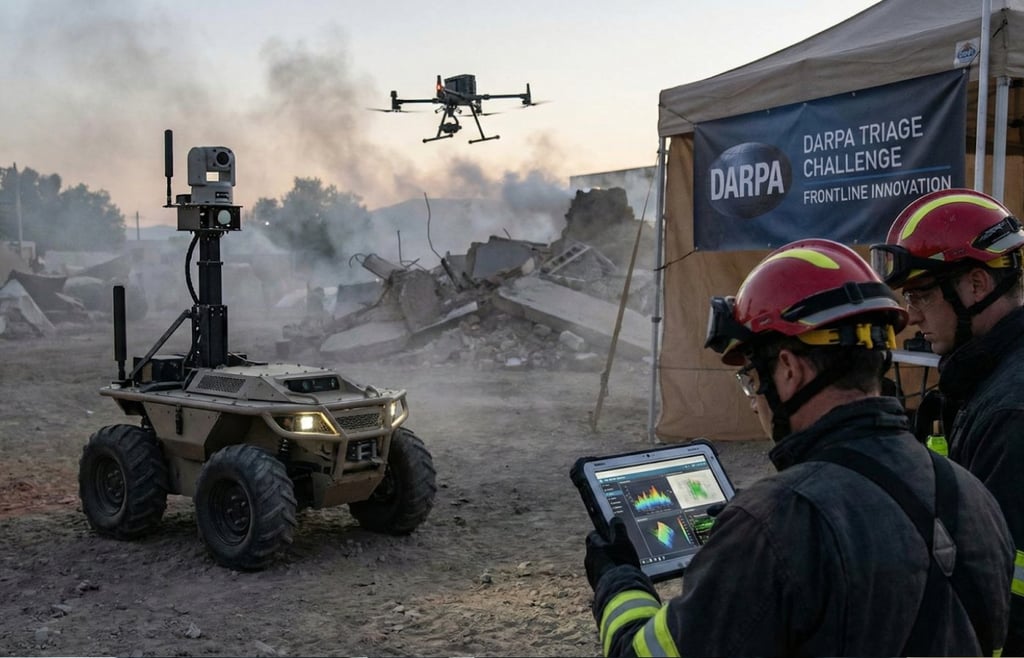


The US Defense Advanced Research Projects Agency (DARPA) is pushing robots into one of the hardest jobs in emergency medicine: triage.
Through its multi-year DARPA Triage Challenge, the agency is testing whether machines can help overwhelmed responders quickly locate injured people, assess injury severity, and share that information in time to save lives.
Earthquakes, plane crashes, battlefield attacks, and large accidents often leave too many injured people and too few medics. DARPA believes robots and data tools can help close that gap.
Triage, at its core, is about speed and judgment, identifying who needs urgent care first when every second matters.
Why DARPA is turning to robots
In chaotic and dangerous environments, medics often work with limited visibility, incomplete information, and real personal risk. DARPA’s approach is to send robots, including drones and ground vehicles, ahead of humans to locate victims, assess vital signs, and transmit key information back to responders.
“By deploying remote technologies, we can better ensure that we get the right patients to the right level of care [at] the right time,” said Col. Stacy Shackelford, Trauma Medical Director of the Joint Trauma System.
How the challenge works
The competition is split into three tracks: Systems, Data, and Virtual.
- Systems teams deploy real robots to find and assess casualties in physical environments.
- Data teams analyze trauma datasets to predict which patients will need life-saving interventions.
- Virtual teams work in simulated disaster scenarios, testing algorithms without physical robots.
DARPA structures the program as a prize-based challenge, forcing teams to build, test, fail, and improve under realistic conditions. According to DARPA, the challenge is designed to “bridge the gap between fundamental research and practical applications for military and national security needs.”
What happened in the first two events
Challenge Event 1, held in September 2024 at Guardian Centers in Perry, Georgia, introduced teams to realistic mass-casualty scenarios. Robots used stand-off sensors to locate victims, while data teams raced to predict medical needs using trauma records. Teams quickly learned that overheating hardware, limited bandwidth, and unclear scoring could derail even strong ideas.
By Challenge Event 2 in September 2025, conditions became harsher. Smoke, darkness, rugged terrain, and visual obstructions forced robots to operate in environments closer to real disasters and combat zones. Data teams faced noisier, more complex datasets, making predictions harder and more realistic.
DARPA says these constraints are intentional, as real emergencies rarely offer perfect conditions.
Who’s leading the pack?
In the second-year event, DARPA named DART, led by Battelle Memorial Institute, as the top performer in the systems competition, according to ExecutiveGov. MSAI took first place in the data category. Other teams, including RoboScout and Coordinated Robotics, also performed strongly.
DARPA-funded and self-funded teams compete side by side, though only self-funded teams qualify for prize money during the early years.
Inside one team’s approach
One of the teams preparing for the final event is Team Chiron from Carnegie Mellon University. The group uses quadruped robots and aerial drones to scout dangerous areas before medics arrive.
Speaking to IEEE Spectrum, Elenberg explained why robots are needed in the first place:
“We simply do not have enough responders for mass-casualty incidents. The drones and ground robots that we’re developing can give us the perspective that we need to identify where people are, assess who’s most at risk, and figure out how responders can get to them most efficiently.”
Elenberg described real-world situations where extra eyes — even robotic ones — could have made a difference, especially when a single responder faces multiple injured patients at once.
The final test ahead
The last and most complex event of the DARPA Triage Challenge is scheduled for November 2026. Teams will face the harshest conditions yet, as DARPA looks to crown an overall winner and, more importantly, prove whether robotic triage can work when lives are truly on the line.
Also read: Robot Olympics turns everyday chores into a stress test for general-purpose robots.