






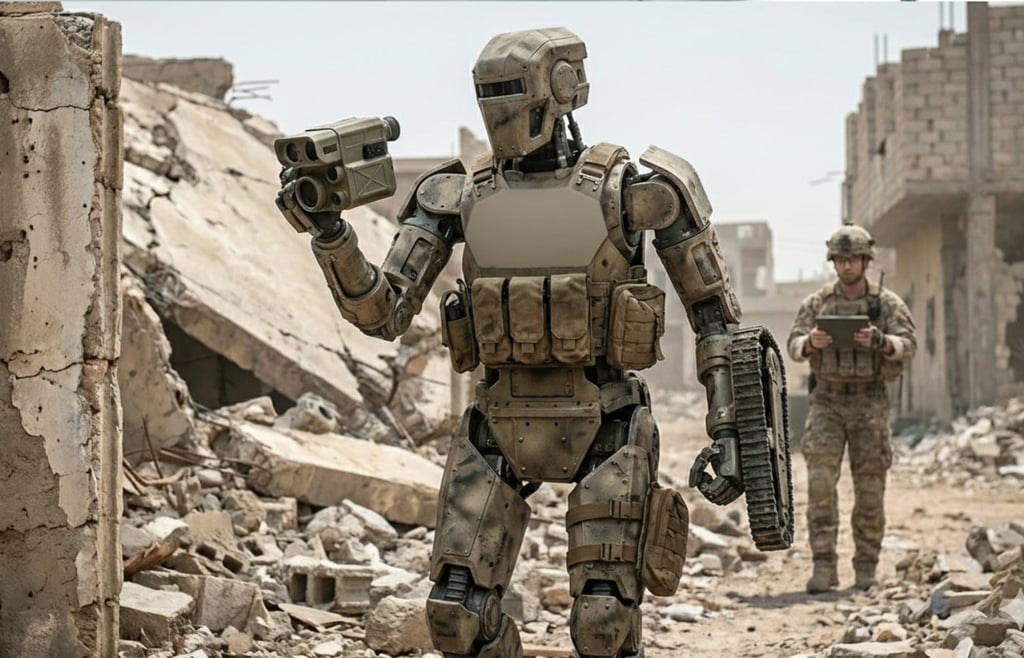


A humanoid robot built for factories is one thing. A humanoid robot built to be the “first body in” to a combat zone is something else entirely.
Robotics startup Foundation says it plans to manufacture 50,000 of its Phantom humanoid robots by the end of 2027, with some units destined for warehouses and others for the US military. At 5 feet 9 inches tall and 180 pounds, Phantom is designed to move seamlessly between domestic labor and warfare, a convergence that puts it among the most controversial machines under development today.
In a recent interview, CEO Sankaet Pathak said that Phantom is built to be the “first body in… and deadly,” though lethal decisions would remain under human control, similarly to drones currently used in military operations.
And Foundation is moving fast, claiming to have gone from founding to working production in just 18 months. The company’s rapid robotics development has been aided by the acquisition of experienced AI software teams and next-gen actuator technology, which it says have accelerated both its control systems and the physical performance of its robots.
The company, founded in 2024, aims to build about 40 robots this year, scale to 10,000 in 2026, and produce another 40,000 in 2027. Foundation intends to lease, not sell, its Phantoms for roughly $100,000 per robot per year, targeting a small number of government and enterprise customers.
Paths to war and work
Foundation’s robot ambitions are in stark contrast to other humanoid robotics firms, such as Tesla Optimus, Apptronik, and 1X, which have primarily focused on industrial and commercial use cases rather than explicitly building hardware for military use.
The company’s push into military applications raises a host of thorny issues around defense policy, ethics, and escalation risks, where deployment decisions carry stiff geopolitical consequences. At the same time, Foundation is also touting Phantoms as production workhorses to potentially carve a more conventional path to success.
If the robots perform as advertised, the implications for the industrial labor sector could be significant.
Foundation argues that a humanoid robot capable of working nearly 24 hours a day could replace three to five human workers, potentially lowering costs for factories, warehouses, and logistics operations. At near-full utilization, the company estimates saving up to $166,000 per robot per year compared to human labor. However, that figure drops to $90,000 when taking downtime and human oversight into consideration.
It is an optimistic forecast that remains unproven across the industry, where humanoid robots have still not surpassed human benchmarks in speed, dexterity, and reliability at scale. Neither Foundation nor its competitors have demonstrated sustained, human-equivalent performance in complex, real-world scenarios, where ongoing maintenance and human supervision could erode projected savings.
The case for governance
There is a reason Foundation’s Phantoms stand out in the current field of humanoid robotic invention: openly building a warbot justifiably raises ethical concerns that we are perhaps not fully ready to reckon with.
Foundation argues that their robots can reduce risks to human soldiers by handling dangerous tasks such as reconnaissance, supply transport, and building entry in war zones. Pathak has also suggested that large-scale deployment could act as a deterrent, potentially reducing the likelihood of conflict.
However, critics counter that the opposite could be true. Lowering the human cost of deployment may make military action more politically and strategically attractive, increasing the risk of escalation. Moreover, the ethical quagmire around armed humanoid systems remains unresolved, and regulatory frameworks for such technology are nearly nonexistent.
Foundation’s strategy collapses the distance between factory tooling and battlefield hardware, perhaps faster than anyone who has seen the Terminator films might be comfortable with. If humanoid robots like Phantom gain traction, the race is on to establish legal, ethical, and political frameworks to govern their use before unleashing them into contested terrain.
Robotics competition is heating up globally — one recent example is China debuting a six-armed robot.