






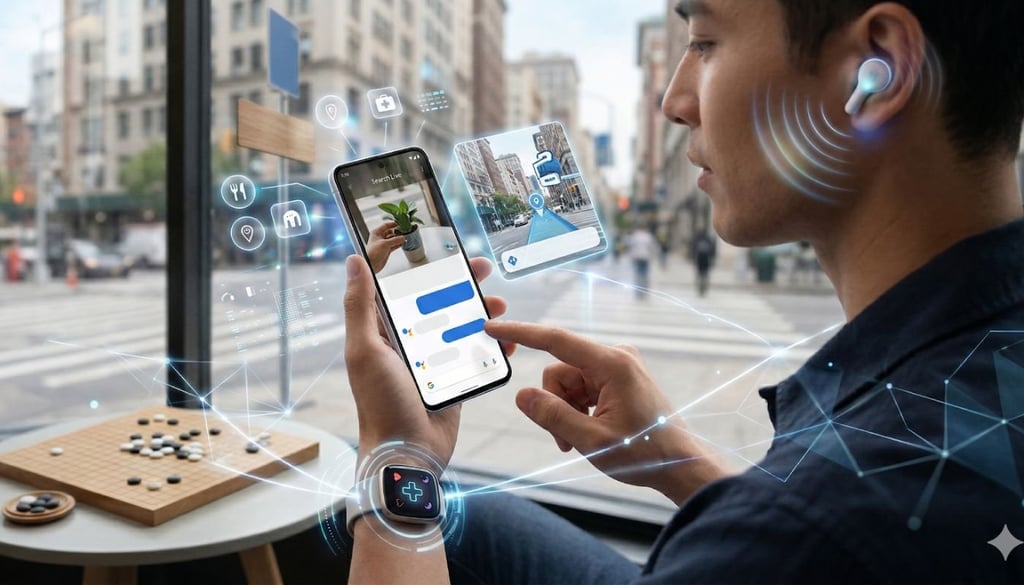


Google is making AI personal enough to live in your pocket, your headphones… and even your medical records.
Throughout March 2026, the tech giant rolled out a wave of updates aiming at turning its Gemini AI into a proactive partner rather than just a chatbot. From the global expansion of voice-activated search to vibe-coding tools that build apps from simple conversations, the month’s releases signal a pivot toward AI that understands your specific life context.
A conversational search revolution
The way we search for information is undergoing its biggest change in decades. Google has officially expanded Search Live to over 200 countries. By tapping the “Live” icon in the Google app, users can now engage in a back-and-forth voice or video dialogue to troubleshoot car engines or identify plants in real time.
Navigation is also getting a conversational makeover. A new feature called Ask Maps allows drivers to ask complex, multi-layered questions. According to the Google Blog, the tool can answer highly specific queries like, “Where can I charge my phone without a long wait for coffee?” and even handle the reservations itself. This is paired with “Immersive Navigation,” which replaces standard flat maps with real-world imagery to help reduce driver stress.
Personal intelligence and the easy switch
Google is doubling down on “Personal Intelligence,” a feature that connects Gemini to your Gmail and Photos to provide tailored advice. Whether it’s building a travel itinerary based on your flight confirmation emails or finding shoes that match your specific style, the AI is becoming more integrated into the Google ecosystem.
Recognizing that many users are already using other AI tools, Google introduced a “migration” feature. This allows new users to import their entire chat history and memory from competing AI apps directly into Gemini.
The power under the hood: Gemini 3.1
On the technical side, Google released two new models: Gemini 3.1 Flash-Lite and Gemini 3.1 Flash Live. Flash-Lite is designed for speed and cost-efficiency for businesses, while Flash Live is the engine behind the company’s new near-instant audio experiences, reducing the “lag” that often makes talking to AI feel robotic.
For creators, Lyria 3 Pro was launched, allowing musicians to generate high-fidelity tracks up to 3 minutes long with precise control over song structures such as verses and bridges. Meanwhile, developers are being introduced to “vibe coding” through the new Google Antigravity agent in AI Studio, which lets them build production-ready apps simply by describing them.
Healthcare and hardware updates
At its annual health event, The Check Up 2026, Google committed $10 million to help train clinicians for the AI era. This focus on wellness extends to the wrist, as Fitbit users will soon see a “personal health coach” in public preview, capable of connecting to medical records to provide advice on sleep and nutrition.
The March Pixel Drop rounded out the month, introducing “Circle to Search” updates that can break down an entire fashion outfit from a single photo and “Magic Cue,” which automatically suggests restaurants within your chat threads.
A decade of AlphaGo
Finally, Google took a moment to look back at its roots, celebrating the 10th anniversary of AlphaGo’s victory over a world champion. The company credits that breakthrough as the “foundational spark” for its current successes in protein folding and scientific discovery, proving that the complex algorithms once used to play games are now solving the world’s most difficult physical challenges.
For more on Gemini’s new migration feature, read how Google now lets users import ChatGPT and Claude data.