






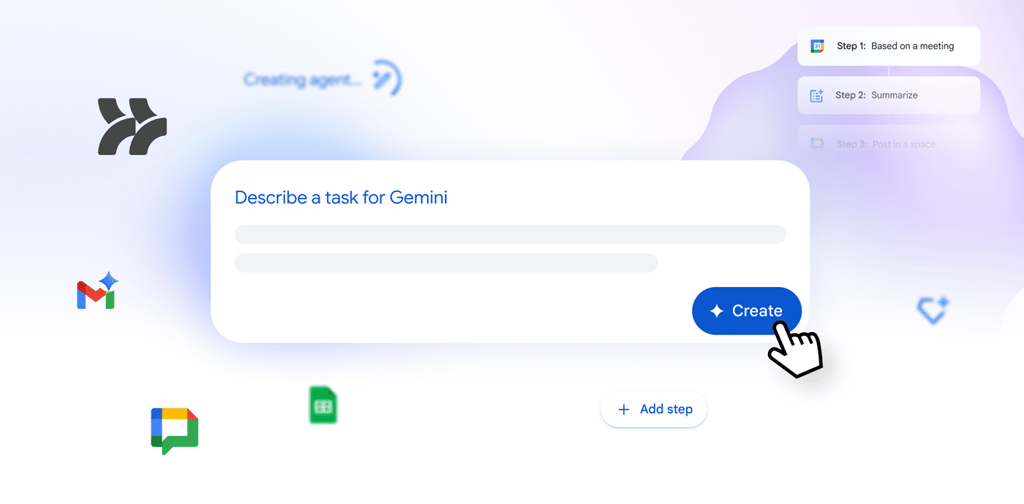


Are manual tasks a thing of the past? Google reckons it could be.
The tech giant has officially launched Google Workspace Studio, a new platform designed to let employees across organizations build, manage, and share AI agents that automate everyday workplace tasks.
The company says the system, powered by Gemini 3’s multimodal reasoning capabilities, will allow users with no coding experience to create agents in minutes, enabling businesses to streamline communication, operations, and decision-making.
Workplace AI automation
Today’s (Dec. 4) announcement reflects a growing trend in enterprise software: giving workers tools to delegate repetitive digital work to AI systems. For years, organizations have struggled with automation platforms that required technical expertise, rigid workflows, and extensive setup time. Google argues that Workspace Studio removes these barriers by placing AI-driven automation directly inside Gmail, Drive, Chat, and other Workspace apps.
As Google put it, “we’re bringing custom agents directly into Workspace with Studio – so you can delegate these repetitive tasks to agents that can reason, understand context, and handle the work that used to slow you down.”
This signals a shift from rule-based automation to systems capable of contextual reasoning and natural language understanding.
For enterprises, the implications are significant. If widely adopted, Workspace Studio could reduce the operational burden on support teams, accelerate project workflows, and centralize knowledge that typically gets lost in email threads and meetings.
Critics could argue that more job cuts will be on the way, and the workers who are left with jobs will be expected to do more as they are using AI tools.
The move also positions Google strongly against competitors building agentic AI ecosystems aimed at the enterprise market.
How Workspace Studio works
Workspace Studio allows users to design automations by describing their goals in natural language. Gemini 3 converts these descriptions into multi-step agents capable of scanning emails, extracting information, triggering notifications, generating content, and coordinating tasks across a range of connected apps.
For example, users can prompt, “If an email contains a question for me, label the email as ‘To respond’ and ping me in Chat.” Studio then builds an agent capable not only of detecting questions, but also extracting details such as invoice numbers or requested actions.
In addition to text-based design, users can start from templates for common workflows. Agents can also be shared across teams, reinforcing Google’s framing of the platform as collaborative, not individual.
This approach could shift how employees interact with enterprise software. Rather than manually configuring triggers or coding workflows, workers can design operational logic in conversational language, potentially lowering barriers to automation inside companies that previously lacked the resources or expertise to build such systems.
Early adoption
One of the first companies to trial Workspace Studio was Kärcher, the global cleaning solutions manufacturer. Their digital platforms team used Studio to overhaul how they evaluate new feature ideas. Previously, the process depended on meetings, notes, and extensive manual consolidation.
Kärcher now deploys a “virtual team” of AI agents triggered when a new idea is proposed in Chat. A brainstorming agent assesses the idea’s merit, a technical agent performs feasibility checks, a UX agent drafts potential user flows, and a final agent creates a consolidated user story. According to Google, “This has reduced their drafting time by 90%, turning hours of manual consolidation into a ready-to-review plan in just two minutes.”
Such gains suggest that agentic workflows could become a new layer of digital teamwork, reducing the overhead of collaboration and enabling faster iteration cycles.
Google reports a strong uptake among organizations participating in the Gemini Alpha program. Over the last 30 days, users have relied on Workspace Studio agents for more than 20 million tasks. These range from basic reminders and status updates to more complex operations such as triaging legal notices and managing internal travel requests.
The company emphasizes that the people creating these agents are not developers. “What these agents — whether they have two steps or 20 — all have in common is that they’re built by the people who know the problems best.” This reflects Google’s broader strategy to democratize AI creation and expand the number of employees capable of building automated workflows.
Integration across the ecosystem
Workspace Studio agents operate across Gmail, Drive, Chat, Calendar, and other Workspace apps. Because they have access to the context of a user’s work, they can personalize content, match organizational policies, and surface relevant insights. Users can monitor agent activity directly within side panels, making AI behavior more transparent and easier to manage.
For more advanced needs, Google supports extensibility through pre-built integrations with Asana, Jira, Mailchimp, Salesforce, and others. Technical users can add custom logic using Apps Script or connect agents with internal tools and proprietary models via Vertex AI. This ensures that Studio can serve both non-technical employees and power users who require deeper customization.
Rollout timeline
Google will distribute Workspace Studio to business customers in the coming weeks. Once available, users can begin by selecting a template or typing instructions into the prompt bar. Google is also encouraging organizations to join its Gemini alpha program for early access to experimental functions and administrative controls.
The launch underscores Google’s accelerating investment in AI-powered productivity tools and its belief that agentic workflows will define the next era of workplace software. As businesses navigate rising workloads and distributed teams, platforms like Workspace Studio may play a central role in reshaping how operational tasks are managed and automated.
AWS was busy and dropped 50+ AI announcements at re:Invent.