







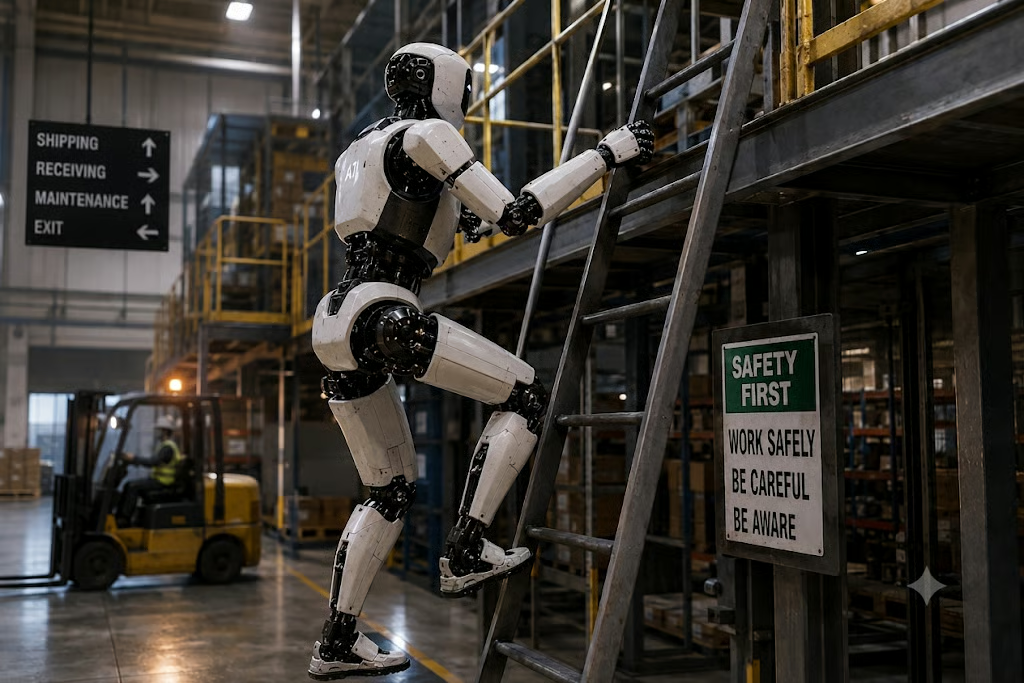
Humanoid robots can run, dance, and climb for the camera. The harder test is whether they can repeat those feats safely when nobody is editing the video.
Factories, warehouses, and office buildings contain stairs, ladders, doorways, uneven surfaces, and people moving in unpredictable directions. Every feature reflects the proportions and abilities of the human body. Humanoid robots are designed to navigate those same spaces. Their form could allow them to move between work areas, use existing equipment, and complete several tasks without extensive changes to a facility.
That promise depends on perception, balance, coordination, and recovery. A missed step or poorly judged surface can quickly turn a routine task into a safety incident.
Why human workplaces are difficult for robots
Factories, warehouses, construction sites, offices, and homes were designed around the human body.
Door handles sit at hand height. Stair treads accommodate human feet. Ladders assume two hands, two legs, and a familiar range of motion. Shelves, tools, carts, and safety equipment follow the same physical template.
That is the central argument for humanoid robots. A machine shaped like a person may be able to work in existing buildings without forcing companies to redesign every workstation, doorway, and aisle.
Boston Dynamics makes this case with its electric Atlas humanoid robot, which is being developed for industrial material handling. Agility Robotics is pursuing a similar goal with Digit, a bipedal robot built for repetitive logistics work.
The engineering is far from simple.
A warehouse floor may include loose packaging, oil, ramps, cables, moving equipment, and people who do not follow predictable paths. A ladder raises the difficulty further. The robot must identify individual rungs, coordinate all four limbs, track its center of mass, and correct small errors before they become a fall.
Researchers behind the LadderMan humanoid climbing system, described in an arXiv preprint, used imitation learning, reinforcement learning, depth perception, and simulation-to-real-world transfer to address those challenges.
Climbing is not walking turned sideways. It is a chain of physical decisions in which one mistake can bring the entire machine down.
How humanoid robots understand where to move
Humanoid mobility depends on a continuous loop between perception, planning, and physical control.
Cameras and sensors collect information about the surrounding environment. Software estimates distance, identifies obstacles, and determines where the robot can safely place its hands and feet. Motors execute the movement while onboard systems monitor balance.
The robot also relies on proprioception, its internal awareness of joint position and body orientation, to understand what its limbs are doing.
Figure describes Helix as a vision-language-action system that handles perception, reasoning, and movement onboard the robot. Rather than following only fixed programmed motions, Figure says the system can select actions based on what it sees.
A scripted robot might climb one ladder in a known position. A more capable system would need to recognize an unfamiliar ladder, estimate its dimensions, align its body, and adjust when the real object differs from its training data.
Figure's Figure 03 announcement says the robot includes upgraded vision, tactile sensing, palm cameras, and hardware designed around Helix.
Those features do not prove reliability, but they show where the industry is heading. Humanoid companies are competing to connect perception, reasoning, and movement into one dependable system.
The mobility skills robots still need
Ladder climbing attracts attention because the danger is obvious. Less dramatic movements may matter more in real deployments.
Robots must walk across uneven or slippery floors, descend stairs, recover from balance failures, carry shifting loads, and move safely around people.
The National Institute of Standards and Technology studies how mobile robots perform in dynamic, unstructured environments filled with obstacles, changing conditions, and unexpected disturbances. Its mobility performance research focuses on measuring stability, adaptability, efficiency, and task performance under repeatable test conditions.
NIST's broader robot mobility test methods evaluate repeated performance across ramps, steps, inclined surfaces, and other terrain. Many of those methods were originally developed for remotely operated emergency-response robots, but their emphasis on repeatable trials offers a useful model for evaluating humanoid systems.
A polished demonstration can show that a task is possible. Repeated testing shows whether the capability is dependable.
How to evaluate a humanoid robot demonstration
Robot videos are useful evidence, but they are incomplete evidence.
A demonstration can establish that a machine performed a task under the conditions shown. It may not reveal how many attempts failed, whether the environment was mapped beforehand, or whether a human could intervene remotely.
Before treating a dramatic capability as deployment-ready, businesses should ask:
- How many attempts were made, and what percentage succeeded?
- Was the environment mapped or rehearsed in advance?
- Could a human take control?
- Can the robot carry a realistic load?
- What happens if it slips or loses visibility?
- Can it perform the task at a commercially useful speed?
- How often does it require maintenance or assistance?
- What is the total cost per productive hour?
NIST is developing a humanoid robot baseline performance benchmark intended to create common tests for commercially available robots.
The proposed benchmark includes locomotion, manipulation, confined-space movement, whole-body control, and limited reasoning tasks. Such standards could help separate engineering progress from demonstration theater.
Where humanoid robots may earn their cost
The most credible early applications involve repetitive, physically demanding, difficult-to-staff, or hazardous tasks. These may include moving materials, feeding production lines, inspecting equipment, unloading containers, and entering dangerous areas.
BMW has tested Figure robots in automotive production and is expanding its work with Figure 03. As eWeek reported in its coverage of BMW's humanoid robot deployments, these projects require workflow integration, production data, monitoring, safety systems, and coordination between IT and operations.
For enterprises, the key question is not whether a humanoid can theoretically perform a job. It is whether the robot can produce enough measurable work to justify its cost, risk, downtime, and integration burden.
A wheeled robot may be faster for moving goods across a flat warehouse. A fixed robotic arm may be safer at a single workstation. Humanoid form becomes most valuable when one machine must move between different human-designed spaces and perform several kinds of work.
That promise remains compelling. It also remains largely unproven at scale.
Safety may become the real deployment gate
Humanoid robots are designed to move through spaces occupied by people. That flexibility creates much of their value, but it also changes the safety problem.
The Occupational Safety and Health Administration's robotics guidance notes that robots can reduce exposure to dangerous or repetitive work while introducing hazards of their own, especially during setup, testing, maintenance, and adjustment.
Businesses must understand what happens if a humanoid loses connectivity, drops a load, misses a step, or detects a worker too late.
A full-size robot combines weight, speed, hard components, and moving joints. Reliability is therefore not only a performance metric. It is a workplace safety requirement.
What these capabilities mean for businesses
Humanoid robots are entering the least cinematic stage of technological development: proving that they can work reliably on ordinary days.
Advanced mobility could allow one robot to reach places that wheeled machines and fixed robotic arms cannot. A humanoid capable of navigating stairs, ladders, narrow passages, and uneven floors could move between several jobs without requiring a company to rebuild the workplace around it.
That flexibility may be valuable in manufacturing, logistics, utilities, construction, and facilities management. Humanoid robots could inspect hard-to-reach equipment, carry tools into hazardous areas, or perform work that exposes employees to falls, heat, chemicals, or repetitive strain.
But mobility is only one part of the deployment equation. Technology and operations teams would also need to provide secure network coverage, integrate robots with existing systems, manage software updates, control access to commands, and establish procedures for human supervision.
Before moving beyond a pilot, businesses should understand what data the robot collects, who can take remote control, what happens if connectivity is lost, and how often the machine requires assistance.
The viral videos show what humanoid robots can do at their best. For businesses, the real breakthrough will come when those machines can deliver measurable value when the floor is wet, the load shifts, and the camera keeps rolling.
Also read: For more on the growing security concerns surrounding connected robots, read our coverage of the FCC's move to restrict certain foreign-made robots and power inverters over cybersecurity risks.