






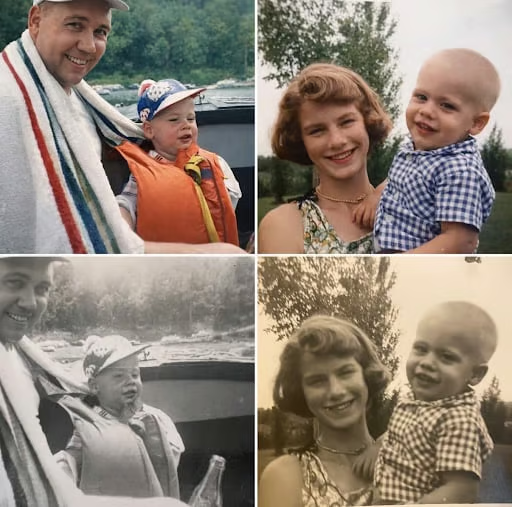


You found an old family photo. It’s faded and scratched. It looks like it survived a minor flood. But is it toast? Not anymore.
The good news: ChatGPT and Google Gemini can now colorize and gently restore old photos in seconds. No Photoshop, plugins, or PhD required.
Bad news: if you’re sloppy, the model will happily “improve” your relatives into people you don’t recognize. The key is careful restraint.
Here’s how to do it right.
Step 1: Give the AI something worth working with
Visit your parents and find that musty shoebox full of mid-20th century photos. It’s important to start with the best input possible.
If you have access, scan them at 300-600 DPI. If you don’t have a scanner, a clear, straight-on, glare-free photo will do just fine. (This is what we did for the images you see saw above).
You don’t need perfection. But clarity matters. Garbage in still gets you… slightly better garbage out.
Step 2: Add a few minor constraints
You’re asking the model to restore, not reinvent. Use a constraint-first prompt like this (copy / paste):
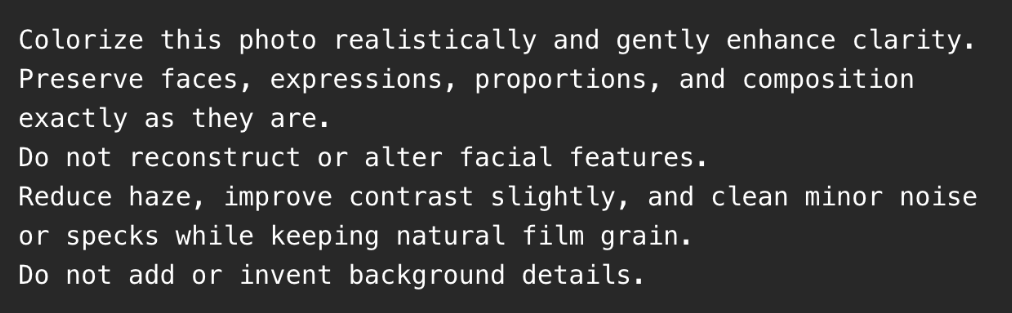
Skip this, and the model will confidently ship you an alternate-universe family.
Step 3: Iterate (subtlety always wins here)
First pass too intense? Say so.
- “Reduce saturation by ~10% and soften sharpening.”
- “Restore texture and grain, especially on faces.”
- “Avoid smooth or plasticky skin.”
The goal is to gently tweak your image, without reworking the photo’s content.
A quick Gemini-specific tip
Gemini behaves best with extra guardrails:
- Explicitly say do not change faces, framing, or background.
- Call out hallucinations directly—it usually corrects itself.
This process works surprisingly well. It can do it with fewer prompts than the one above, but having some minor constraints seemed to increase the quality a bit more. With ChatGPT Image (OpenAI’s latest image model), I didn’t spot any awkward artifacting or bizarre color choices.
You will notice in the image of the man and boy in the boat that there is an odd spot around the lifejacket between the two subjects. However, in the original image, that bright spot was present, so it’s likely the model didn’t have enough data in that region and had to interpret it.
Once you’ve done a few of these, share them with your family and blow their minds. They’ll think you’re a wizard.
Editor’s note: This content originally ran in the newsletter of our sister publication, The Neuron. To read more from The Neuron, sign up for its newsletter here.