






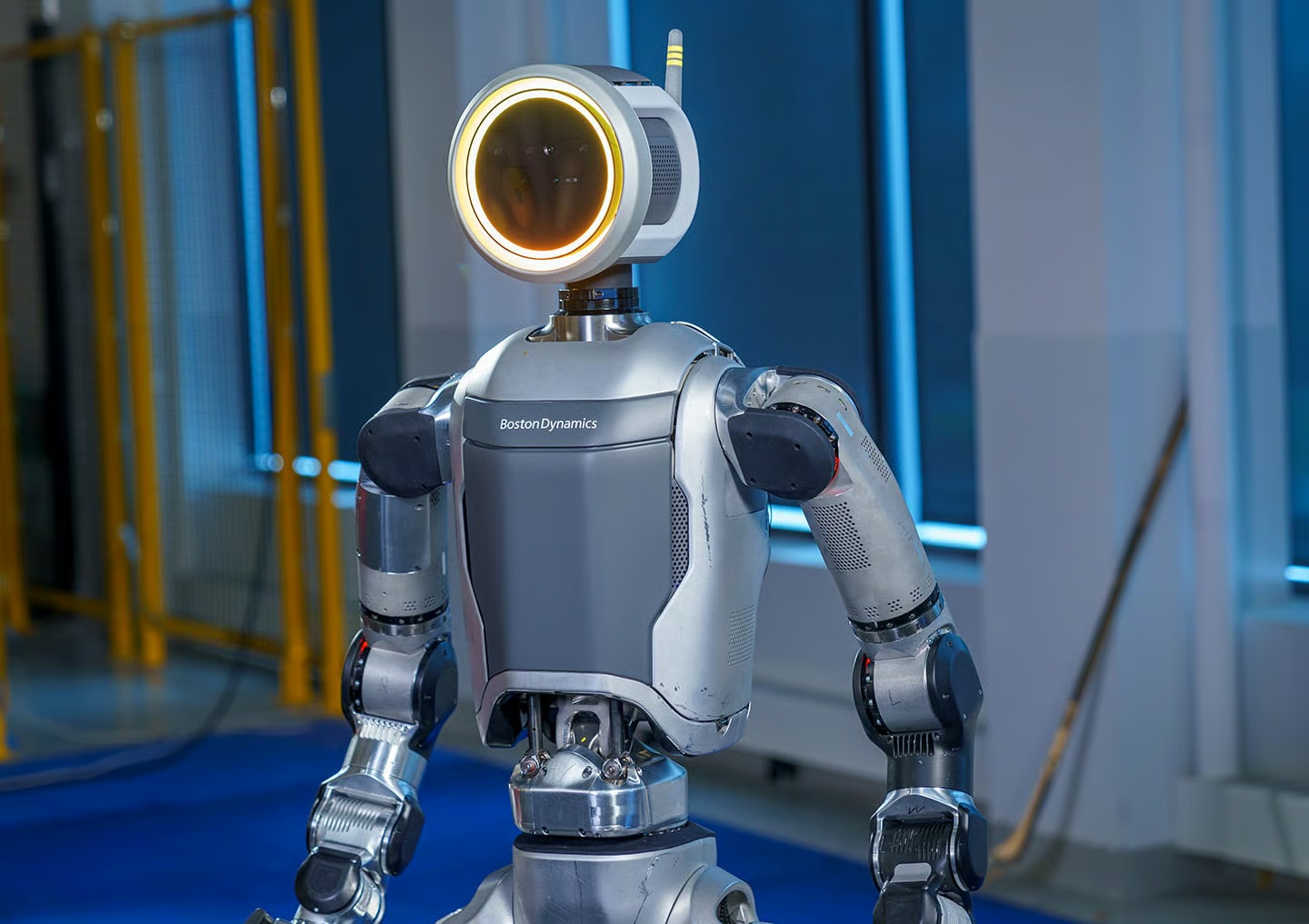


Hyundai’s next factory workers may not need hard hats.
The company is preparing to deploy more than 25,000 Atlas-based humanoid robots across its manufacturing operations, according to reports from Yonhap News Agency. The effort is expected to begin at Hyundai’s Georgia Metaplant in 2028 before expanding to Kia’s Georgia plant in 2029.
For Hyundai, the rollout is not just a robotics flex. It is a test of whether humanoid robots can perform useful, repetitive, physically demanding work at an industrial scale, and whether Boston Dynamics’ Atlas can become more than the internet’s favorite backflipping machine.
What will the robots do?
The robots, developed by its US robotics arm Boston Dynamics, are based on the Atlas humanoid platform and are expected to take on physically demanding factory tasks such as lifting, moving parts, and handling logistics.
The plan was outlined during recent investor relations sessions hosted by JPMorgan Chase, where Hyundai detailed its long-term physical AI strategy that blends artificial intelligence with real-world robotics systems, according to reports from Yonhap News Agency.
Hyundai is no longer positioning itself strictly as an automaker. Instead, it is shifting toward becoming a mobility and AI-driven technology company. The company has set an annual production goal of around 30,000 Atlas humanoid robots by 2028. From that output, the company plans to deploy more than 25,000 units inside its own manufacturing ecosystem.
According to Yonhap, the rollout is expected to be gradual, allowing Hyundai to collect operational data, improve safety systems, and refine robot performance before wider deployment.
Building the robot supply chain
To support mass production, Hyundai is also investing heavily in core robot components, particularly actuators, the mechanical systems that function like joints and muscles. The company plans to produce more than 300,000 actuator units annually at US-based facilities.
These components are expected to be central to both performance and cost reduction as production scales up, since actuators account for a large share of humanoid robot manufacturing costs. Before full-scale deployment, Hyundai is already experimenting with robots in controlled environments.
The company has introduced service-style robots for tasks like security, delivery, and facility management at its renovated headquarters in Seoul, using the site as a real-world testing ground.
Hyundai is also preparing to launch a Robot Metaplant Application Center in the United States, which will train robots using AI systems developed with Google DeepMind, according to investor briefings reported by Yonhap.
Technology behind Atlas
The Atlas humanoid robot has recently demonstrated advanced physical capabilities, including lifting and transporting heavy objects such as refrigerators. Boston Dynamics says the system relies on reinforcement learning and large-scale simulation training, allowing the robot to practice millions of task variations before real-world deployment.
Unlike many humanoid systems, Atlas also uses proprioception, internal sensing of balance and movement, to adjust in real time when handling unstable loads. Hyundai’s push places it in direct competition with other major players, including Tesla, which is also developing its own humanoid robot program.
However, industry analysts say Hyundai’s strategy is more focused on industrial use inside factories, while competitors like Tesla are targeting broader applications beyond manufacturing. The key goal for Hyundai is not just innovation, but cost efficiency, using factory-scale deployment to reduce production costs and prove the commercial viability of humanoid robotics.
Also read: Figure’s Helix-powered humanoid robots worked more than 17 hours and handled more than 22,000 packages.