








Samsung Electronics is done treating robots as a side project.
The South Korean tech giant announced Tuesday that it's launching a new division called RX, short for Robotics eXperience, that will report straight to co-CEO Roh Tae-moon.
The move pulls together robotics work that had been scattered across different teams at Samsung — hardware, AI, software and product planning — into one unit with a single chain of command.
Samsung described the reorganization as a way to move faster. "The RX Business Promotion Office, launching as a unit directly under the CEO, will accelerate technology development based on swift decision-making and execution, while responding nimbly to market changes to create business opportunities," the company said, according to BigGo Finance.
Leading the strategy team is Executive Vice President Lee Dong-kun, who joined Samsung in May after leading robotics strategy at Hyundai Motor Group, where he helped guide Boston Dynamics.
Samsung also recruited two university professors: Kim Hyoun-jin of Seoul National University, an expert in autonomous robot control, and Kim Ui-kyum of Ajou University, who specializes in robotic hands, widely seen as one of the toughest engineering problems in building a humanoid.
Factories first, homes later
Samsung's plan unfolds in stages. It's building a research hub at its Seoul campus and a data factory at its Gumi plant to collect the real-world data needed to train robots. It also plans research centers in the U.S., China and Japan.
The company aims to turn its own production lines into AI autonomous factories by 2030, deploying manufacturing and logistics robots before eventually branching into homes and retail stores, according to Android Headlines.
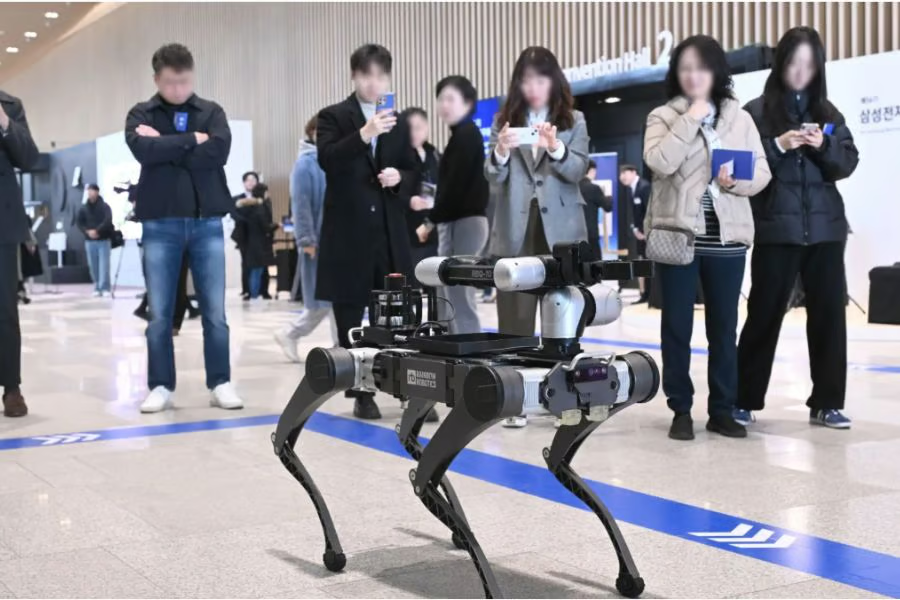
The effort builds on Samsung's growing stake in Rainbow Robotics, the Korean robotics maker it began investing in back in 2023 and later folded in as a subsidiary.
Reading between the lines
Samsung's timing isn't an accident.
Its mobile and appliance businesses have been squeezed by price competition and a maturing smartphone market, so robotics offers a fresh growth story at a time when investors are looking for one. Samsung shares climbed roughly 6% after the announcement, according to Silicon Republic.
Hiring Hyundai's former Boston Dynamics strategist also nods to Samsung's actual advantage: it's not starting from scratch on hardware. Between chips, sensors and displays, Samsung already makes most of the parts a humanoid needs, something rivals building robots from the ground up don't have.
What could go wrong
None of this guarantees a working humanoid anytime soon. Samsung hasn't announced a commercial model, and its record with consumer robotics is mixed; its home robot Ballie missed its planned launch and was quietly repurposed as an internal test platform.
The company also faces stiff competition from Tesla, Hyundai-owned Boston Dynamics and a wave of Chinese startups all chasing the same market.
For a company that spent decades defined by chips and phones, betting big on machines that walk and grip is a real strategic pivot.
Also read: Hyundai workers in South Korea demanded job protections before Atlas humanoid robots enter factories, highlighting the labor questions that can follow industrial robotics plans.