








Allow us to reframe the current moment: for the last 15 years, we’d argue we have lived in the “Read/Write” era of technology. You tap a glass screen, you open an app, you press buttons, and you get a result.
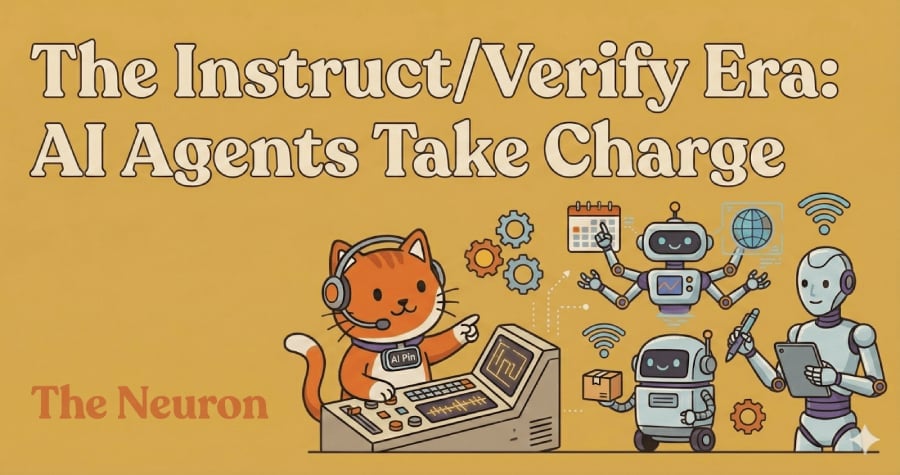
But reports from both China and Silicon Valley yesterday confirm that 2026 is the year we switch to what we’re calling the “Instruct/Verify” era: where the primary interaction paradigm is you tell an AI what you want, and it goes and does it for you.
This shift is happening in two massive waves: Software in the East and Hardware in the West.
You’ll be excused if you thought it was in reverse, because I’m not talking about the frontier-level progress (where Western AI labs are pioneering top-tier AI models, and Chinese labs are mass-producing robotic hardware at scale). In this case, I’m talking about the application layer. And actually, more concretely, I’m talking about the death of the app as a standalone “app.”
Okay, death of the app might be a bit dramatic. But what I’m talking about is the evolution of the Super App into its final, most powerful form: The Operating System.
This is happening in two shifts: interface and distribution
1. The Interface Shift (The “Super App” becomes the OS): In the old “Read / Write” era, a Super App was a cluttered screen with 1,000 mini-app icons (Ride Hailing, Food, Payments). It was messy.
In the new “Instruct / Verify” era, the “Super App” is simply a single chat window (or a real-world chat voice). This will need some kind of canvas. We like structure, so it won’t necessarily be an infinite canvas, but that’s what makes sense to me.
Something akin to an infinite canvas where you can create your own generative UI on the fly, or stick with your preset favorites (or the defaults of the application creators).
2. The Distribution Shift (The “App Store” becomes the “Agent Store”): If the interface is a conversation, then “Apps” are no longer icons you download; they are skills you hire.
- The Old Way: You go to the App Store, download “Expedia,” create an account, and tap buttons.
- The New Way: You go to the “Agent Store” (likely controlled by Apple, OpenAI, Google, or Tencent) and “enable” the Expedia Agent.
- The Interaction: Now, when you tell Siri or WeChat “Book a trip,” your main Super App delegates the task to the Expedia Agent in the background.
The Result: The “Super App” essentially becomes the browser and the OS for your entire digital life.
Now here’s the hard evidence for this paradigm shift
First, the “Software Agent” Shift (China): According to a new CNBC report, Chinese tech giants Alibaba, Tencent, and ByteDance are aggressively pivoting from “Super Apps” to “Agentic Commerce.”
- Alibaba (Taobao): Is integrating its Qwen models to handle complex tasks like “Plan a birthday party for under $200,” automatically finding items, applying coupons, and arranging shipping.
- Tencent (WeChat): Is deploying “smart agents” that automate booking and payments directly in the chat stream, removing the need to click through mini-app menus.
OpenAI’s attempt to launch apps on ChatGPT is the West’s version of this. You can test this in action when you enable these apps: instead of opening the Canva app, you call the Canva agent when you want to make a presentation.
Second, the “Hardware Agent” Shift (USA): While China reinvents the software, the US is trying to kill the screen entirely. Consider the newfound rivalry between OpenAI and Apple on voice-first hardware designs:
- Apple’s AI Pin: Mac Rumors via The Information reports that Apple is developing an AirTag-sized wearable with multiple cameras and microphones. It’ll be a “Siri-first” device designed to act as a visual assistant that sees what you see.
- And then there’s the New Siri: Mark Gurman at Bloomberg reported that iOS 27 will overhaul Siri into a “ChatGPT-like chatbot” powered by Google Gemini, capable of handling complex, multi-step actions.
- OpenAI x Jony Ive: OpenAI confirmed its new hardware device is “on track” for a late 2026 reveal. Rumors suggest it’s an audio-first, screen-free wearable (thecodenamed “Sweetpea”) designed to reduce screen time.
And then there is the physical body of the Agent: Yesterday, Microsoft released “Rho,” a new AI model designed specifically for robots.
- The Novelty: Rho is what Microsoft calls a “VLA+” model (Vision-Language-Action + Touch). It gives robots a sense of touch, allowing them to adjust their grip when they feel resistance.
- The Learning: Unlike older robots that needed perfect code, Rho learns from “Course Correction.” If it fails, a human can nudge it with a joystick, and the model learns from that specific intervention instantly.
Why this matters
We are entering a weird phase where technology is about to become less like a tool you use (a hammer) and more like, and this is weird, a pet you command (a dog). We won’t call these things full humans yet; “pets” sounds closer.
The weird part is that this will change the way we interact with technology; as we said above, instead of reading and writing, we’ll be talking to our tools as if they were another being, and they’ll…talk back.
Not just via chat, or via voice, but with physical bodies, too. Remember this little Disney robot always kicking it with Jensen Huang? There’ll be a lot more things like this, walking around our environment, doing things for us, or interacting with us directly (like, idk, say, a pen you talk to?).
Whether it’s a Disney or Microsoft Rho bot in your kitchen, an OpenAI pen in your palm, or a thousand agents in your agent store (stall?), the result is the same: We are soon about to stop looking at screens all the time, and instead get back to interacting in the real world.
Editor’s note: This content originally ran in the newsletter of our sister publication, The Neuron. To read more from The Neuron, sign up for its newsletter here.