






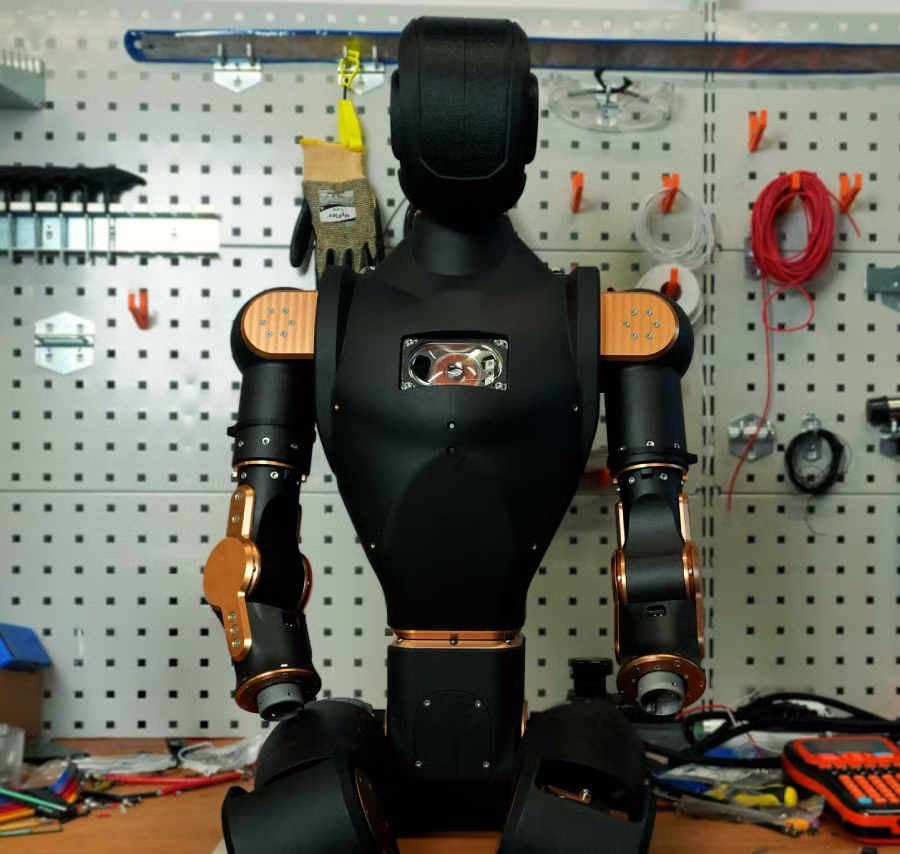


Singapore-based Menlo Research has introduced a new DIY version of its open-source humanoid robot, Asimov, aimed at developers, robotics enthusiasts, and research teams who want to experiment with humanoid machines without spending millions of dollars.
The robot, called the “Here Be Dragons Edition,” comes as a completely unassembled kit with a target price of $15,000.
According to the company, the package includes the structural frame, actuators, motors, sensors, wiring harnesses, assembly manuals, and instructional videos needed to build the humanoid from scratch.
On its website, the company describes the project as being built for “those who want to build a humanoid robot from scratch” and says the engineering team will assist builders through Discord support channels.
The robot stands 1.20 meters tall, weighs 35 kilograms, and features more than 25 degrees of freedom. Menlo Research says some of the robot’s arm components are powerful enough to handle roughly 15-kilogram bicep curls and 18-kilogram lateral raises.
Open-source design focuses on customization
Unlike polished consumer robots, Asimov is positioned as a flexible research platform that users can modify freely. Menlo Research compares the concept to platforms like Raspberry Pi and Arduino, but for humanoid robotics.
The company says the robot uses off-the-shelf components alongside 3D-printable parts, making repairs and upgrades easier for builders. According to Humanoids Daily, the humanoid’s modular architecture allows users to swap out arms, legs, torsos, and heads without redesigning the entire machine.
Most of the structural components are optimized for Multi Jet Fusion 3D printing, reducing reliance on expensive CNC manufacturing while lowering replacement costs.
The robot also uses a parallel Revolute-Spherical-Universal ankle system designed to improve torque distribution and movement on uneven surfaces. Instead of powered toes, Asimov relies on passive articulated toe joints to help maintain traction and balance while reducing mechanical complexity.
Software built around real-world imperfections
Beyond the hardware, the project also places heavy emphasis on simulation-based robotics training.
According to Humanoids Daily, Asimov’s software stack uses what the company calls a “Processor-in-the-Loop” simulation system. Rather than training robots in perfect virtual environments, the system intentionally introduces messy real-world problems like communication delays and noisy sensor data.
The setup reportedly simulates CAN Bus delays of up to nine milliseconds while injecting sensor noise through an I2C emulation layer.
The robot is trained using an asymmetric actor-critic reinforcement learning model, in which one system receives accurate simulation data while the operational system operates with delayed and imperfect information, reflecting real hardware conditions.
Navigating the robotics market
At $15,000, the Asimov kit sits in a precarious middle ground between hobbyist toys and multi-million-dollar industrial platforms. It is notably more expensive than the $8,999 K-Bot Founder’s Edition previously offered by K-Scale Labs.
However, the robotics industry is still reeling from K-Scale’s recent shutdown, triggered by its failure to secure funding to scale up high-capital-expenditure manufacturing.
By keeping the robot open-source, selling close to the bill-of-materials cost, and utilizing 3D-printable designs, Menlo Research appears to be intentionally avoiding the high-volume tooling trap that led to their competitor’s collapse.
Also read: China is preparing robot ID rules as humanoid machines move closer to factories, public spaces, and regulated use.