






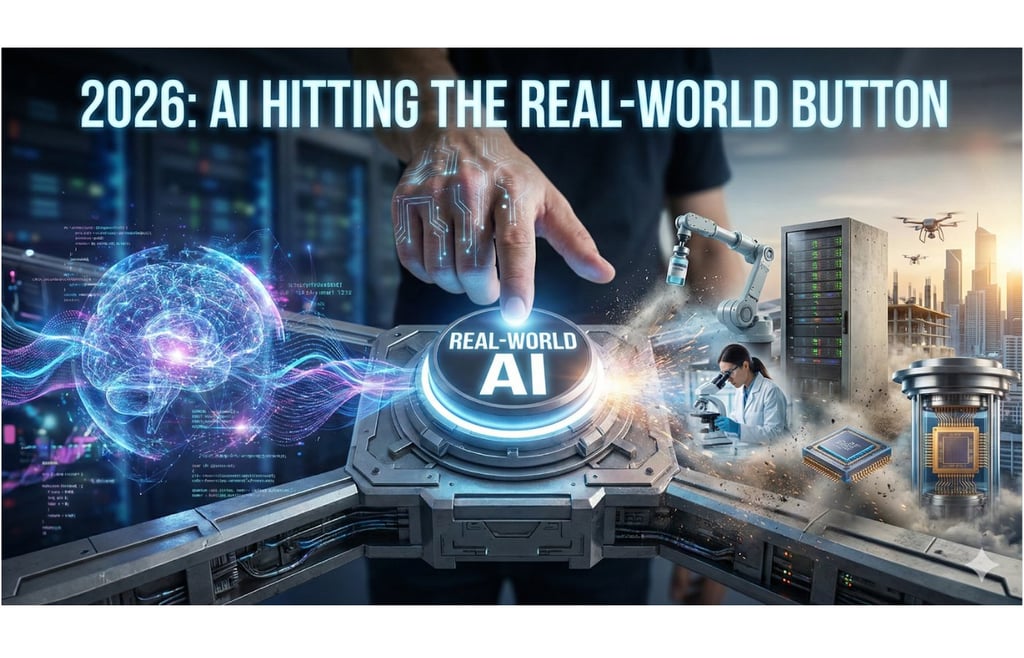


If 2025 felt busy for artificial intelligence, Microsoft says 2026 will feel like AI hitting the “real-world” button.
In a new outlook, the company highlights seven major trends it believes will define the next stage of AI adoption, touching everything from healthcare and research to software development and quantum computing.
AI becomes a true partner, not a replacement
Microsoft says AI’s role at work is shifting from answering questions to helping people do more together. Aparna Chennapragada, the company’s chief product officer for AI experiences, says the focus next year will be on collaboration between humans and AI.
“The future isn’t about replacing humans,” she says in Microsoft’s report. “It’s about amplifying them.” She adds that teams who learn to work with AI “will get the best of both worlds.”
Security becomes non-negotiable for AI agents
As AI agents become more common in workplaces, Microsoft stresses that trust and security must grow alongside them.
Vasu Jakkal, Microsoft’s corporate vice president of Security, warns that all AI helpers in an organization should be treated with the same safeguards as human staff. “Every agent should have similar security protections as humans,” she says, adding that without proper controls, agents could become “double agents” if compromised. “Trust is the currency of innovation,” Jakkal says.
Closing the health gap
Microsoft believes AI could help ease pressure on health systems globally. Dr. Dominic King, vice president of health at Microsoft AI, said the role of AI in medicine is expanding quickly. “We’ll see evidence of AI moving beyond expertise in diagnostics and extending into areas like symptom triage and treatment planning,” he said.
King highlighted Microsoft’s Diagnostic Orchestrator (MAI-DxO), which demonstrated 85.5% accuracy in solving complex medical cases. He noted that this progress is arriving at a moment when the global need is severe and growing.
AI steps into the research lab
Peter Lee, president of Microsoft Research, described 2026 as a turning point for scientific discovery. He said AI will not only help summarize research but will also participate in discoveries. In his words, “AI will generate hypotheses, use tools and apps that control scientific experiments, and collaborate with both human and AI research colleagues.”
This, he said, is leading toward an era where researchers can rely on AI assistants that suggest experiments and even help carry them out, speeding up progress across fields like climate science and molecular research.
AI infrastructure becomes smarter, not just bigger
Mark Russinovich, chief technology officer and deputy chief information security officer for Microsoft Azure, said the race to build bigger data centers is over. What matters next, he said, is efficiency. “The most effective AI infrastructure will pack computing power more densely across distributed networks,” he said.
Russinovich added that AI systems will start operating more like an air-traffic control network, moving workloads around so no computing power goes to waste. He emphasized that AI will be “measured by the quality of intelligence it produces, not just its sheer size.”
AI that understands the ‘why’ of code
Microsoft’s rundown also highlights a shift happening inside software development. GitHub’s chief product officer, Mario Rodriguez, said next year will emphasize “repository intelligence.” He explained that this refers to AI that not only reads code but also understands its history and structure, leading to better suggestions and fewer errors.
This context allows it to make smarter suggestions and catch errors earlier, promising higher-quality software built at a breakneck pace.
“It’s clear we’re at an inflection point,” Rodriguez said, predicting that this deeper context will create “smarter, more reliable AI” that supports developers.
Quantum computing steps into ‘years, not decades’ era
Quantum computing may be closer than many expect. Jason Zander, executive vice president of Microsoft Discovery and Quantum, says the world is entering a “years, not decades” timeline for machines capable of surpassing classical computers.
Zander says, “Quantum advantage will drive breakthroughs in materials, medicine, and more. The future of AI and science won’t just be faster, it will be fundamentally redefined.”
He highlights the rise of hybrid systems where AI, supercomputers, and quantum work together. Microsoft’s Majorana 1 chip, using topological qubits designed for error correction, is positioned as a major step forward.
Also read: AI tools now help professionals learn new skills faster, demonstrating how adaptive platforms leverage personalized feedback and multimodal models to accelerate training and retention.