






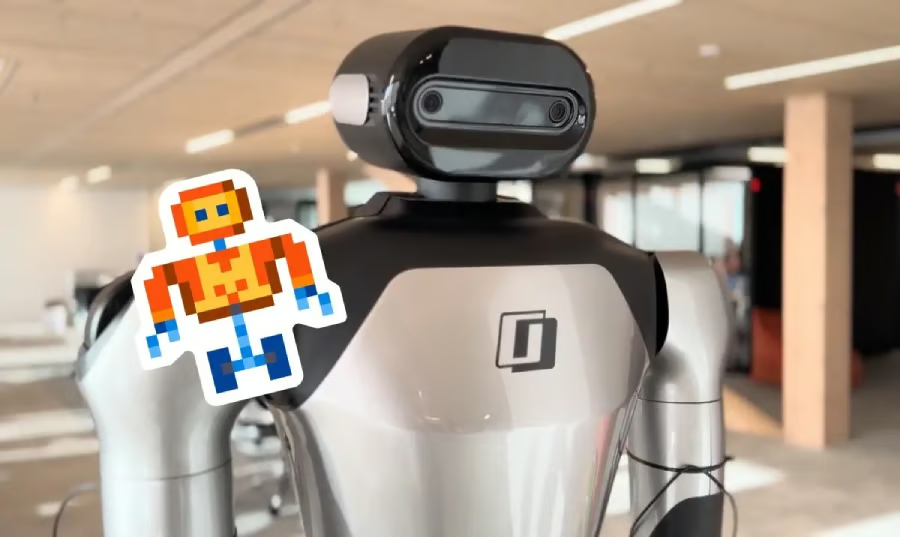


Mistral AI is stepping out of the chatbot and into the physical world.
French AI company Mistral AI launched its first robotics model, Robostral Navigate, as it moves beyond language models and deeper into physical AI. The 8-billion-parameter model is designed to help robots navigate complex environments using a standard RGB camera and natural-language instructions.
Instead of relying on LiDAR, depth sensors, or multiple cameras, Robostral Navigate uses visual information from a single camera to determine where a robot should move next.
Mistral says the model can handle instructions such as moving through a building, entering a specific room, and stopping at a particular location without requiring a human operator to guide each step. The company aims to use Robostral Navigate across manufacturing, logistics, delivery, hospitality, and other environments where autonomous robots are becoming more common.
A smaller model with ambitious navigation goals
According to Mistral, Robostral Navigate achieved a 76.6% success rate on the R2R-CE validation unseen benchmark. The benchmark tests whether a model can follow navigation instructions in simulated environments it did not encounter during training.
The company said this performance is 9.7 percentage points higher than the best single-camera approach and 4.5 points higher than systems using additional hardware such as depth sensors or multiple cameras. The model also achieved a 79.4% success rate on validation environments it had previously seen, according to Mistral.
Rather than calculating movement only through traditional distance commands, Robostral Navigate uses a “pointing” approach. It predicts the location in the robot’s camera view where it should move and the direction it should face when arriving. When a target is outside the camera’s view, the system can switch to local movement instructions.
Built for different robots and environments
Mistral said the model was developed entirely in-house and trained using simulation rather than relying on existing open-source vision-language models.
The company created a training dataset containing about 400,000 robot trajectories across 6,000 simulated environments. It also introduced a training technique based on prefix caching, which it says reduced the number of training tokens by 22× compared with processing each movement step separately.
After initial training, Mistral used online reinforcement learning through its CISPO algorithm to improve performance. The company said this process helped the model learn through trial and error, recover from failures, and improve exploration, increasing success rates by 3.2%.
Why this matters for the robotics industry
Robots have traditionally relied on expensive sensor systems and carefully controlled environments. A model that can navigate using only a standard camera could reduce hardware costs and make deployment easier for companies looking to expand their automation.
However, navigation is only one part of building capable robots. Robostral Navigate focuses on movement and does not address tasks such as picking up objects, manipulating tools, or performing complex physical work. The model’s real-world success will depend on how reliably it handles unpredictable environments, changing conditions, and safety requirements around humans.
More news: Chinese robotics is also making major advancements with the world’s first full-size ultra-bionic humanoid robots. Learn more about what these robots can do.