








At CES 2026, Jensen Huang took the stage and dropped a line that might define the next decade: “The ChatGPT moment for physical AI is here.” Bold claim.
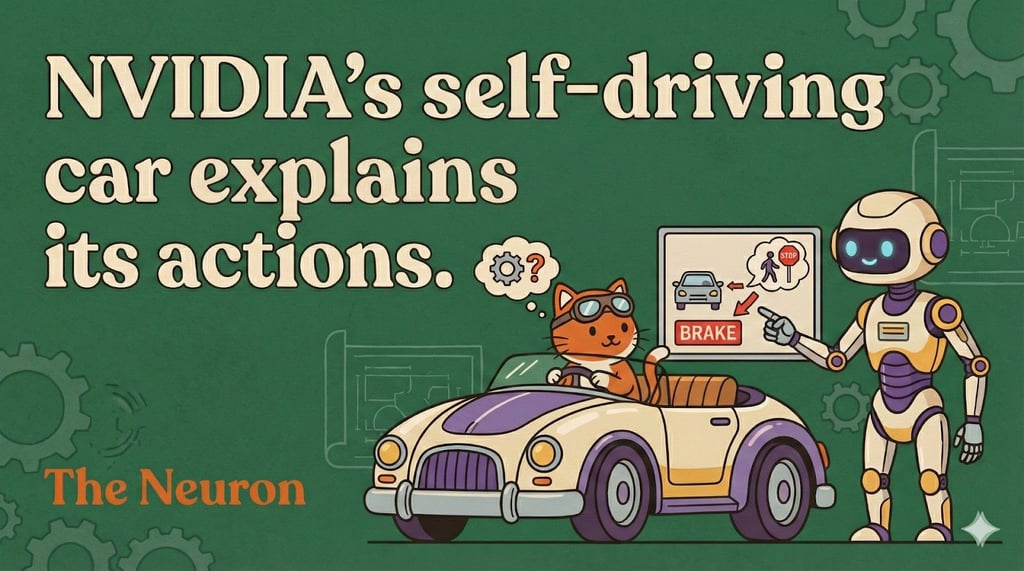
The star of Nvidia keynote was Alpamayo, what Jensen calls “the world’s first thinking, reasoning autonomous vehicle AI.”
Here’s the problem it solves
- Traditional self-driving cars separate seeing from deciding. Works great 99% of the time, but that remaining 1% (weird edge cases, unexpected scenarios) is where accidents happen.
- Alpamayo does something different; it reasons about what it sees. It can explain why it’s making a decision, describe the scenario, and think through novel situations step-by-step, like how you’d talk through a tricky merge with a nervous passenger.
- Huang explains: the system doesn’t just output steering commands, but tells you what action it’s taking, why it chose that action, and the trajectory it plans to follow.
So, what will be the first car with Alpamayo? The Mercedes-Benz CLA (conveniently just rated “the world’s safest car” by the NCAAP), shipping Q1 2026 in Europe. It runs two AI stacks in parallel: Alpamayo for reasoning and a classical backup system — redundancy for safety.
What else did Nvidia announce?
- Vera Rubin: Next-gen AI supercomputers with 1,152 GPUs per pod, cooled with 45°C water (no chillers needed; v chill indeed).
- Nemotron Speech: Voice recognition that’s 10x faster than competitors — Bosch is already using it for in-car assistants.
- Isaac GR00T N1.6: Foundation models for humanoid robots, now with full-body reasoning.
- Cosmos: Physical AI models topping reasoning leaderboards — Uber, Salesforce, and Hitachi are building on them.
Why this matters: If you’ve ever been nervous about trusting a self-driving car, this (potentially) changes the game. These cars will both drive you and explain why they’re driving that way. When something goes wrong, there’s a trace of reasoning to examine. Not a black box.
Our take…
This will be an interesting spoke thrust into the wheel(s) of the Tesla vs. Waymo self-driving race, which recently took a unique turn.
While Waymos are definitely safe enough to roll out across many major cities, a recent blackout in SF proved they’re not so reliable without a city’s infrastructure to support them; meanwhile, Dave Moss just drove a non-robotaxi Tesla 100% coast to coast across the US in full self-driving mode with no disengagements (including for parking).
Editor’s note: This content originally ran in the newsletter of our sister publication, The Neuron. To read more from The Neuron, sign up for its newsletter here.