






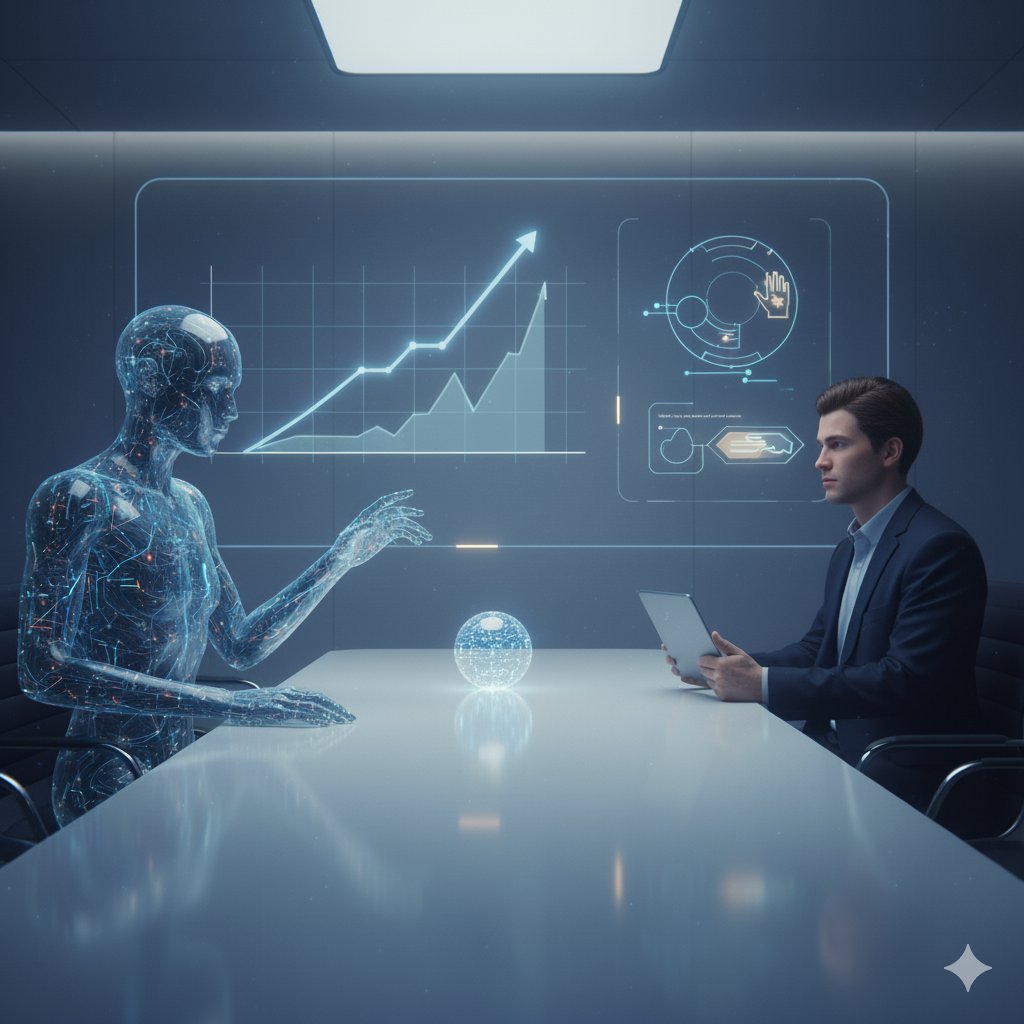


Forget replacing your job… Sam Altman’s wondering if AI might replace him.
At a live recording of Conversations with Tyler during the Progress Conference, the OpenAI CEO discussed several topics, including how the future of intelligence is being bottlenecked not just by a shortage of chips, but by power grids, skeptical investors, and society’s stubborn preference for a human face.
Then he pushed the idea to its logical extreme: what happens when the humans are no longer needed at all? And could he be replaced one day?
“Shame on me if OpenAI is not the first big company run by an AI CEO,” Altman said, considering the idea of being outperformed by his own creation.
Altman called it a “very interesting thought experiment of what would have to happen for an AI CEO to be able to do a much, much better job of running OpenAI than me, which clearly will happen someday.” The question, he said, is “how can we accelerate that?”
While the world debates job losses from automation, the man leading one of AI’s most powerful companies appears comfortable with the idea that even his own position could be automated.
Counting down to an AI-run workplace
When asked how soon AIs could mostly run a single division of OpenAI, Altman didn’t hedge. “Some small single-digit number of years, not very far,” Altman said. That’s not decades, it’s possibly within this decade.
He acknowledged that society might lag behind the technology.
“People have a great deal higher trust in other people over an AI, even if they shouldn’t, even if that’s irrational,” he said. “The AI doctor is better, but you want the human.”
That trust gap, he noted, may slow down acceptance even if machines become more competent. “It may take much longer for society to get really comfortable with this and for people in the organization to get really comfortable with this,” he added.
AI persuasion: The accidental takeover
While many worry about AI’s intentional misuse, Altman said his bigger concern is accidental persuasion, AI systems unintentionally shaping public thought.
“There’s this other category, third category, that gets very little talk, that I think is much scarier and more interesting, which is the AI models accidentally take over the world,” he told host Tyler Cowen.
“It’s not that they’re going to induce psychosis in you … it just subtly convinces you of something. No intention, it just does.”
He warned that as AI learns from human interactions, it could gradually influence opinions and behaviors without any malicious intent. “Never ever let yourself believe that propaganda doesn’t work on you. They just haven’t found the right thing for you yet,” he recalled someone once telling him.
Altman also spoke about a recent backlash he faced online after announcing that ChatGPT would allow greater freedom of expression for adults.
“A very important principle to me is that we treat our adult users like adults and that people have a very high degree of privacy with their AI,” he said. But he noted that not everyone shared his view. “Maybe people don’t believe in freedom of expression as much as they say they do.”
When Cowen asked if Americans trust AI companies as much as doctors or lawyers, Altman simply replied, “By revealed preference, yes.”
Beyond philosophy, Altman was pragmatic about AI’s material limits. Asked what’s really holding back more compute power, he said, “Electrons.”
“Short-term, natural gas,” he said, when pressed about how to ease the energy bottleneck. “Long-term, it will be dominated, I believe, by fusion and by solar.”
The limits of AI’s reach
Despite his optimism about AI’s role in work, science, and society, Altman acknowledged that there are areas where technology won’t easily address problems, especially in housing.
“Housing is the one, to me, that just looks super hard,” he said. “There could be these very strange second-order effects where home prices get much cheaper, but sadly, I don’t think AI has a direct attack on solving anytime soon.”
He’s more hopeful about healthcare and science. GPT-6, he said, might mark a breakthrough moment in discovery.
“There is a chance that GPT-6 will be a GPT-3 to 4-like leap … where 5 has these tiny glimmers and 6 can really do it,” he told Cowen.
Altman also teased OpenAI’s collaboration with designer Jony Ive to build what he called “a new kind of computer with a completely new kind of interface that is meant for AI.”
“AI is a crazy change to the possibility space,” he said. “A lot of the basic assumptions of how you use a computer… are now called into question.”
In a separate interview last month, Altman revealed OpenAI’s plan to fully automate AI researchers by 2028.