







Knowing which types of jobs AI will replace can help you stay ahead in today’s workforce and prepare for shifts in the job market driven by this dynamic technology. As AI models improve and the tools become more sophisticated, their range of abilities grows dramatically. The jobs most at risk involve routine or rule-based tasks, where AI can easily step in to handle repetitive work more efficiently.
While AI will augment rather than eliminate many roles that are less prone to full automation, upskilling and reskilling will become more essential for adapting to a dynamic workforce. Understanding the top 10 roles likely to be replaced by AI, why they’re most vulnerable, and what it means for workers can help you make more informed decisions about your career and build the skills that will matter most in the future.
Key takeaways
- Jobs at higher risk of automation are concentrated in industries like manufacturing, healthcare, and customer service, largely because these sectors rely heavily on routine, repetitive tasks that can be automated. (Jump to section)
- Building skills that AI cannot replace, investing in continuous learning, and staying adaptable through upskilling and reskilling will be crucial for remaining competitive in an AI-driven job market. (Jump to section)
- Besides job displacement, AI’s economic impacts include increased productivity, but also potential risks of widening income inequality. (Jump to section)
- Top 10 jobs AI will replace
- 1. Data entry clerks
- 2. Telemarketers
- 3. Retail cashiers
- 4. Bookkeepers
- 5. Receptionists
- 6. Production workers
- 7. Bank tellers
- 8. Proofreaders
- 9. Customer service representatives
- 10. Translators
- Preparing for an AI-driven job market
- The economic impacts of AI job replacement
- Frequently asked questions (FAQs)
- Conclusion: Navigating the AI-driven job landscape
Top 10 jobs AI will replace
The table below provides an overview of the jobs AI is expected to replace in the future, including the likelihood of AI replacing each role and the projected job growth by 2030. Most of these positions are projected to decline, with a few showing only minimal growth. Source: Will Robots Take My Job?
1. Data entry clerks
AI replacement risk: 95%
Data entry clerks are at a high risk of being replaced by AI, mainly because their work involves tedious, structured, and highly repetitive tasks that AI can automate easily. AI tools can quickly process large amounts of data with minimal errors, saving time and money for companies. With advancements in natural language processing (NLP) and optical character recognition (OCR),
AI can manage unstructured data, like handwritten notes or scanned documents, more effectively. Because AI can perform these tasks faster, businesses are likely to rely less on human data entry in the future.
2. Telemarketers
AI replacement risk: 94%
This role is likely to be replaced by AI because it focuses on following scripts and managing routine customer interactions, tasks that AI can now perform just as well, if not better. AI-powered chatbots and voice assistants can make calls, answer questions, and even personalize conversations based on customer data.
AI chatbots can also manage multiple calls more efficiently and are available 24/7 without needing any breaks, making them a cost-effective alternative to human telemarketers.
3. Retail cashiers
AI replacement risk: 93%
The jobs of retail cashiers are increasingly at risk of AI replacement as self-checkout systems and automated payment technologies become more common. These systems enable customers to scan and pay for items independently, eliminating the need for a cashier to operate a register.
AI advances are also allowing stores to use the Just Walk Out technology, a sensor-driven payment that automatically charges customers for items as they leave. For companies, these AI solutions mean lower labor costs and accelerated checkout times.
4. Bookkeepers
AI replacement risk: 93%
Bookkeepers are at serious risk of being replaced by AI because their work is straightforward and repetitive, exactly what AI tools are built for. AI-powered software can track expenses, automate reconciliations, and even generate financial reports more quickly and accurately than people can.
These systems can also connect directly to bank accounts and other financial platforms, eliminating the need for manual data entry. Businesses typically look for ways to cut costs and save time, making bookkeepers highly vulnerable to automation.
5. Receptionists
AI replacement risk: 91%
Receptionists face a significant risk of being replaced by AI as automated systems like virtual assistants become capable of managing calls, scheduling, and visitor check-ins. These AI tools save costs and complete routine tasks smoothly and without breaks.
While human receptionists can build rapport and address complex issues, businesses might prioritize the round-the-clock availability of AI, especially when dealing with high volumes of routine inquiries.
6. Production workers
AI replacement risk: 88%
Production or manufacturing jobs are under threat because AI and robotics can now take over many physical tasks. Machines can perform everything from assembling products to inspecting them, often with greater consistency than human workers. Automation is particularly useful for tasks that require high precision or repetitive movements, as robots don’t tire and can be programmed to work non-stop.
7. Bank tellers
AI replacement risk: 88%
Bank tellers are facing a high chance of AI replacement due to the rise of digital banking and automated systems. With more customers using mobile banking apps and online platforms for everyday transactions, in-person banking is becoming increasingly unnecessary.
ATMs and self-service kiosks are also taking over basic tasks, like cash deposits, withdrawals, and balance checks. These systems are not only quicker but also reduce the costs associated with maintaining a large, in-person staff.
8. Proofreaders
AI replacement risk: 85%
Proofreading jobs are vulnerable to AI because many of their tasks can now be done by advanced editing software. AI-powered grammar checkers and style editors can spot errors in text faster than humans can, from typos to sentence structure issues.
Additionally, these programs are constantly updated to recognize more complex language patterns, making them a practical choice for companies looking to cut down on costs. Even though human editors will still be required for complex tasks, AI is steadily taking over more of the routine, error-catching work traditionally done by proofreaders.
9. Customer service representatives
AI replacement risk: 76%
Customer service representatives are on the list of jobs AI will replace due to AI chatbots and virtual assistants growing more adept at managing routine inquiries, such as account updates and order tracking. These tools give businesses a cost-effective way to provide 24/7 support while handling requests simultaneously. However, human representatives may still be indispensable for emotionally charged situations where empathy is necessary.
10. Translators
AI replacement risk: 75%
Translators are seeing their roles shift as AI-supported language tools become more sophisticated, processing text in real time, translating accurately in dozens of languages. These tools are now able to pick up context and tone, which were once areas where humans had the advantage.
For routine tasks, such as translating documents or conducting basic conversations, AI can often complete the job faster at little to no cost. Human translators might still be needed for highly nuanced or creative work, but the demand for traditional translation services is likely to decrease as these technologies continue to develop.
Preparing for an AI-driven job market
AI will continue to transform industries, so preparing for the changing job market is more important than ever. It’s undeniable that AI will take over, if not eliminate, some jobs, but it will also create new opportunities. Developing a mix of new skills and a mindset that welcomes change will help you thrive in this environment. Here’s what you can do to make yourself more valuable in the job market.
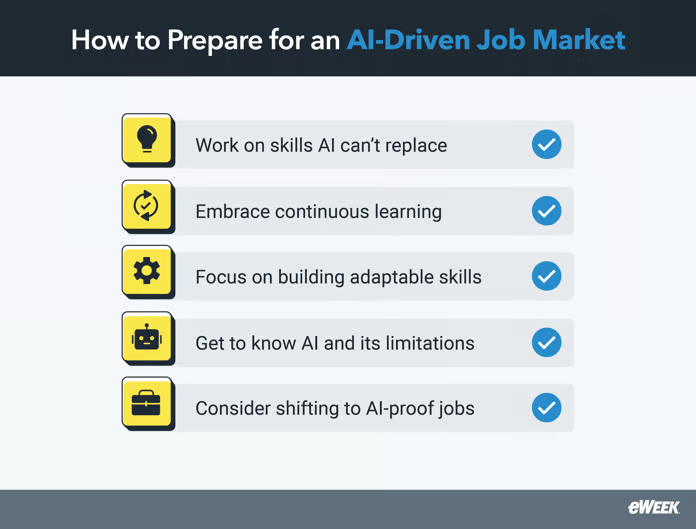
To prepare for an AI-driven job market, you must work on skills AI can’t replace, learn continuously, build adaptable skills, and learn about AI and its limitations. You may also consider shifting to AI-proof jobs.
Work on skills AI can’t replace
Automation can deal with routine tasks efficiently, but human traits, such as creativity and empathy, are irreplaceable. These skills will be even more valuable as routine work is automated. Focus on critical thinking, problem-solving, creativity, and interpersonal communication, areas where humans still have a distinct advantage.
Prioritize continuous learning
Staying informed is essential as AI technologies continue to advance. Maintain a curious mindset and continually acquire new skills through online courses or certifications, workshops and AI conferences. Keeping up with the latest AI trends will help you remain relevant and open up new career opportunities as the job market shifts.
Build adaptable skills
Learn to work with new technologies and different processes to be ready to switch industries if necessary. Workers who can pivot quickly and become proficient in working with AI tools will be in demand, as new roles will call for constant flexibility.
Understand AI and its limitations
Because AI plays a large role in the workplace, it’s imperative to understand both its strengths and limitations. While it’s hard to beat at data processing because of its speed and accuracy, it struggles with complex decision-making and creativity. By recognizing these limitations, you can use AI tools effectively and concentrate on areas where human judgment remains essential.
Explore AI-resilient careers
If you’re considering a career shift, explore roles that rely on human interaction, hands-on expertise, and skills that are difficult for machines to replicate. Professions like chefs and social workers need nuanced decision-making and emotional intelligence, which machines cannot duplicate. Pursuing these AI-proof jobs can offer stability in a future where automation seems unstoppable.
The economic impacts of AI job replacement
AI continues to mold industries and job markets, and its economic impact goes far beyond job displacement. While the technology introduces substantial benefits, it also raises serious concerns about inequality, workforce transitions, and ethical implications.
Increased productivity and economic expansion
AI-driven automation is poised to boost productivity, contributing an estimated $15.7 trillion to the global economy by 2030. This expansion will primarily come from enhanced efficiency and increased consumer demand, with the healthcare, finance, and manufacturing sectors standing to benefit the most.
The challenge, however, is making sure that this improvement is not limited to just a few industries or companies. If the benefits are concentrated in a small group, the broader economy could face widening inequality.
Job losses and workforce displacement
Artificial intelligence could potentially replace around 800 million jobs worldwide by 2030, according to SEO.AI. Job losses are to be expected in various sectors, with automation replacing basic roles. Workers in manufacturing, retail, and customer service industries are particularly vulnerable.
As AI takes over repetitive tasks, the shift in the workforce may cause disruptions and lead to retraining requirements for displaced workers.
Income disparity
AI is set to widen the income gap, especially in lower-wage sectors, like retail, food service, and manufacturing. A Brookings Institution report found that more than 30% of workers could see half of their tasks disrupted by generative AI. On the other hand, higher-paying, skilled positions in STEM, business, and finance industries are more likely to benefit from AI.
Simply put, the economic gains from AI could disproportionately favor those with higher skills, leaving lower-income workers behind and making income inequality worse.
Frequently asked questions (FAQs)
Which industries are most affected by AI?
AI is having a major impact on the manufacturing, healthcare, and customer service industries by automating tasks that humans previously did. In manufacturing, automation replaces manual labor on production lines. In healthcare, AI is handling diagnostics and administrative tasks. Meanwhile, in customer service, AI chatbots manage routine support roles, reducing the need for human involvement in simple inquiries.
Will AI create more jobs than it replaces?
AI is expected to create new job opportunities, particularly in AI development, data analysis, and machine learning fields. These new roles usually come with competitive AI job salaries, reflecting the specialized skills necessary. That said, the number of AI careers may not fully offset the jobs lost to automation. The effect will depend on how industries adjust, with higher-paying roles in tech, but fewer traditional jobs in more automated industries.
What skills are needed to work alongside AI?
To work alongside AI, you must gain skills in data analysis, machine learning, and critical thinking. You can also take AI-related courses or self-paced AI certifications to learn AI in detail. Developing these skills will help you collaborate with AI technologies in various sectors.
Conclusion: Navigating the AI-driven job landscape
The job market is undergoing a significant transformation, and while some roles become obsolete or face automation, others are emerging in response to new demands. Adapting to this shift means focusing on continuous learning and cultivating skills that AI cannot easily duplicate. Invest in human-centric abilities and skills that would complement new technologies to remain relevant and resilient as the nature of work evolves.
Find out which businesses are setting the new standards in AI by reading about the top AI companies and NLP companies.
TechnologyAdvice writer Kezia Jungco contributed to this article.