






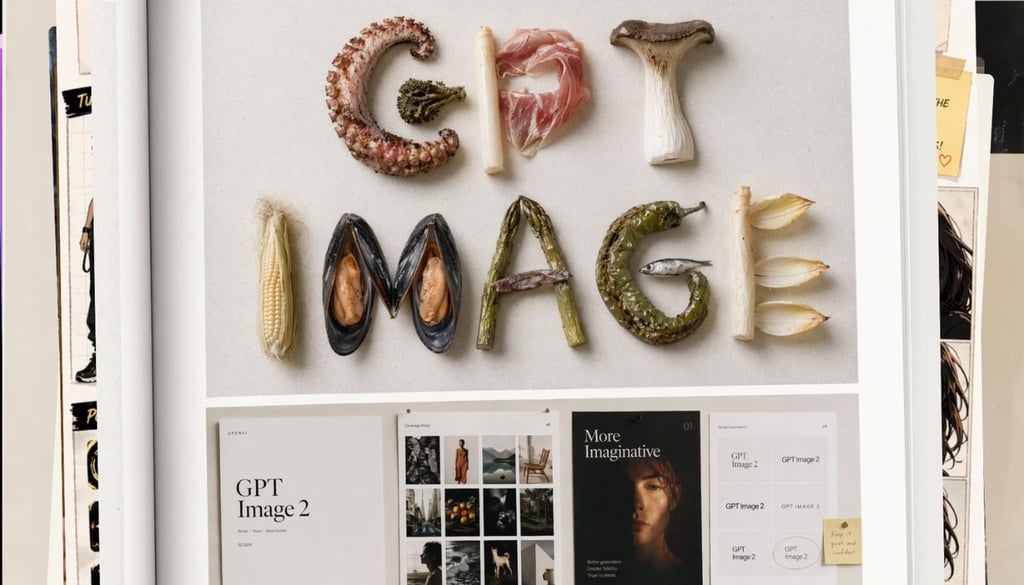


OpenAI announced the release of ChatGPT Images 2.0 today, a massive overhaul that moves beyond the one-and-done style of AI art.
This update, powered by the new gpt-image-2 model, introduces a Thinking mode that allows the AI to research the web, plan out layouts, and generate consistent sets of images rather than just single, disconnected squares.
The core philosophy behind this release is a shift in how we use AI visuals. OpenAI is no longer pitching this as a toy for making pretty pictures, but as a tool for actual work. “Images are a language, not decoration. A good image does what a good sentence does — it selects, arranges, and reveals,” the company wrote. “It can explain a mechanism, stage a mood, test an idea, or make an argument.”
By integrating its O-series reasoning capabilities, the model no longer just draws; it plans. When you use the new Thinking mode, the AI acts more like a design partner. It can browse the web for real-time context, analyze uploaded documents to create infographics, and verify its own work before showing it to you.
If you’ve ever tried to make an AI generate a menu or a sign, you know the struggle with AI gibberish. Images 2.0 claims to have solved this. The model now handles dense text, small iconography, and complex user interfaces (UI) with professional-level precision.
It’s also gone global. While previous models struggled with non-Latin scripts, this version is a polyglot, showing significant improvements in Japanese, Korean, Chinese, Hindi, and Bengali. Rather than simply translating words, the system is designed to integrate language naturally into the visual layout, an improvement that could make it more useful for global audiences and localized content creation.
Flexible formats and higher-quality output
ChatGPT Images 2.0 supports a wider range of aspect ratios, allowing users to generate visuals from 3:1 (wide) to 1:3 (vertical). This flexibility makes it easier to create assets for everything from presentations to social media.
The model can also produce images at up to 2K resolution, with even higher resolutions in testing through the API.
Another noteworthy change is how users interact with the system. Instead of a one-shot prompt, image creation is becoming more conversational. Users can refine outputs step by step, adjusting elements, changing layouts, or iterating on ideas without starting over. The system retains context, enabling a more fluid design process.
Developers and business use cases
OpenAI is also pushing the technology beyond casual use. The new gpt-image-2 model is available through its API, allowing developers to integrate advanced image generation into their products.
The company says this could support real-world applications such as marketing design, educational content, and creative tools. Integration with Codex also means users can generate and iterate on visuals within a broader workflow, including app development and product design.
Availability and access
ChatGPT Images 2.0 Instant is available today to all ChatGPT and Codex users, including those on the free tier. Thinking mode with web search, multi-image generation, and reasoning capabilities is reserved for ChatGPT Plus, Pro, and Business subscribers.
Developers can access the model via the API under the identifier gpt-image-2, with pricing set at $8.00 per input, $2.00 for cached inputs, and $30.00 per output, which varies based on the selected quality and resolution.
Some limitations remain. OpenAI notes that the model can still struggle with tasks requiring a precise physical world model, such as origami guides, Rubik’s Cube configurations, and surfaces that are angled, hidden, or reversed.
Very dense or repetitive textures, like sand grains, can also push the model’s limits. And diagram labels, especially those relying on precise arrows and part references, may still need a human review pass.
Also read: Our ChatGPT cheat sheet breaks down how image generation, editing, reasoning, and web tools now fit into OpenAI’s broader product lineup.