






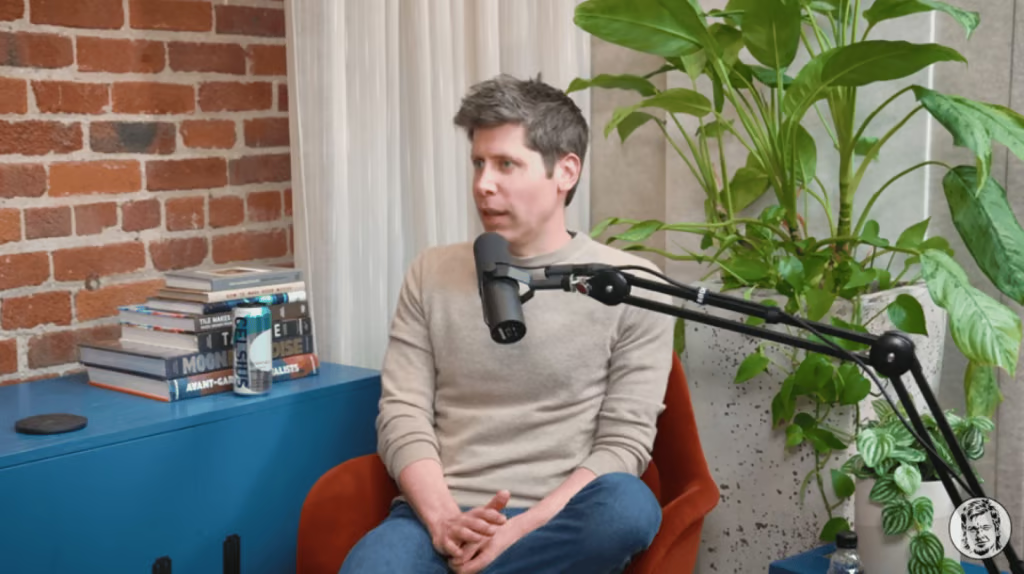


On Tuesday, OpenAI CEO Sam Altman hosted a livestream on how the company is tracking toward building an intern-level research assistant by September 2026 and a fully automated “legitimate AI researcher” by 2028.
This means an AI that can autonomously handle entire research projects, not just answer questions or write code, but actually conduct original scientific research from start to finish.Chief Scientist Jakub Pachocki joined Altman on the stream and described this future AI researcher as “a system capable of autonomously delivering on larger research projects.” An AI that can think through complex problems, run experiments, analyze results, and potentially make scientific discoveries without human hand-holding.
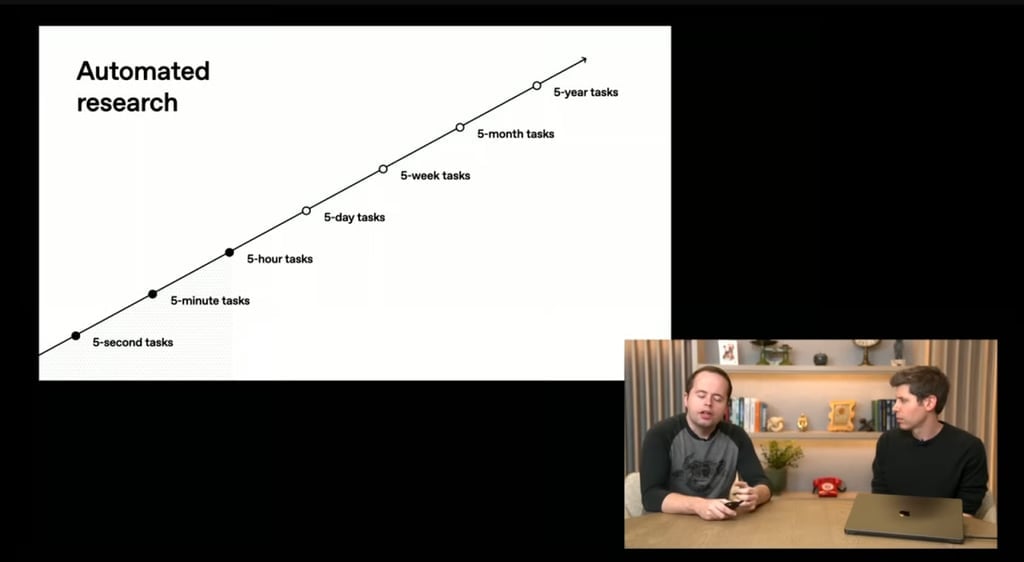
Here’s how they plan to get there
- Algorithmic innovation: Continuing to improve the underlying models and architectures.
- Scaling “test time compute”: Letting models spend way more time thinking through problems. We’re talking potentially dedicating entire data centers’ worth of computing power to solve a single major scientific breakthrough.
- Extending time horizons: Current models handle tasks with about a five-hour thinking window. OpenAI wants to push this dramatically further for complex research problems.
Let’s talk about the timing. This news came the same day OpenAI finalized its transition to a public benefit corporation. The new structure splits things up: a non-profit OpenAI Foundation will own 26% of the for-profit arm and govern the research direction, plus it has a $25 billion commitment to use AI for curing diseases.
Meanwhile, the for-profit side can now raise the massive capital needed to actually build this stuff. Altman mentioned OpenAI has committed to 30 gigawatts of infrastructure buildout—a $1.4 trillion financial obligation—over the next few years.
Why this matters
If OpenAI hits these milestones, we’re not just talking about better chatbots or Sora 2 memes.
We’re talking about AI that could potentially make scientific discoveries faster than humans, tackle problems beyond current human capabilities, and dramatically speed up breakthroughs in medicine, physics, and technology. And maybe, just maybe, an AI I can rely on to finish a single task end to end. Any day now!
Pachocki also said deep learning systems could be “less than a decade away from superintelligence“, which would be a single system smarter than humans across a large number of critical actions. What, like it’s hard??
Editor’s note: This content originally ran in today’s newsletter send from our sister publication, The Neuron. To read more from The Neuron, sign up for its newsletter here.