









Another legislative trouble is around the corner for Google.
US Senator Elizabeth Warren, who represents Massachusetts, is clamoring for deeper insights into the privacy structure of Google’s Gemini checkout. In a letter to Google CEO Sundar Pichai, she raised concerns about how Google intends to use user data for the feature.
The letter, dated Feb. 3, said, “On January 11, 2026, you announced Google’s partnership with Shopify, Etsy, Wayfair, Target, Walmart, and other retailers to implement a new AI standard termed the Universal Commerce Protocol (UCP), allowing AI agents at different retailers ‘to talk to each other across every step of the shopping journey.'”
Expressing her worry, she also added, “I am concerned that these partnerships and Google’s integration of a new shopping feature into Gemini could allow Google and its retail partners to exploit sensitive user data to violate consumer privacy and manipulate consumers into spending more and paying higher prices.”
How the Universal Commerce Protocol works
UCP is an open shopping protocol developed by Google and Shopify, with other retailers later coming on board. Its open standard enables AI agents to handle the shopping experience — from product identification to checkout and beyond — streamlining buying operations.
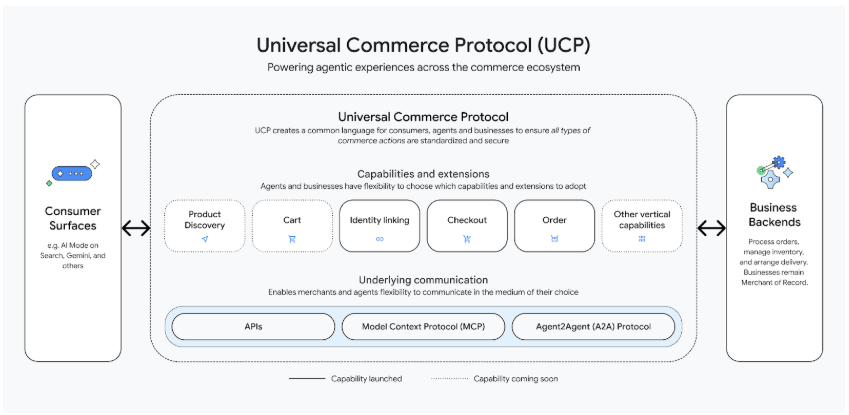
Image: Google
According to Google Developers, it integrates flexibly with APIs, allowing businesses and their developers to add it to their services. For example, a restaurant can integrate UCP into its website, enabling users to purchase items after checking them out via a service like Gemini.
Google’s aim for consumers is simple: remove the friction of navigating multiple steps when shopping. The result is a reduction in the time spent from product discovery to purchase decision.
The rise of AI-driven commerce
In today’s world, there is a touch of AI in everything. From simple-looking generative AI to complex AI agents handling enterprise needs, and even robots running home errands. As a result, it is reasonable to expect AI to be used actively in commerce in this way.
Predictive AI is already being used to analyze statistics and user behavior through shopping algorithms. But Google is moving quickly with UCP.
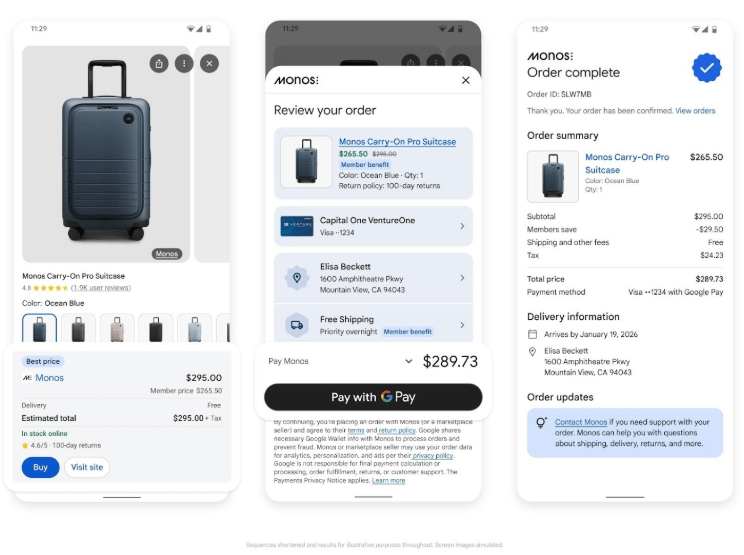
Image: Google
Currently endorsed by over 20 partner companies, if this scales and succeeds, it will not only challenge OpenAI but also significantly alter how global commerce is conducted in the future.
Google’s response and the growing concern over its users’ data usage
The three-page letter expects Google to respond to its 12 questions by Feb. 17. As of when writing this, Google hasn’t given any response yet, which isn’t unusual because it’s just two days in. However, we expect them to respond with a clarification and defense of their stance.
Google, however, is not new to these kinds of probes. In recent years, the tech giant has faced numerous investigations, regulations, and even fines related to its data policies. Being one of the largest holders of internet users’ data, primarily from its search engine, product announcements like this always raise privacy concerns.
AI-based projects need data, the kind that Google has, and given its growing notoriety for engaging in unethical data practices, we expect more prying eyes, including the EU, as the feature will touch there too.
Also read: NRF 2026 coverage of agentic commerce explains how SAP is embedding agent-driven intelligence across retail operations.