






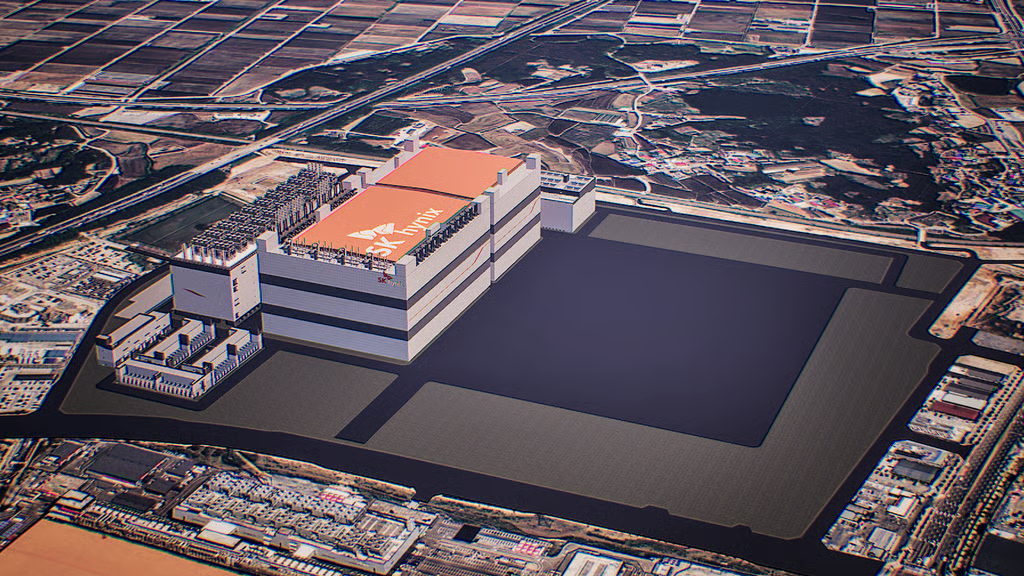


SK Hynix is putting Cheongju at the center of South Korea’s next big AI chip buildout.
The memory giant plans to spend 100 trillion won, or about $64 billion, on new chip facilities in the central South Korean city, including a NAND flash factory slated for completion by 2029 and an advanced packaging plant targeted for late 2027.
The buildout gives SK Hynix greater capacity in storage and packaging technologies that AI data centers need, while supporting South Korea’s broader effort to spread semiconductor investment beyond the Seoul area.
The plan also shows how the AI boom is moving from cloud platforms and GPU headlines into factory sites, regional development plans, and long-term memory supply bets.
Cheongju moves deeper into South Korea’s chip strategy
Reuters reported that SK Hynix said it would spend 80 trillion won, or about $51 billion, on a new NAND memory chip factory by 2029 and another 20 trillion won, or about $13 billion, on an advanced packaging plant by late 2027.
At an event attended by South Korean President Lee Jae Myung, SK Hynix CEO Kwak Noh-jung pointed to tight supply and rising demand. “While demand for NAND has been increasing and is expected to continue growing in the future, NAND supply is constrained,” he said, according to Reuters.
Construction of the new NAND factory, known as M17, is expected to start next year. The Cheongju projects form part of a broader chip plan involving SK Hynix and Samsung Electronics, as South Korea aims to double its memory chip production capacity within five years.
Cheongju gives the plan a regional development angle because South Korea wants the AI chip boom to support manufacturing growth beyond the Seoul metropolitan area. The city already anchors part of SK Hynix’s NAND operations, and the new plants could deepen its place in the country’s semiconductor map.
AI data centers need more than HBM
High-bandwidth memory typically draws attention in AI hardware because accelerators require fast working memory. SK Hynix has benefited from that demand, but NAND still matters because AI data centers also need large amounts of storage.
The Next Web noted that M17 will be SK Hynix’s fourth NAND fab and is expected to begin production in the first half of 2029. NAND chips store data even when devices are turned off, making them central to solid-state drives used in data centers, PCs, and enterprise systems.
The packaging plant gives the expansion a performance and efficiency angle. Tech in Asia said that the facility will focus on advanced packaging, which combines chips into a high-density unit to improve performance and energy use.
The two plants address different parts of the same problem.
AI systems need faster memory, larger storage pools, and more efficient ways to connect chips inside crowded servers. Packaging can affect performance, power use, and how quickly chipmakers can deliver systems for hyperscale customers.
The $64B buildout still comes with risk
The market reaction showed investors are still asking hard questions about the AI cycle.
Reuters reported that SK Hynix shares ended down 15%, while Samsung shares fell 9%, as a broader chip sell-off raised concerns that spending on AI data centers could eventually outpace demand.
SK Hynix also cautioned in a filing that long-term investment plans could change depending on global chip demand, customer spending, and construction-site issues.
The gamble is that chip factories take years to build, while AI demand can change much faster.
If hyperscalers continue to invest heavily, SK Hynix could enter the next decade with greater leverage in NAND and advanced packaging. If AI investment cools, the same factories could become a costly reminder that memory markets still move in cycles.
South Korea’s chip strategy is becoming clearer: turn today’s AI demand into manufacturing scale, regional investment, and supply-chain influence. SK Hynix’s challenge is ensuring Cheongju’s new capacity arrives when customers still need it.
Learn more about how Samsung and SK Hynix are expanding South Korea’s AI chip production with a planned $590B investment.