






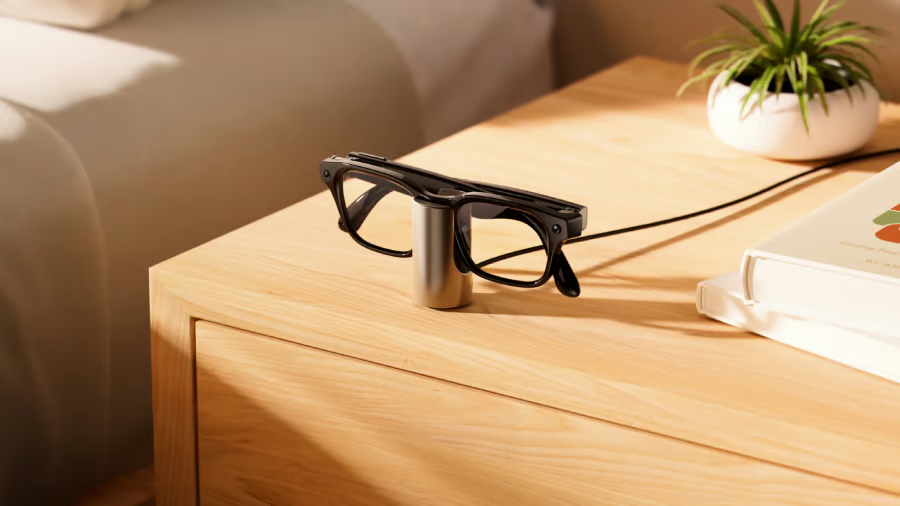


Smart glasses have evolved from niche experiments into one of the fastest-growing categories in consumer electronics.
Powered by advances in artificial intelligence (AI), miniaturized hardware, computer vision, and display technologies, today's smart glasses can capture photos, answer questions, translate languages, provide navigation, display digital information, and even replace traditional monitors in some scenarios.
With companies including Meta, Google, and Samsung investing heavily in the space, many analysts view smart glasses as the next major personal computing platform after smartphones.
What are smart glasses?
Smart glasses are wearable computers integrated into conventional-looking eyewear. Unlike traditional glasses that only correct vision or protect against sunlight, smart glasses incorporate electronics such as processors, microphones, speakers, cameras, displays, sensors, wireless connectivity, and increasingly, AI assistants.
Modern smart glasses generally fall into four categories:
- Audio glasses: Provide music, phone calls, and voice assistants through open-ear speakers.
- Camera or AI glasses: Add cameras and AI capabilities for hands-free photography, video, and contextual assistance.
- Display or AR glasses: Project virtual screens or digital information into the user's field of view.
- Enterprise and industrial glasses: Prioritize remote assistance, workflow guidance, and productivity.
Smart glasses vs AI glasses vs AR glasses
These terms are often used interchangeably but represent different technologies.
Smart glasses are the broad category encompassing all connected eyewear.
AI glasses focus on intelligent assistance using large language models and computer vision. They answer questions, recognize objects, summarize information, translate languages, and interact naturally through voice.
AR (augmented reality) glasses overlay digital information onto the real world using optical displays such as waveguides or prism optics. Some consumer products marketed as AR glasses are actually wearable private displays rather than true spatial AR devices.
What smart glasses actually do
Capability | How it works | Example products |
| Notifications and calls | Bluetooth link to phone; audio or text alerts | Ray-Ban Meta, Even Realities G2 |
| Voice AI assistant | Wake word triggers cloud/on-device AI (Meta AI, Gemini, Even AI) for Q&A, visual search, translation | Ray-Ban Meta, Oakley Meta, Google/Samsung intelligent eyewear |
| Camera capture | 12MP-class sensor, POV photo/video, some with 3K recording | Ray-Ban Meta, Oakley Meta HSTN/Vanguard |
| Live translation | Captions/audio translated in real time | Even Realities G2 (33 languages), Ray-Ban Meta (6 languages) |
| Navigation/HUD | Turn-by-turn directions displayed in-lens | Meta Ray-Ban Display, upcoming Google/Samsung display glasses |
| Virtual monitor/entertainment | Prism projector creates a large private screen for video, work, or gaming | Viture Beast, Xreal One Pro, RayNeo Air 4 Pro |
| Fitness integration | Pairs with Garmin/Apple Watch for stats, auto-capture | Oakley Meta Vanguard, Engo3 |
| Accessibility | Live captions for the hard of hearing; audio description for the visually impaired | Captify Pro, Be My Eyes integration in Ray-Ban Meta |
Who smart glasses serve
- Everyday phone reducers: Users who want notifications, calls, and quick AI answers without pulling out a phone.
- Content creators and social media users: Users who want hands-free, first-person photo and video capture, a major driver of Ray-Ban Meta’s mainstream popularity.
- Athletes and outdoor users: Users who want sports-specific models such as Oakley Meta Vanguard and Engo3 that pair with fitness devices and can withstand sweat, rain, and impact.
- Remote and mobile knowledge workers: Users who want prism-display glasses such as Viture Beast and Xreal One Pro as portable ultrawide monitors.
- People with hearing or vision loss: Users who rely on captioning glasses such as Captify Pro and XanderGlasses or audio-description features as assistive tech.
- Enterprise and industrial users: Logistics, manufacturing, field service, and healthcare workers who use ruggedized AR glasses such as Vuzix M400, RealWear, and Magic Leap-derived enterprise lines for hands-free remote assistance and real-time data overlay.
- Parents and travelers: Users who want POV capture of family moments, live translation, or navigation for travel.
Quick buyer's guide
If you want... | Consider | Why |
| The best all-around everyday AI glasses | Ray-Ban Meta (Gen 2) | Most popular, most stylish, broad feature set, prescription-compatible. |
| Best sound quality | Xreal One Pro/Oakley Meta HSTN | Bose speakers (Xreal); best audio leakage control among Meta models |
| Best for sports/outdoor use | Oakley Meta Vanguard | IP67 waterproof, louder speakers, Garmin integration |
| Best private-screen/work monitor | Viture Beast | Widest FOV, brightest display, ultrawide mode |
| No camera/privacy-first | Even Realities G2 | Camera-free by design, strong display, wide prescription range |
| Best value AR display glasses | RayNeo Air 4 Pro | Bright, colorful, cheapest of the "good" prism glasses |
| Accessibility (hearing loss) | Captify Pro | Purpose-built live captioning, simple interface |
| Cutting-edge consumer AR | Snap Specs | True waveguide AR, agentic AI dev platform |
| Waiting for the "safe" mainstream option | Hold for Apple (late 2027) or Google/Samsung Android XR (fall 2026) | Broad ecosystem backing, cross-platform design |
The established players and their products
Meta: The current market leader
Meta's Ray-Ban and Oakley partnerships (with EssilorLuxottica) are, by every account, the runaway commercial leader in this category.
Product | Type | Key specs |
| Ray-Ban Meta (Gen 2) | Camera/audio AI glasses | 12MP camera, 3K video, ~8 hrs battery (+48 hrs case), IPX4, 32GB storage, Meta AI |
| Oakley Meta HSTN | Camera/audio AI glasses | Same core hardware as Ray-Ban Meta, slightly better battery/audio |
| Oakley Meta Vanguard | Sports AI glasses | IP67 (fully waterproof/dustproof), louder speakers, Garmin Connect IQ integration, no prescription support |
| Meta Ray-Ban Display | Waveguide AR glasses | 600×600 monocular color HUD in right lens, Meta Neural Band gesture wristband, navigation/messages overlay |
Meta has faced sustained criticism over privacy. More than 70 advocacy organizations urged Meta to abandon a reported facial-recognition feature internally called Name Tag; a group of US senators separately pressed Meta on the same plans, citing risks of stalking, doxxing, and use by immigration enforcement.
Meta subsequently removed facial-recognition code from its companion app after the reporting. A federal lawsuit also alleges that human contractors, not just AI, review some footage and audio from the glasses, despite Meta's original privacy marketing.
Google + Samsung: Android XR (Intelligent Eyewear)
At Google I/O 2026, Google and Samsung jointly unveiled their first Android XR-powered glasses, co-designed with fashion partners Gentle Monster and Warby Parker, running on Qualcomm Snapdragon silicon and powered by Gemini AI.
Two categories were confirmed: audio-only glasses and, coming in 2027, display glasses. Features include navigation, notification summaries, real-time translation (including voice-matched audio translation), and hands-free photo capture, all cross-compatible with both Android and iOS.
First collections are slated to launch in fall 2026 in select markets, with pricing not yet announced.
Apple: Not yet shipped, repeatedly delayed
Apple has no smart glasses on the market as of mid-2026. According to Bloomberg's Mark Gurman, Apple's first-generation glasses (codenamed N50) will be display-free, camera- and Siri-centric, designed as an iPhone accessory (like AirPods or Apple Watch) rather than a spatial computer, built in-house (not co-branded with an eyewear partner, unlike Meta and Google), and offered in four acetate frame styles.
Originally targeted for a late-2026 unveiling and early-2027 shipping, the timeline has slipped again: as of May 31, 2026, Bloomberg reports the launch has been pushed to "late 2027," with a lighter Vision Air headset (successor to Vision Pro) not expected before 2028–2029.
Analyst Ming-Chi Kuo has separately projected mass production beginning in the second quarter of 2027, with 3 million to 5 million units in the first year.
Snap: Pivoting from cheap camera glasses to expensive AR
Snap's original Spectacles were a $130 camera-only product that sold about 220,000 units, below the company’s expectations. Snap has since rebuilt the line as a developer-only AR platform (5th-gen Spectacles, $99/month lease).
In June at AWE, Snap unveiled Specs, its first true consumer AR product: waveguide display, 51-degree field of view, dual Snapdragon chips, electrochromic lenses, approximately 4 hours battery (20 hours with the charging case), and contextual AI.
AR prism display specialists (personal-screen glasses)
These are not really trying to compete with Meta or Google on AI; they compete on being the best portable private monitor.
Brand/product | Standout feature |
| Viture Beast | Widest FOV (58°), built-in head tracking, ultrawide mode (3840×1200 virtual monitor) |
| Xreal One Pro | Bose speakers, best sound quality, 3DOF via built-in chip |
| RayNeo Air 4 Pro | HDR10 support, affordable |
| Rokid Max 2, Viture Luma/Luma Pro, Asus AirVision M1 | Superior picture quality, integrated electrochromic dimming, and excellent ecosystem support. |
Waveguide ‘everyday AR’ specialists (no camera, privacy-first)
Even Realities builds its entire value proposition around not having a camera, deliberately addressing the "creepy glasses" backlash that hit Meta and Google Glass before it.
Its G2 model offers a 1,200-nit HAO 2.0 display, prescription support from −12.00 to +12.00 diopters, an R1 smart-ring controller, 33-language translation, and a new "Conversate" AI conversation-assistant feature, which reviewers found genuinely useful but also flagged as ethically fraught, since conversations can be transcribed without a visible recording indicator (unlike Meta's LED).
Other waveguide players: Captify Pro (captioning-only, built for hard-of-hearing users), Halliday Glasses (panned by WIRED for poor legibility and an awkward ring controller).
Audio-only and niche players
- Chamelo Music Shield, Aura, and Dusk: Electrochromic tintable lenses plus audio, with no camera.
- Lucyd Reebok Octane: Bluetooth sports sunglasses with physical controls.
- Solos AirGo Vision: ChatGPT-powered camera glasses that reviewers have criticized for weak photo and audio quality.
- Engo3: Ultralight 38.5-gram sports HUD glasses for runners and cyclists that sync with Garmin and Apple Watch.
Enterprise/industrial incumbents
Vuzix, RealWear, Epson, and Magic Leap remain significant in industrial AR (manufacturing, logistics, field service, healthcare), a segment that a Grand View Research and DataM report both identify as currently the largest application category by revenue, well ahead of consumer social/media use Vuzix, for example, received a "six-figure follow-on order" from AcuraFlow in April 2026 for its M400 industrial glasses according to Grand View Research.
Companies that have struggled, pivoted, or failed
Smart glasses have a long graveyard, and understanding it explains why today's successful products look the way they do.
- Google Glass: Google Glass launched as a consumer product from 2013 to 2015, with the Enterprise Edition discontinued in March 2023. Priced at $1,500, it was criticized for bulky design, weak battery life, limited real-world usefulness, and, most consequentially, a privacy backlash that spawned the pejorative “Glasshole” and got the device banned from bars, restaurants, and casinos. Google later pivoted to a business and industrial Enterprise Edition, which lasted until 2023, when the company ended sales and support.
- North Focals: North, formerly Thalmic Labs, made Focals, a smart glasses product backed by Amazon and Intel. Focals were praised as a more wearable alternative to Google Glass but never reached scale. Google acquired North in mid-2020 and discontinued both the shipping Focals 1.0 and the unreleased Focals 2.0. By July 2020, the Focals app and North account backend were set to stop working, turning the product into a cautionary tale about connected hardware that depends on a cloud backend.
- Snap Spectacles: Snap Spectacles originally launched in 2016. The first-generation camera glasses sold about 220,000 units, below expectations, and reportedly cost Snap millions in write-offs. Snap subsequently retreated to a developer-only distribution model before returning to consumers with the more expensive 2026 Specs.
- Intel Vaunt: Intel Vaunt and other now-defunct prototypes are often cited in industry histories as promising waveguide concepts that never shipped commercially, underscoring how many attempts preceded the current wave.
The pattern industry historians draw from these failures: successful modern smart glasses look like ordinary eyewear rather than gadgets, do one or two things well rather than trying to replace the smartphone outright, and increasingly treat privacy design (or its absence) as a make-or-break feature rather than an afterthought.
Privacy, legal, and social-acceptance issues in 2026
This is arguably the single biggest headwind facing the category's growth.
- US federal law: No dedicated US federal law governs always-on wearable cameras or microphones. Devices fall under a patchwork of state recording-consent laws and general biometric privacy statutes.
- Illinois BIPA: Illinois' Biometric Information Privacy Act, or BIPA, is one of the most consequential US state biometric laws. It requires informed written consent before collecting biometric identifiers, including face geometry, and provides a private right of action with penalties of $1,000 for negligent violations and $5,000 for intentional or reckless violations.
- California SB 1130: California lawmakers introduced SB 1130, a wearable recording device bill, in February 2026. The bill would prohibit people from using wearable recording devices to capture sound or video of another person in certain business areas where that person has a reasonable expectation of privacy, unless explicit consent is given.
- EU AI Act: The EU AI Act restricts real-time remote biometric identification in publicly accessible spaces, especially for law enforcement, with narrow exceptions. Its rules also cover biometric categorization and other high-risk biometric systems, with major high-risk AI obligations scheduled for August 2026, though implementation timing remains politically contested.
- Meta Name Tag backlash: Meta's reported Name Tag facial-recognition feature triggered calls from more than 70 civil liberties, domestic violence prevention, and immigrant advocacy organizations for Meta to abandon the plans. US senators also warned that the feature could “normalize mass surveillance,” amid separate reports that Border Patrol and ICE agents in multiple states had been seen wearing Meta AI glasses during field operations. Meta later removed face-recognition components from its Meta AI companion app after WIRED reported that the code had been embedded in the platform.
- Third-party facial recognition: Two Harvard students demonstrated that footage from Ray-Ban Meta glasses could be fed into third-party facial-recognition tools to identify strangers on the street in real time. The demonstration showed that privacy risks can come from any camera-equipped glasses, not only from built-in Meta features.
- Voice data by default: Voice recordings triggered by Ray-Ban Meta's wake word may be stored in the cloud for up to a year to improve Meta's products, and can be deleted through the Meta AI app.
New and expected innovations
Near-term (2026)
- Full-color waveguide displays reaching consumer price points: Meta Ray-Ban Display and the upcoming Google/Samsung display glasses (2027) both push in-lens AR displays toward mainstream design rather than bulky prototypes.
- Neural/gesture control input: Meta's Neural Band (EMG wristband gesture control) is the most advanced consumer example so far; expect competitors to follow with similar low-friction input methods since touch panels and voice-only control have proven clunky.
- Cross-platform "intelligent eyewear" ecosystems: Android XR glasses are explicitly designed to work with both Android and iOS, a deliberate strategy to avoid Meta's app-walled-garden criticism.
- Falling prices, converging ASPs: IDC projects that screenless smart glasses ASPs will fall from approximately $376 (2026) to about $229 (2030), which should considerably widen the addressable consumer market.
- Agentic AI + developer platforms maturing: Snap's Specs ship with support for building AI-agent experiences via Claude Code, OpenAI Codex, and Cursor; this signals glasses becoming a genuine third-party app/agent platform, not just a manufacturer-locked feature set.
Medium-term (2027–2029)
- Apple's expected entry: Apple's reported late-2027 entry could become a forcing function for the category because of the company's existing hardware and software ecosystem, though its first-generation glasses are expected to be conservative and ship without a display.
- Apple Vision Air: A lighter, cheaper Vision Pro successor is reportedly expected around 2028 to 2029, suggesting Apple may eventually connect spatial computing headsets and everyday glasses more closely.
- Regulatory pressure: Regulatory pressure could shape product design. Facial-recognition features are likely to remain a competitive and legal battleground, and the EU AI Act and US state bills such as California's SB 1130 could shape what manufacturers are willing to ship.
- Health-device convergence: Health-device convergence could become a long-term trend. Bloomberg has reported that Apple believes glasses could eventually evolve into a health device, suggesting future glasses could absorb some health-sensing features now associated with watches and rings.
- Market bifurcation: The market could continue to split into two tiers: lower-cost, mass-market, display-free AI companion glasses from companies such as Meta, Apple, Google, and Samsung, and more expensive, display-rich spatial-computing glasses such as Snap Specs, future Android XR display glasses, and Apple's later AR products.
Also read: Smartwatch blood sugar tracking remains a sensor problem, with Apple Watch, Galaxy Watch, Garmin, and Oura still relying on CGM data rather than direct measurement.