






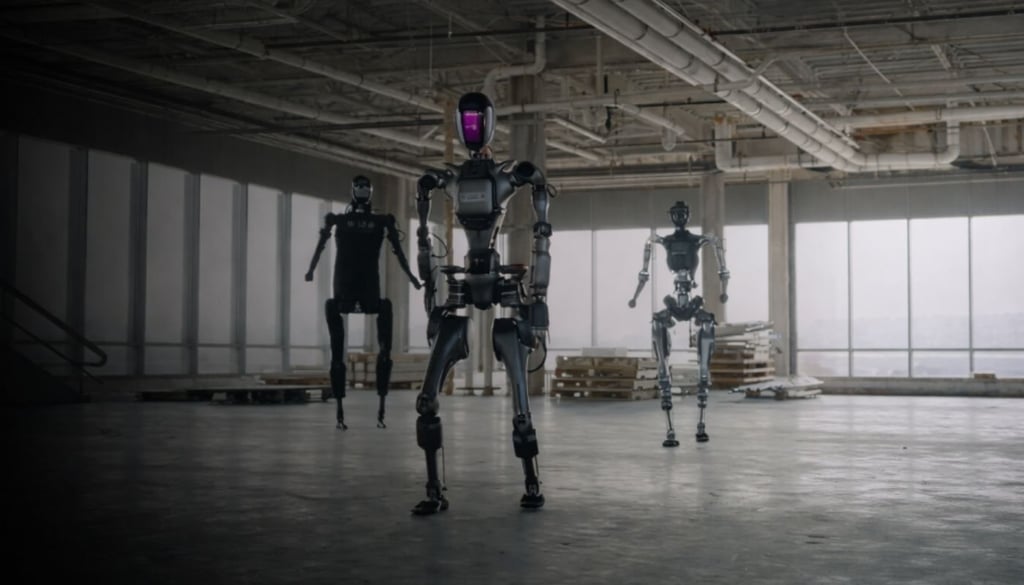


What if every robot could run on the same brain? SoftBank wants to find out.
On Jan. 14, robotics startup Skild AI raised $1.4 billion in a SoftBank-led funding round, tripling its valuation to $14 billion and cementing its place as one of the most valuable robotics AI companies in the world. Just two years after launch, Skild has now attracted 22 investors and more than $1.83 billion in total funding, signaling surging confidence in “physical AI” as the next major tech frontier.
Building a unified AI brain beyond robotic hardware
Deepak Pathak, the CEO and co-founder, told Bloomberg that the limited number of robots today stems from a fundamental lack of specialized AI brains.
Crunchbase, cited in this blog post, described the unified brain as “omni-bodied,” meaning the AI can power any robot. The Skild AI brain can be removed from a humanoid robot, placed inside a delivery robot, and perform without issues.
Referencing a press release, Crunchbase quoted Pathak saying, “The Skild Brain can control robots it has never trained on, adapting in real time to extreme changes in form or environments. The model is forced to adapt rather than memorize — much like intelligence in nature.”
The company plans to build a single AI model that operates much like a large language model (LLM). Just as an LLM powers chatbots, image generation, and agentic applications, the Skild Brain will operate in a similar way.
A single Skild Brain can control different types of robots because it does not require prior knowledge of the robot’s body. Pathak told Bloomberg’s Caroline Hyde and Ed Ludlow that the brain’s ability to adapt in real time, learn from videos, and interact with humans creates a highly intelligent system.
Innovation that goes beyond just robotics
While many others focus on building robotic hardware, Skild AI focuses on developing the software that powers robots. Skild AI aims to transform how robots perform tasks across verticals
Company President Abhinav Gupta told Technical.ly:
“We believe this omni-bodied learning is essential for building AGI that works reliably in the physical world, paving the way for robots that can safely help humans in everyday environments.” Gupta continued, “This enables robots to operate dynamically in complex environments without requiring preprogrammed instructions for each scenario.”
An investment that speaks volumes
The $1.4 billion fund shows that robotics, also called physical AI, is being taken seriously as the next major technological frontier.
The startup generated over $30 million in revenue in 2025. The revenue confirms a successful commercial trajectory for the AI brain’s applications.
SoftBank led the investment round, bringing total funding to $1.8 billion, according to Technical.ly.
Other top financiers include NVentures (Nvidia’s venture capital arm), Jeff Bezos (through Bezos Expeditions), and unnamed entities administered by Macquarie Capital. Samsung, LG, Sequoia Capital, Lightspeed, and Coatue also participated in the round.
A diverse group of investors provided further support, including Disruptive, 1789 Capital, Felicis, and Schneider. The list also featured CommonSpirit, Salesforce Ventures, TF Capital, Andra Capital, Palo Alto Growth Capital, KIC, Alpha Square, and Mirae Asset.
Widespread applications and future scope
They have begun rolling out the technology in facility inspections, last-mile, and point-to-point delivery, warehouses, manufacturing, and construction. Its use in security, data centers, and potentially demanding environments suggests that its unified AI brain can reliably handle the most complex and mission-critical operations.
Although their current commercialization is for enterprise usage, the company claims its technology allows robots to perform home chores, just like those built for the home.
Also read: AI startups raised a record $150 billion in 2025, reshaping venture capital as investors chased the next wave of models.