






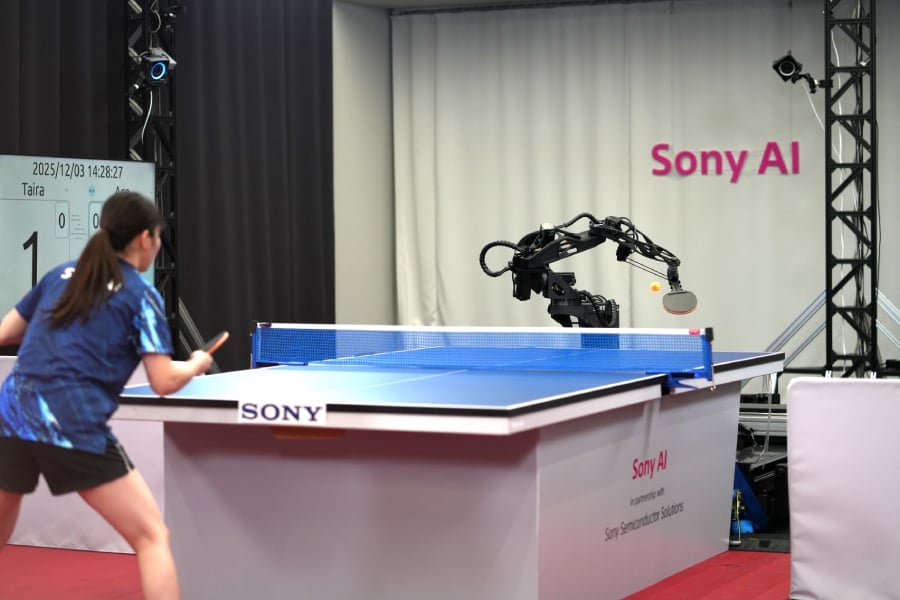


In Tokyo, researchers from Sony AI have unveiled “Ace,” an autonomous robot that has competed with, and in some cases beaten, elite human table tennis players in real matches.
Unlike traditional ball machines, Ace reacts in real time to live returns, making each shot a test of speed, spin, and timing.
The achievement is being described as a milestone in robotics, particularly because table tennis demands rapid perception, split-second decisions, and precise physical execution, areas where machines have traditionally struggled.
“We wanted to prove that AI doesn’t just exist in virtual spaces,” said Michael Spranger, president of Sony AI. “It’s not just tech you interact with in the virtual world — you can actually have a physical experience, and the technology is ready for that.”
Ace is not a humanoid robot. Instead, it uses an eight-degree-of-freedom robotic arm mounted on a movable base, designed to replicate the speed and reach needed for high-level play. Its real advantage lies in its vision system.
Table tennis is a nightmare for robots because of the speed and the spin. A ball can curve, dip, and kick off the table in ways that are hard for even humans to track. To solve this, Sony equipped Ace with a specialized vision system: nine traditional cameras and three “event-based” sensors that act like motion detectors.
While a human takes about 230 milliseconds to react, Ace has an end-to-end latency of just 20.2 milliseconds. This allows it to see things that would be a total blur to us, like the logo on a spinning ball moving at 700 Hz. The robot’s brain was trained using “reinforcement learning.” Essentially, it spent 3,000 hours playing against itself in a computer simulation before ever touching a real paddle.
Peter Stone, Sony AI’s Chief Scientist, noted that this is a historical moment: “It’s the very first time there’s been a human expert-level demonstration of competitive play in the real world across any sport—not just table tennis.”
The scorecard: Humans vs Ace
Ace isn’t undefeated, but it’s getting scary good.
In initial tests in April 2025, it won three out of five matches against elite players. While it initially struggled against top-tier professionals like Minami Ando and Kakeru Sone, it has since evolved. By March 2026, Ace secured three wins against professionals, including a victory over Miyuu Kihara, a top-25 world-ranked player.
Despite its speed, Ace has one major disadvantage: it doesn’t have a soul. Professional players noted that playing a robot is eerie because there’s no body language to read.
However, humans are also finding ways to beat the machine. Elite player Rui Takenaka discovered that while Ace handles complex spins beautifully, it can be confused by simplicity.
“But when I used a simple serve — what we call a knuckle serve — Ace returned a simpler ball. That made it easier for me to attack on the third shot, and I think that was the key reason why I was able to win,” Takenaka said, according to Reuters.
While a ping-pong robot sounds like a fun hobby, the tech behind Ace could eventually change how we build everything from factory arms to assistive robots for healthcare.
Ace’s arrival comes in a busy week for robots in sport.
This past weekend, robots outran human competitors in a half-marathon race in Beijing, marking another milestone that underscores how quickly the field is advancing.