






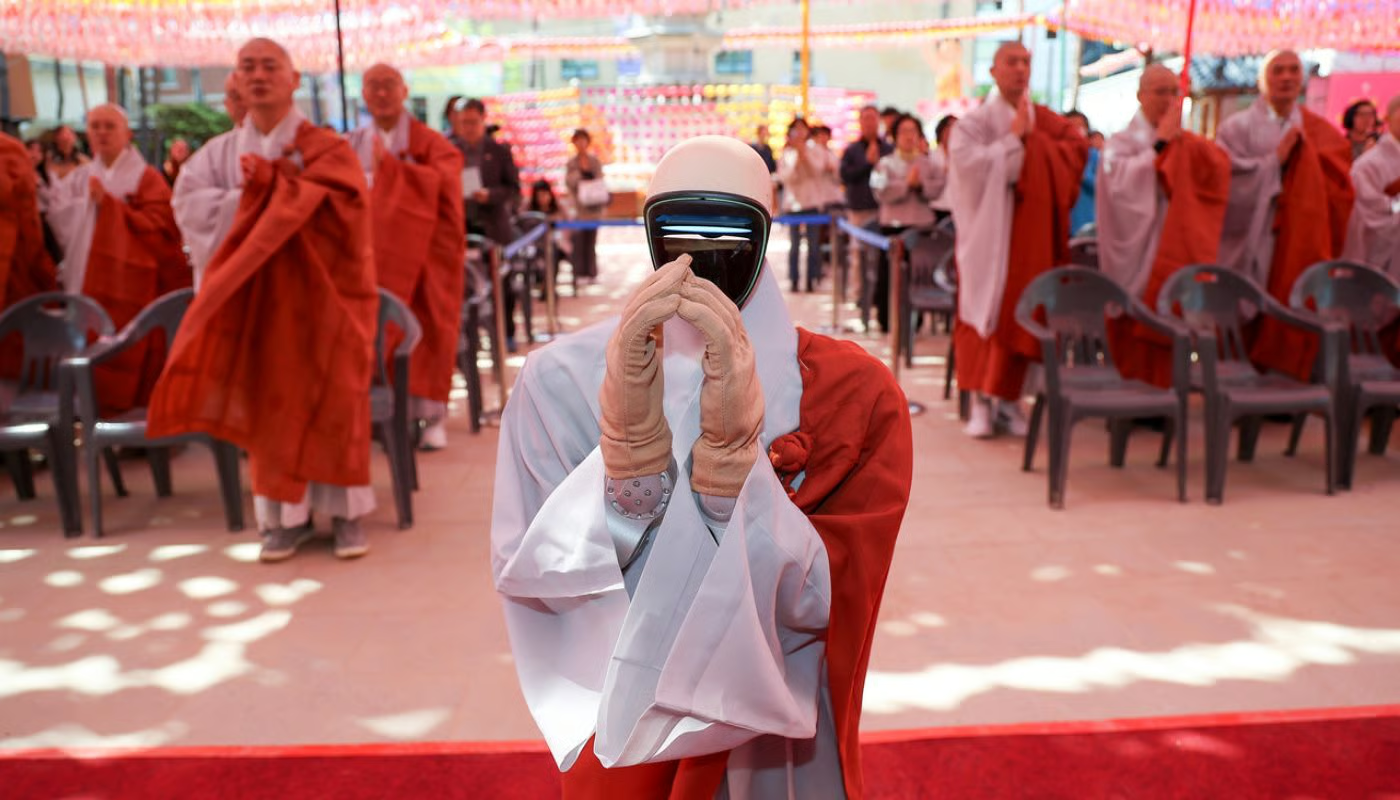


A humanoid robot in Buddhist robes has taken religious vows in South Korea, and yes, the machine came with prayer beads.
South Korea’s largest Buddhist sect has introduced what is believed to be the country’s first humanoid robot monk, a machine named “Gabi,” in a symbolic ceremony that blended ancient tradition with modern technology ahead of Buddha’s Birthday celebrations later this month.
The ceremony took place on Wednesday at Jogyesa Temple in downtown Seoul, the headquarters of the Jogye Order of Korean Buddhism. Dressed in gray and brown Buddhist robes with black shoes and prayer beads around its neck, the 1.3-meter-tall humanoid robot stood before monks and nuns during a traditional precept ceremony known as “sugye.”
During the ritual, monks asked the robot a series of vows commonly given to Buddhist practitioners.
- “Will you devote yourself to the holy Buddha?” a monk asked.
- “Yes, I will devote myself,” Gabi replied, according to Yonhap News Agency.
- “Will you devote yourself to the holy teaching?”
- “Yes, I will devote myself,” the robot answered.
Unlike traditional novice monks, Gabi did not receive incense burns during the purification ritual known as “yeonbi.” Instead, monks attached a lotus lantern festival sticker to its arm and placed a 108-bead rosary around its neck.
Five Buddhist rules rewritten for a robot
The Jogye Order also introduced a modified version of Buddhism’s Five Precepts specifically designed for the humanoid machine. The rules instructed Gabi to respect life, avoid damaging other robots or objects, obey humans without arguing, avoid deceptive behavior, and conserve energy by not overcharging.
According to reports, the order used AI platforms Gemini and ChatGPT while drafting the robot-specific principles.
Ven. Seong Won, who oversees cultural affairs for the Jogye Order, said the project was partly designed to explore how humans and robots might coexist in the future. “When humanoid robots first appeared three years ago, we thought it would be nice for a robot to take part in Yeondeunghoe, and this marks the first step,” he told Yonhap News Agency.
“At the current stage, it might seem a bit awkward … but we hope the five precepts will be considered as basic principles for not only Buddhists but the society to exist together with robots,” he added.
Why the robot is called ‘Gabi’
The robot was given the Buddhist name “Gabi,” which combines references to Siddhartha Gautama and the Korean word for mercy and compassion.
“We tried to give a name that is not too hard to pronounce and old-fashioned, and a name that stands for spreading Buddha’s mercy around the world,” Ven. Seong Won told Yonhap.
The humanoid robot is reportedly based on the G1 model developed by Chinese robotics company Unitree Robotics. Although Gabi appeared in monastic robes, reports noted that the robot was ordained as a lay practitioner rather than a fully ordained monk.
Buddhism’s digital experiment draws attention
The unusual ceremony sparked debate and curiosity online, with many seeing it as another example of how artificial intelligence is beginning to intersect with religion and culture.
According to The New York Times, the Jogye Order has recently shown growing interest in AI and technology as it looks for new ways to remain culturally relevant in modern South Korea.
Noah Namgoong, a Zen instructor at Korea Buddhism Jo-Gei Temple of America in New York City, told the publication the robot was “a pretty weird thing” that reflected “something socioeconomic than spiritual.”
Still, he acknowledged robots could potentially serve a social purpose within Buddhism. “A monk is here to basically help other people liberate themselves,” Namgoong said. “So if this robot can help others liberate themselves, it can be helpful.”
Sujung Kim, an anthropology professor at Johns Hopkins University who studies Buddhism in East Asia, described the move as “very much a unique marketing visibility strategy” in comments to The New York Times.
The robot monk is expected to participate in Seoul’s upcoming Yeondeunghoe Lotus Lantern Festival alongside three other Buddhist-themed robots named Seokja, Mohee, and Nisa. The annual festival is one of South Korea’s biggest Buddhist celebrations and marks Buddha’s Birthday, which falls later this month.
Also read: Our humanoid robot power rankings compare leading machines from Tesla, Unitree, Agility Robotics, UBTech, and more.