






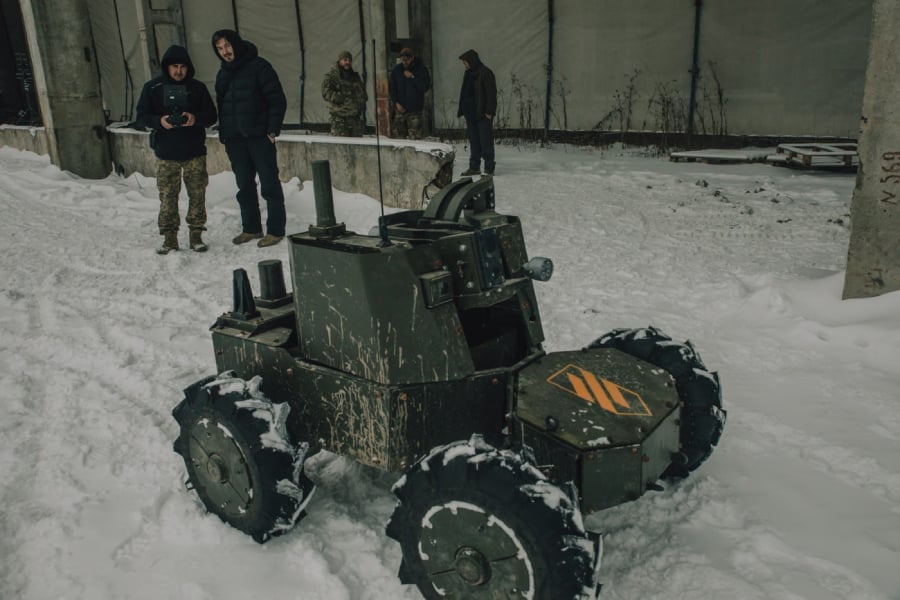


Robots now roam Ukraine’s front lines, taking on missions so dangerous that even seasoned soldiers won’t attempt them.
As the war with Russia drags on into its fifth year, Ukraine is turning to lower-cost robotic systems to reduce casualties and maintain operational tempo. Introduced in 2024, these robots are increasingly becoming a critical part of Kyiv’s strategy to adapt faster than its adversary.
From supply deliveries to surveillance and even armed robots opening fire against adversary troops, Ukraine is slowly proving that the future of wars may involve fewer humans and more war-programmed robots.
Creativity at the heart of war
Periods of war have birthed and advanced the development of some of the world’s most advanced technologies. From radar detection systems to drones and even food preservation methods, wartime exigencies have caused some advances in human civilization. And the Ukraine-Russia war is advancing another.
What began as a war filled with uncertainty, given the Kremlin’s military size and budget, has now turned into a battle for technological superiority.
According to The Guardian, war drones developed by Ukraine have had such significant accuracy that they’ve now become highly sought after by many Gulf countries. The Guardian reports that these drones “can shoot down long-range kamikaze Shahed drones, used by Tehran in its attacks on its neighbours, and by Moscow.”
By deploying unmanned robots, Ukraine is not just saving itself from human fatalities; it is saving costs with robots and drones made from cheap materials but with lethal abilities.
A mix of war machines
Several types of these robots are used in the war. While some serve as drones for supply delivery, others dominate the air, delivering precision-guided bombs. And another category either intercepts missiles or is fitted with machine guns for combat.
The Guardian also notes that land robots, also known as Unmanned Ground Vehicles (UGVs), now handle 90% of the Ukrainian army logistics. It also reports that in January, the country’s army recorded 7,000 UGV operations.
Victor Pavlov, a lieutenant with the Ukrainian 3rd army corps, explained the reason for the use of UGVs for logistics, saying: “It’s very difficult to move around because of enemy first-person-view drones. So we use robotic systems.”
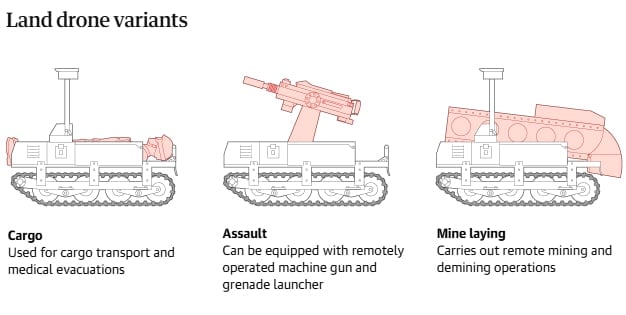
Screenshot from The Guardian. Image from Tencore
Notable successes with these robots include a DevDroid TW 12.7, which reportedly defended Ukrainian troops’ positions for 45 days. Another robot traveled 20km to a building used by Russian troops and blew it up using 200kg of explosives it carried with it all through.
Because these robots don’t stop when being fired at, they’ve been used to carry out risky rescue operations and even to perform construction work, such as laying barbed wire and mining.
The advantage of size and cost
According to Pavlov, 25% of these robots are lost to the Russians, but when compared with the work they do in saving Ukrainian troops, that’s a small price. Aside from the price of materials, which allows Ukraine to mass-produce more drones, the size of these machines also gives it an advantage.
Unlike armored vehicles, these war machines are smaller, making them difficult for enemy drones to spot. Separately, an operating duration of eight hours is more than what an average human soldier can realistically and consistently deliver, giving it another edge.
Limitations of a machine this lethal
According to a BBC report, the machines do have some limitations, but many are self-imposed due to ethical and humanitarian guidelines.
A deputy commander told the BBC that many of the unmanned machines are remotely controlled by human soldiers who call the final shots. Going by the callsign Afghan, the deputy commander said that “Modern UGVs are part-autonomous. They can move on their own and observe and detect the enemy. But still, the decision to open fire is made by a human, their operator.”
Emphasizing why humans remain in the loop, Afghan also said that “Robots can misidentify the wrong person or attack a civilian. That’s why the final decision must be made by an operator.”
A new kind of war
Russia isn’t relenting. The Guardian notes that the country’s troops have their own war machines, including Courier, an electric vehicle capable of carrying 250kg of load and conducting electronic warfare.
In addition to Courier, the BBC also reports that Russia is developing Kuryer, a UGV that can be fitted with a flame-thrower and a machine gun and can operate for five hours. One of its earliest UGVs, Lyagushka kamikaze, has been used against Ukrainian troops.
The use of robotic machinery in this war reflects one of the many directions robotics can take. Already, the US is doubling down on the use of AI in war, signaling that the future of war will be dominated by automation.
However, a big concern remains: the safety and reliability of these machines. And while countries like Ukraine are already observing ethics in the use of such war machines, the application of unmanned machines is still rapidly growing, and possibilities for abuse may still happen, unless checked by international law.
Also read: China’s robot dogs, drones, and AI-powered metro system show how robotics is spreading beyond battlefields into civilian infrastructure and public transit.