






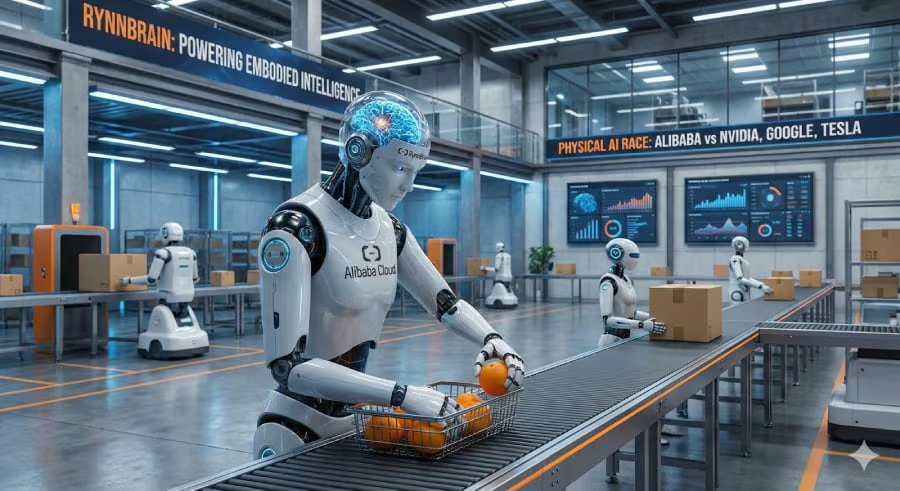


Robots are getting smarter, and Alibaba wants to help power their brains. The Chinese tech giant this week introduced RynnBrain, a new artificial intelligence model designed to help machines understand and act in the physical world.
The launch signals how fast the AI race is expanding beyond chatbots and cloud software into factories, warehouses, and humanoid machines. With RynnBrain, Alibaba is aiming to compete with Nvidia, Google, and Tesla in what industry executives describe as a multitrillion-dollar opportunity.
A model built for physical reasoning
Alibaba on Tuesday unveiled RynnBrain through its DAMO Academy, according to CNBC. The company described RynnBrain as an embodied foundation model designed to help robots comprehend their surroundings and identify objects. In a demonstration video, a robot identified fruit and placed it into a basket. The task required object recognition, spatial awareness, and coordinated movement.
“Robotics falls under the umbrella term dubbed ‘physical AI,’ which includes machines that rely on artificial intelligence, such as self-driving cars — an area China has prioritized as it competes with the US for technological leadership,” CNBC wrote.
The South China Morning Post, which is owned by Alibaba, reported that RynnBrain is based on Alibaba’s Qwen3-VL architecture and is aimed at advancing embodied intelligence systems that perceive, reason, and act in physical settings.
Alibaba said the model moves beyond passive observation to “performing physically aware reasoning and executing complex real-world tasks.” The company added that RynnBrain can identify and spatially map actionable possibilities within localized or three-dimensional contexts, enabling downstream Vision-Language-Action (VLA) models to handle more complex tasks.
Alibaba emphasized that the model achieved top performance in major benchmarks across key metrics for embodied models. This includes “embodied recognition, embodied cognition, embodied localization, and grounded visual understanding,” Alibaba told SCMP.
Charlie Zheng, chief economist at Samoyed Cloud Technology Group Holdings, explained that RynnBrain’s spatial reasoning capabilities set it apart from its peers. Zheng also added that the AI model is “marking a leap for Chinese developers in the field of embodied intelligence foundational model.”
Open source strategy and global competition
CNBC noted Alibaba is releasing RynnBrain as open source, allowing developers to use the model at no cost. The SCMP also reported that the company is offering multiple configurations, including 2- and 8-billion-parameter dense versions and a 30-billion-parameter mixture-of-experts variant.
Zheng also told SCMP that Alibaba’s ability to solidify its position would depend not only on model performance but also on the “establishment of the company’s ecosystem and the industrial applications of the embodied models.”
Competition is intensifying globally. Last year, Nvidia CEO Jensen Huang described AI and robotics as “a multitrillion-dollar growth opportunity,” CNBC reported.
The SCMP also emphasized that Google DeepMind and Tesla are developing robotics-focused AI systems. Ant Group in China recently open-sourced its own robotics model, LingBot-VLA, described as a universal brain for robots.
See our list of robots and humanoids making waves right now, or read our breakdown of top humanoid companies that could shape automation.